
Kaspa (KAS): A Post-Liquidation Buying Opportunity Amid Surging Network Activity
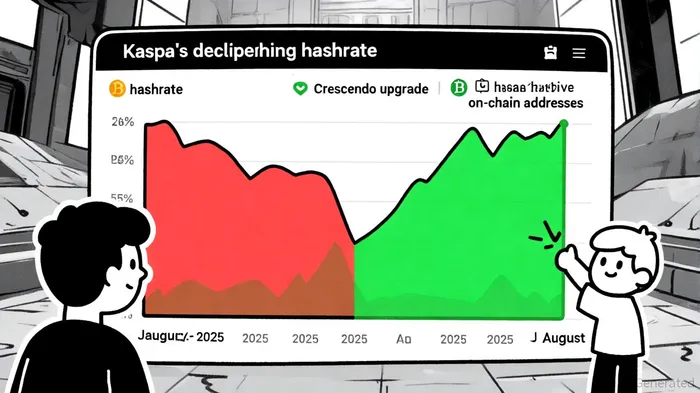
The cryptocurrency market has long been a theater of contradictions, where price action often diverges from fundamental progress. Kaspa (KAS), a high-throughput proof-of-work blockchain, now finds itself at such a crossroads. While its price has languished amid broader market weakness and miner sell-offs, on-chain metrics and technological advancements suggest a compelling case for contrarian optimism. This article dissects the dissonance between Kaspa’s bearish price trajectory and its surging network activity, arguing that the recent liquidation phase may have created a buying opportunity for those who recognize the project’s long-term potential.
The Bear Case: A Market in Retreat
Kaspa’s price has underperformed in recent months, falling 1.6% to $0.0842 in the past 24 hours and declining 3.63% over seven days [2]. This weakness is partly attributed to miner behavior: as mining profitability waned, operators shifted resources to BitcoinBTC-- and TAO, triggering sell-offs that exacerbated downward pressure [2]. Technical indicators reinforce this narrative, with the price breaking below the critical $0.093 support level, triggering stop-loss orders and amplifying bearish momentum [2].
The hashrate decline further fuels skepticism. From a peak of 1.59 EH/s in January 2025, Kaspa’s hashrate has plummeted by 55% to 602.22 PH/s as of August 2025 [2]. Critics argue this signals waning miner confidence or structural vulnerabilities, such as potential centralization risks if mining power consolidates among a few pools [2]. Meanwhile, broader market sentiment remains fragile, with the Fear & Greed Index hovering at 48—a neutral but cautious reading [5].
The Bull Case: A Network on the Rise
Yet, beneath the surface, Kaspa’s fundamentals tell a different story. On-chain activity has surged, with daily active addresses reaching 25,000 and total transaction volume hitting $259.74M over seven days [1]. This surge coincides with the August 31 Crescendo upgrade, which launched smart contracts via Kasplex, a Layer-2 solution offering EthereumETH-- Virtual Machine (EVM) compatibility [4]. This milestone, long-awaited by developers, positions Kaspa as a scalable alternative to Ethereum and CardanoADA--, combining proof-of-work security with programmability [4].
Kaspa’s technological edge lies in its GHOSTDAG consensus protocol, which enables parallel block processing at 10 blocks per second—far outpacing Bitcoin’s 7 transactions per second [5]. While the network’s long-term goal of 100 blocks per second remains aspirational, the current throughput already supports high-throughput applications like DeFi and NFTs. Notably, the transition to Rust has reduced latency and boosted performance, further solidifying Kaspa’s infrastructure [3].
Active mining participation also defies the bearish narrative. Despite the hashrate decline, over 85,000 active mining addresses continue to secure the network [3]. This resilience suggests that while profitability has dipped, decentralization remains intact. The kHeavyHash algorithm’s GPU-friendly design ensures accessibility for individual miners, mitigating centralization risks [3].
Contrarian Logic: Price vs. Progress
The key to identifying a buying opportunity lies in the dissonance between price and fundamentals. Historically, Kaspa’s hashrate and active addresses have moved in tandem, but the recent divergence—a falling hashrate amid rising on-chain engagement—hints at a market correction rather than a collapse. Miner sell-offs, while bearish in the short term, often create oversold conditions that attract contrarian buyers.
Moreover, the Crescendo upgrade represents a catalyst that could unlock new value. By enabling smart contracts, Kaspa opens the door to developer ecosystems and real-world use cases. Early adopters like PPKAS’s NFT platforms and DagScan tools are already leveraging the network, signaling a shift from speculative interest to utility-driven adoption [2]. Analysts project prices could reach $0.13–$0.16 by year-end if this trend accelerates [2], though broader market conditions—such as Ethereum’s price action—remain a wildcard [5].
Risks and Realities
No investment is without risk. The 51% attack fears, though speculative, highlight the need for vigilance. Additionally, Kaspa’s market capitalization remains small, making it vulnerable to liquidity shocks. However, these risks are inherent to early-stage blockchain projects and do not negate the project’s technical merits.
Conclusion: A Post-Liquidation Inflection Point
Kaspa’s recent price weakness has created a dislocation between its fundamentals and market valuation. While the bear case is valid, the surge in network activity, coupled with the Crescendo upgrade, suggests the market may be pricing in a worst-case scenario rather than a realistic one. For investors with a medium-term horizon, this divergence presents a compelling opportunity to acquire KAS at a discount to its intrinsic value.
As the crypto market matures, projects that combine innovation with decentralization will outperform. Kaspa, with its scalable proof-of-work architecture and growing developer ecosystem, is poised to capitalize on this shift—provided the market recognizes its potential before the next bull cycle.
**Source:[1] KASPA Live Price Data [https://www.kucoin.com/price/KAS][2] Latest Kaspa (KAS) Price Analysis [https://coinmarketcap.com/cmc-ai/kaspa/price-analysis/][3] Kaspa Coin 2025: The Future of Scalable Proof-of-Work Blockchain [https://www.btcc.com/en-US/square/R0thIRANexus/889562][4] The Weekly Knight: Kasplex Reigns Supreme, Smart Contracts Launching August 31 [https://kasmedia.com/article/weekly-knight-07282025][5] Kaspa Price Chart & Market Cap [https://coincodex.com/crypto/kaspa/]






Comentarios
Aún no hay comentarios