
The Kansas City Chiefs: Assessing Long-Term Financial and Competitive Viability in the NFL
The Kansas City Chiefs stand at a pivotal juncture in their storied history, balancing recent on-field dominance with emerging financial and operational challenges. As the NFL's most valuable franchises continue to climb toward $10–$13 billion valuations, the Chiefs' $6.2 billion enterprise value—ranked 21st in 2025—raises questions about their long-term sustainability[4]. This analysis evaluates the team's competitive trajectory, financial health, and ownership strategy to determine whether the Chiefs remain a compelling investment in the evolving sports economy.
Competitive Viability: A Franchise in Transition
The Chiefs' 2025 season began with a 0-2 record, exposing vulnerabilities in an offense that once defined modern NFL innovation. Patrick Mahomes, the league's reigning MVP, has struggled with efficiency (58.8% completion rate, 445 yards, 2 TDs in two games), while the running game lacks explosiveness[3]. Defensively, the team has allowed 5.1 yards per play, a stark contrast to their 2024 dominance[1]. These early struggles, compounded by injuries to key players like Felix Anudike-Uzomah, highlight a roster that may lack depth in critical positions[3].
However, the Chiefs' long-term competitive outlook hinges on Mahomes' ability to elevate a young, unproven receiving corps and the coaching staff's capacity to adapt. Analysts project a 12-5 record for 2025, with playoff contention likely but a Super Bowl title less certain[4]. The emergence of teams like the Baltimore Ravens and Buffalo Bills further tightens the AFC's competitive landscape[4]. For the Chiefs to maintain relevance, they must address their offensive inefficiencies and invest in strategic draft picks to bolster positional depth.
Financial Sustainability: Balancing Revenue and Risk
Financially, the Chiefs benefit from a robust revenue base, generating $610 million annually through gate receipts, media rights, and merchandise[2]. Their economic impact on the Kansas City region—$993.2 million annually, supporting 5,860 jobs—underscores their role as a regional economic engine[5]. Yet, looming challenges threaten this stability.
A critical issue is the 2026 salary cap crunch, driven by high-cap hits from Mahomes ($78.2 million), Chris Jones ($44.85 million), and Trey Smith ($24.25 million)[3]. Projections indicate the team will exceed the cap by $48–$60 million, forcing difficult roster decisions or contract restructures[3]. While 2027 offers relief with up to $100.5 million in cap space, short-term financial strain could disrupt team-building efforts[3].
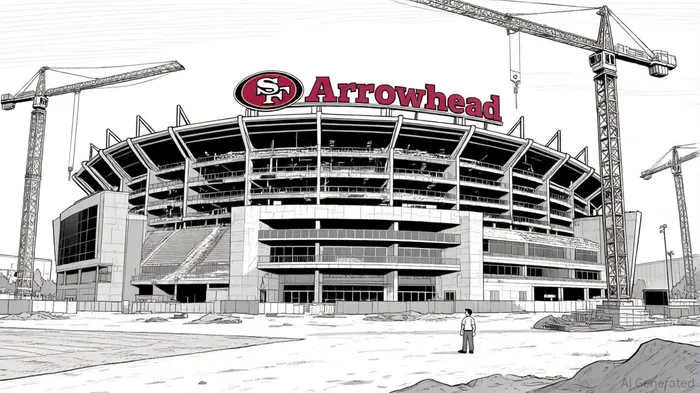
Stadium development adds another layer of complexity. The planned $800 million ArrowheadARWR-- Stadium renovation, contingent on a 2026 tax extension, aims to modernize facilities with a 360-degree concourse and enhanced fan experiences[1]. However, stalled infrastructure funding and the defeat of a 2024 sales tax measure introduce uncertainty about the project's timeline and cost overruns[2].
Ownership Strategy: Legacy and Liquidity
The Hunt family's stewardship has been central to the Chiefs' success, with Clark Hunt's leadership marked by strategic hires (Andy Reid, 2013; Patrick Mahomes, 2017) and a commitment to community engagement[1]. The family's equal 25% ownership structure, inherited after the passing of Lamar and Norma Hunt, ensures continuity but limits external investment opportunities[1].
Recent NFL reforms allowing private equity investments (up to 10% ownership without voting rights) could reshape franchise financing models[4]. While the Chiefs have not pursued such investments, Clark Hunt has endorsed the policy, recognizing its potential to fund stadium upgrades and enhance liquidity[4]. This openness to innovation positions the franchise to adapt to evolving ownership dynamics, though the Hunt family's conservative approach may delay capitalizing on these opportunities.
Market Dynamics: Regional Influence and Global Ambitions
The Chiefs' market position is bolstered by Kansas City's unique status as a mid-sized city with a passionate fanbase. Arrowhead Stadium's 76,410-capacity consistently ranks among the loudest in the NFL, driving premium ticket and merchandise sales[5]. However, the team's valuation lags behind peers like the Dallas Cowboys ($13 billion) and New York Giants ($10.1 billion), reflecting disparities in real estate holdings and ancillary businesses[4].
To close this gap, the Chiefs are expanding globally through international partnerships and digital content, aiming to grow their fanbase beyond the Midwest[6]. This strategy aligns with NFL-wide trends toward global brand equity but requires sustained investment in technology and fan engagement to translate reach into revenue.
Conclusion: A Franchise at a Crossroads
The Kansas City Chiefs remain a cornerstone of the NFL's competitive and financial ecosystem, but their long-term sustainability depends on navigating three key challenges:
1. Competitive Resilience: Rebuilding offensive explosiveness and depth to counter emerging AFC rivals.
2. Financial Prudence: Managing cap constraints and securing stadium funding to maintain operational excellence.
3. Ownership Innovation: Leveraging private equity opportunities to enhance liquidity and valuation.
While the Chiefs' brand strength and regional economic impact provide a solid foundation, their ability to adapt to financial pressures and evolving ownership models will determine whether they remain a top-tier franchise or fall behind peers with more diversified revenue streams. For investors, the Chiefs represent a high-reward, high-risk proposition—one where legacy meets the demands of a rapidly changing sports landscape.







Comentarios
Aún no hay comentarios