
Kalshi's Global Expansion and the Future of Predictive Markets
In the rapidly evolving landscape of financial technology, Kalshi has emerged as a pivotal player in the prediction market sector, leveraging regulatory clarity and technological innovation to redefine event-based trading. As the platform expands globally and navigates a post-Regulation Best Practices (RBP) environment, its trajectory offers critical insights into the disruptive potential of real-time event-based trading platforms.
Regulatory Tailwinds and Strategic Expansion
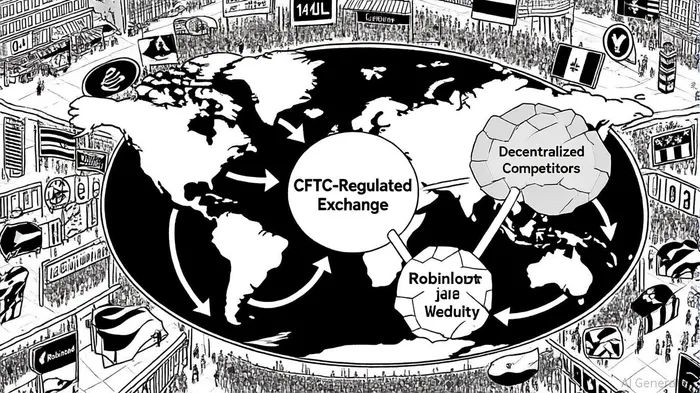
Kalshi's global expansion in 2025, which grants access to over 140 countries, has been underpinned by its status as a U.S. Commodity Futures Trading Commission (CFTC)-regulated Designated Contract Market (DCM), according to a Financial Content report. This regulatory edge has enabled the platform to differentiate itself from decentralized competitors like Polymarket, which remains inaccessible to U.S. users due to jurisdictional restrictions, as noted in a Regulatory Oversight analysis. The recent $300 million Series D funding round, valuing Kalshi at $5 billion, underscores investor confidence in its ability to scale within a structured regulatory framework, per a Kalshi announcement.
The CFTC's ongoing reevaluation of prediction market rules under Acting Chair Caroline D. Pham signals a potential shift toward a more innovation-friendly approach, according to a CoinPaprika article. This aligns with broader 2025 trends in financial services regulation, which emphasize proportionality and adaptability in governing emerging technologies like AI and blockchain, as outlined in a Deloitte outlook. For Kalshi, this regulatory reset reduces compliance burdens and opens avenues for cross-border liquidity pools, as the Financial Content report notes.
Market Dynamics and Competitive Edge
Kalshi's dominance in the prediction market sector is evident in its trading volume metrics. In September 2025, the platform recorded $1.3 billion in monthly trading volume, surpassing Polymarket's $773 million and capturing 62% of the total market share, according to a Financial Content analysis. This growth is driven by its focus on sports betting-accounting for 70% of its trading activity-and strategic partnerships with mainstream platforms like Robinhood and Webull, as covered in a Blockhead article. By integrating blockchain infrastructure and stablecoins (e.g., USDC), Kalshi has also positioned itself as a bridge between traditional finance and crypto ecosystems, per a Techopedia piece.
However, regulatory fragmentation remains a challenge. Legal battles in states like Nevada and Maryland highlight tensions between federal preemption under the Commodity Exchange Act (CEA) and state gaming laws, as detailed in a Spectrum Search analysis. While a federal court in Nevada granted Kalshi a temporary injunction to continue sports-related contracts, conflicting rulings across jurisdictions underscore the risks of a patchwork regulatory environment, per a Traders Magazine report.
Investment Viability and Sector Projections
The prediction market sector is projected to grow to $95.5 billion by 2035, driven by mainstream adoption and technological advancements, as Blockhead reported. Kalshi's regulated status and institutional-grade infrastructure position it to capture a significant share of this growth. Its recent valuation milestones-$2 billion in June 2025 and $5 billion in October 2025-reflect investor optimism about its scalability and profitability, according to a Reuters report.
Yet, the path to dominance is not without hurdles. State-level legal challenges could delay expansion into lucrative markets like New Jersey and Nevada, while competition from decentralized platforms may intensify as regulatory clarity improves, as the Financial Content report argued. For investors, the key differentiator lies in Kalshi's ability to maintain its CFTC-regulated edge while adapting to evolving compliance standards.
Conclusion: A Balancing Act of Innovation and Regulation
Kalshi's global expansion and regulatory-first approach exemplify the transformative potential of prediction markets in a post-RBP environment. While its CFTC-backed model offers a blueprint for scalable innovation, the sector's long-term success will depend on resolving jurisdictional conflicts and aligning regulatory frameworks with technological progress. For investors, Kalshi represents a compelling case study in navigating the intersection of compliance, capital, and creativity-a space where the future of finance is being rewritten in real time.






Comentarios
Aún no hay comentarios