
Kalshi's 62% Market Share Surge: A New Era for Institutional Adoption and On-Chain Sentiment Analysis
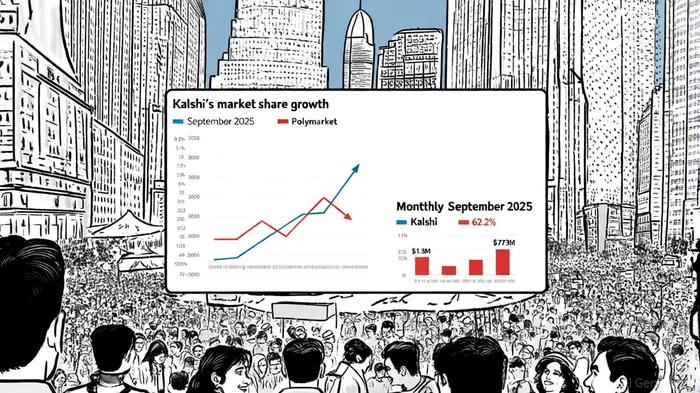
Kalshi's meteoric rise to 62.2% of global prediction market volume—a leap from 3.1% just one year ago—has redefined the landscape of on-chain sentiment analysis and institutional-grade speculative finance[2]. This surge, driven by a confluence of regulatory legitimacy, strategic partnerships, and surging trading volumes, positions Kalshi not merely as a niche crypto-native platform but as a potential cornerstone of the next-generation financial infrastructure.
Institutional Adoption: The CFTC Edge
Kalshi's U.S.-regulated status under the Commodity Futures Trading Commission (CFTC) has been a game-changer. Unlike its unregulated counterparts, Kalshi's compliance framework has attracted both retail and institutional participants, with the latter drawn to its legal clarity and transparency[4]. This is evident in the platform's September 2025 trading volume of $1.3 billion, outpacing Polymarket's $773 million[3]. Institutional interest has further crystallized through Kalshi's recent $185 million Series C funding round, led by Paradigm and Sequoia Capital, valuing the company at $2 billion[1]. Investors are betting on Kalshi's ability to bridge the gap between speculative retail trading and institutional risk management, a niche where prediction markets could serve as real-time barometers of market sentiment.
On-Chain Sentiment: A New Financial Layer
Prediction markets have long been dismissed as niche tools for gamblers and hobbyists. Kalshi's growth, however, suggests a broader shift: these platforms are emerging as critical nodes in the financial ecosystem. By aggregating bets on events ranging from sports outcomes to Federal Reserve decisions, Kalshi's markets act as decentralized, crowd-sourced indicators of sentiment. For instance, its open interest of $189 million in September 2025—compared to Polymarket's $164 million[3]—reflects a growing demand for real-time, data-driven insights. This aligns with broader trends in crypto and AI, where decentralized systems are increasingly valued for their transparency and efficiency.
Legal Challenges and Competitive Dynamics
Despite its dominance, Kalshi faces headwinds. Lawsuits from states like Maryland, Nevada, and Massachusetts allege it operates as an unregistered sportsbook[5], while Polymarket's re-entry into the U.S. market via its acquisition of QCX signals a regulatory arms race[1]. Yet, Kalshi's regulated edge remains formidable. Its partnership with SolanaSOL-- and Base to launch the KalshiEco hub underscores its ambition to integrate prediction markets into broader blockchain ecosystems[5], potentially expanding its utility beyond speculative trading.
The Road Ahead: Valuation and Vision
Kalshi's $2 billion valuation, while modest compared to Polymarket's rumored $9–$10 billion target[4], reflects investor confidence in its regulatory moat and infrastructure. The company plans to reinvest its latest funding into scaling liquidity, expanding event categories, and developing new market structures[1]. If successful, Kalshi could cement itself as the default platform for on-chain sentiment analysis—a tool not just for traders but for corporations, policymakers, and AI systems seeking to parse collective human expectations.
Conclusion
Kalshi's 62% market share is more than a statistic; it's a harbinger of a financial future where prediction markets serve as both speculative assets and institutional-grade analytics tools. While legal and competitive risks persist, the platform's regulated status, institutional backing, and strategic vision position it as a leader in a sector poised for mainstream adoption. For investors, the question is no longer whether prediction markets matter—but how quickly they will become indispensable.







Comentarios
Aún no hay comentarios