
Kalshi's $300M Raise and Global Prediction Market Expansion: A New Frontier in Financial Forecasting and Geopolitical Risk Hedging
Kalshi's recent $300 million Series D funding round, valuing the company at $5 billion, marks a pivotal moment in the evolution of decentralized prediction markets. This surge in capital, led by top-tier investors like Andreessen Horowitz and Sequoia Capital, underscores growing institutional confidence in the platform's ability to redefine financial forecasting and geopolitical risk management, according to a Kalshi press release. With trading volume surging 200× and user base expanding 20× in the past year, Kalshi now commands 62.2% market share, outpacing rivals like Polymarket. The company's strategic pivot to global expansion-targeting 140 countries-positions it as a leader in a sector projected to grow from $1.4 billion in 2024 to $95.5 billion by 2035, according to a market projection.
Decentralized Forecasting: Aggregating Global Sentiment
Prediction markets like Kalshi aggregate diverse opinions into real-time probability estimates, offering a unique alternative to traditional polling and expert analysis. For instance, Kalshi's election contracts for the 2024 U.S. presidential race demonstrated superior accuracy compared to conventional polls, with traders betting over $85 million on outcomes, according to FinanceFeeds. These markets function as "sentiment engines," enabling participants to hedge against political uncertainties or gain insights into public sentiment. A case in point: Kalshi launched contracts speculating on whether China would invade Taiwan by 2025, with prices reflecting collective risk assessments, as reported by FinanceFeeds. Such tools are increasingly valued by hedge funds, think tanks, and media outlets for scenario modeling and capital allocation decisions, the guide notes.
Geopolitical Risk Hedging: From Elections to Trade Conflicts
Kalshi's platform allows users to hedge against geopolitical risks that traditional financial instruments often overlook. For example, during the 2024 U.S. election, the platform enabled investors to mitigate exposure to policy shifts by trading binary contracts on outcomes like congressional control, the Kalshi press release reported. Similarly, enterprises navigating U.S.-China trade tensions have used Kalshi to hedge against disruptions in supply chains or regulatory changes, according to a ScienceDirect study. Academic studies highlight that companies facing geopolitical risks-such as Chinese A-share firms-often adopt offshore M&A strategies to stabilize operations, that study finds. Kalshi's event contracts provide a more direct and liquid alternative, allowing real-time adjustments to risk exposure.
Regulatory Challenges and Strategic Resilience
Despite its momentum, Kalshi faces regulatory headwinds. While the CFTC dropped its case earlier this year, state-level lawsuits in Nevada and Maryland continue to challenge the legality of its sports-related contracts, the guide notes. Kalshi's defense of federal preemption under the Commodity Exchange Act has been bolstered by a New Jersey court ruling, which temporarily halted enforcement actions, the guide adds. The company's regulatory moat-being the first and only CFTC-regulated prediction market-remains a critical differentiator, attracting institutional investors wary of unregulated platforms, FinanceFeeds reports. To scale globally, Kalshi is simplifying onboarding processes and integrating with brokerages like Robinhood and Webull, aiming to demystify prediction markets as tools for hedging rather than speculation, according to FinanceFeeds.
The Road Ahead: Innovation and Expansion
Kalshi's $300 million raise will fund the creation of a unified global liquidity pool, a feature that could redefine market depth and accessibility, the press release says. The company also plans to launch new contract types, including those tied to cryptocurrency price movements and macroeconomic indicators, FinanceFeeds reports. Partnerships with blockchain networks like SolanaSOL-- and stablecoins aim to enhance liquidity, while collaborations with financial media outlets seek to shift public perception toward viewing prediction markets as legitimate risk-management tools, according to FinanceFeeds.
Conclusion: A Disruptive Force in Financial Innovation
Kalshi's expansion into decentralized financial forecasting and geopolitical risk hedging represents a paradigm shift in how markets price uncertainty. By leveraging blockchain, smart contracts, and regulatory compliance, the platform is bridging gaps between traditional finance and digital innovation. For investors, Kalshi's strategic positioning-coupled with its ability to navigate regulatory complexities-offers a compelling opportunity to capitalize on a sector poised for exponential growth. As the line between prediction and reality blurs, Kalshi's success may well redefine the future of risk management in an increasingly volatile world.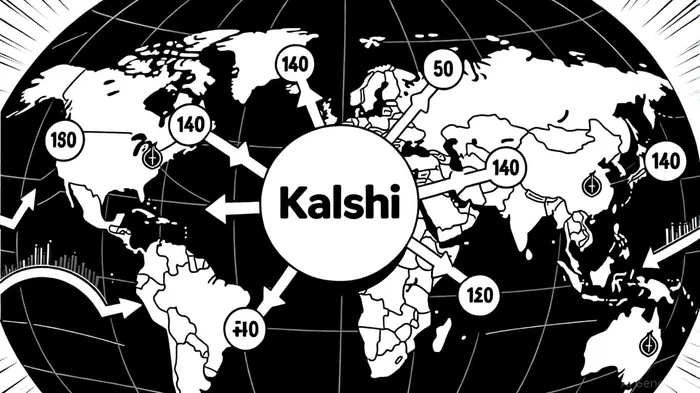






Comentarios
Aún no hay comentarios