
Justin Sun's Strategic Altcoin Moves: What Investors Should Watch in 2026
Justin Sun, the enigmatic founder of the TRONTRX-- blockchain, has long been a polarizing figure in the crypto space. However, his recent dual investments in TRON and LITLIT-- tokens in late 2025 and early 2026 have reignited debates about his role as a market signal provider. These moves-$18 million into Tron Inc.TRON-- and $33 million into LIT-underscore a strategic vision that aligns with broader trends in decentralized identity, institutional adoption, and blockchain infrastructure. For investors, these actions are not just personal bets but potential indicators of where the altcoin market is headed in 2026.
TRON: A Public-Private Synergy and Institutional Validation
Sun's $18 million investment in Tron Inc., a publicly traded entity aligned with the TRON ecosystem, is a masterstroke of corporate and blockchain strategy. By purchasing restricted common shares at $1.3775 apiece, Sun has not only bolstered Tron Inc.'s TRX treasury but also signaled his confidence in the company's ability to act as a bridge between traditional finance and decentralized infrastructure. This move has been hailed as a "strong endorsement of Tron Inc.'s strategic direction and long-term vision," with the company planning to use the funds to expand its digital asset holdings and enhance shareholder value.
The institutional validation of TRON is further reinforced by its recent partnerships. For instance, Revolut integrated TRON for staking and stablecoin remittances, leveraging its high-throughput network for "Crypto 2.0" services. Similarly, TRON's collaboration with Kalshi has expanded onchain liquidity pathways, positioning it as a critical infrastructure layer for hybrid financial systems. These partnerships suggest that TRON is evolving from a mere blockchain network into a foundational pillar of global decentralized finance (DeFi).
Despite a decline in total accounts (falling below 100 million in late 2025), TRON remains a top-10 blockchain with a $26 billion market cap. Its dominance in stablecoin settlements-processing billions in daily transactions-further cements its relevance in an era where institutional-grade blockchain solutions are in high demand.
LIT Token: Decentralized Identity and the Future of Web3
While TRON's narrative is rooted in infrastructure, Sun's $33 million acquisition of 1.33% of LIT tokens (5.32% of circulating supply) highlights his interest in decentralized identity (DID) and programmable blockchain solutions. The LIT token, native to the Lit Protocol, is designed to enable access control management, encrypted data sharing, and self-sovereign identity (SSI) systems according to developer documentation. Its utility extends to cross-chain orchestration and Wallet-as-a-Service (WaaS), simplifying onboarding for Web2 users while maintaining decentralized principles.
The LIT token's alignment with SSI and zero-knowledge proof (ZKP) trends is particularly noteworthy. As global decentralized identity markets grow at a 79.35% CAGR, LIT's role in enabling privacy-preserving authentication and dynamic access management positions it as a key player in the next phase of Web3 adoption. Moreover, the token's airdrop strategy and vesting schedules have been structured to align incentives between developers and ecosystem participants, mitigating concerns over insider allocations.
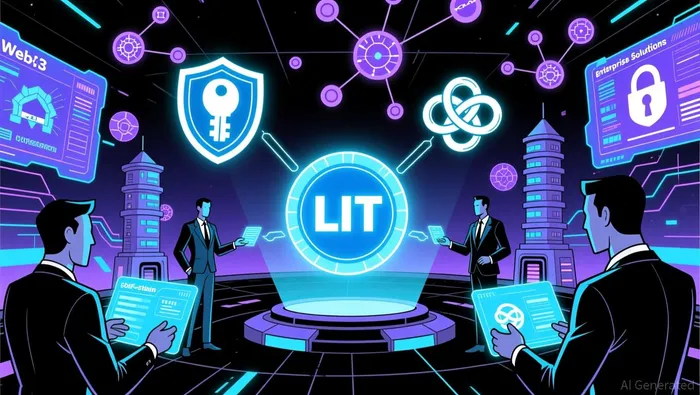
Institutional interest in LIT is also emerging. Whale wallets deposited $10 million in USDC to purchase LIT post-token generation event, signaling confidence in its utility and governance model. While the token's fundamentals remain under scrutiny, its integration into decentralized exchanges and its role in AIoT environments suggest a growing use case beyond speculative trading.
Sun's Vision: Risk-Taking and Emerging Trends
Sun's investments reflect a broader thesis: blockchain's future lies in hybrid systems that merge infrastructure scalability with identity-centric innovation. By doubling down on TRON's institutional partnerships and LIT's DID capabilities, he is betting on a world where decentralized networks underpin both financial and identity ecosystems.
This strategy aligns with regulatory tailwinds. The U.S. GENIUS Act (2025) and EU's MiCA framework have created clearer pathways for institutional adoption, reducing friction for projects like TRON and LIT. Sun's public endorsements-whether through stock purchases or token acquisitions-act as social proof, attracting capital to altcoins that might otherwise be overlooked in a Bitcoin-dominated market.
What Investors Should Watch
- TRON's Public Market Performance: Tron Inc.'s stock price and balance sheet strength will be critical indicators of Sun's influence. A rising share price could signal broader institutional confidence in the TRON ecosystem.
- LIT's Utility Adoption: The token's integration into enterprise-grade identity solutions and cross-chain protocols will determine its long-term value.
- Regulatory Developments: Continued clarity under MiCA and the GENIUS Act could accelerate institutional validation for both projects.
- Network Metrics: TRON's transaction volume and stablecoin dominance, alongside LIT's developer activity, will provide on-chain signals of health.
Conclusion
Justin Sun's 2025-2026 moves are more than personal investments-they are strategic bets on the future of blockchain. By leveraging TRON's infrastructure and LIT's identity solutions, he is positioning himself at the intersection of institutional adoption and Web3 innovation. For investors, these actions serve as a roadmap: altcoins with clear utility, institutional partnerships, and regulatory alignment are likely to outperform in 2026. As the crypto market matures, Sun's risk-taking may well become a blueprint for navigating the next bull run.





Comentarios
Aún no hay comentarios