
Jupiter's Dual Expansion: ICO Platform and Prediction Market on Solana and Its Implications for DeFi Innovation
Prediction Markets: A New Frontier for On-Chain Speculation
Jupiter's prediction market, developed in partnership with regulated platform Kalshi, is set to launch in Q4 2025 after a successful beta phase. The beta, which opened in October 2025, allowed users to bet on real-world events like the Formula One Mexico Grand Prix, generating over $120,000 in trading volume within its first month. Max Verstappen emerged as the favorite at 46% odds, illustrating the platform's appeal to both casual and institutional participants, according to the Jupiter beta report.
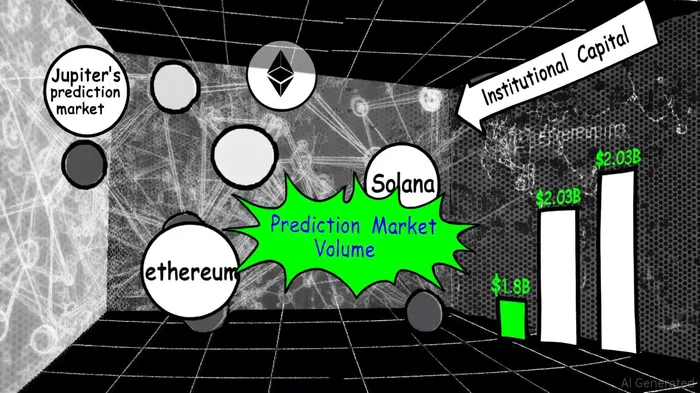
By integrating Kalshi's liquidity infrastructure, Jupiter ensures secure, high-speed transactions on Solana, which processes 65,000 transactions per second (TPS) at a fraction of Ethereum's gas fees, as noted in a Solana vs. Ethereum analysis. This technical edge is critical in a sector where prediction markets like Polymarket and Kalshi have already attracted $2.03 billion in weekly trading volumes, according to a BlockchainReporter analysis. Jupiter's entry into this space is not just about competition-it's about redefining accessibility. With Solana's low barriers to entry, the platform could democratize speculative markets, drawing in retail users who previously found Ethereum-based platforms prohibitively expensive.
ICO Platform: Democratizing Venture Capital on the Blockchain
Parallel to its prediction market, Jupiter is launching an ICO platform in November 2025, enabling community-funded projects through permissioned capital raises. Exclusive access to these raises is granted to JUPJUP-- token stakers, aligning incentives between project creators and Solana's ecosystem. This model not only incentivizes JUP staking but also introduces a governance-driven framework for venture capital, where token holders vote on project vetting and funding allocations, according to the JUP ICO announcement.
The implications for JUP's tokenomics are profound. By tying participation in capital formation to JUP staking, Jupiter creates a flywheel effect: increased demand for JUP drives staking, which in turn boosts token liquidity and utility. This is particularly significant given JUP's recent struggles, as its price approached a three-month low despite Jupiter reporting $46 million in Q3 revenues, per a Q3 revenue report. The ICO platform could reverse this trend by embedding JUP into the core of Solana's venture ecosystem, much like how Ethereum's ERC-20 standard became the backbone of token fundraising.
Solana vs. Ethereum: A Battle for DeFi's Future
While EthereumETH-- remains the dominant force in DeFi, Solana's technical advantages-speed, low fees, and scalability-are reshaping the competitive landscape. In Q4 2025, Solana's Real-World Asset (RWA) market grew by 218%, reaching $550 million in value, driven by institutional partnerships and Jupiter's ecosystem expansion, according to a Cointribune report. Ethereum, with an 83.69% share of the RWA market, still holds an edge, but Solana's 3.9% share is growing rapidly. Analysts at BlockchainReporter predict it could surpass ZKSyncZK-- Era's 17.2% within 18–24 months.
Jupiter's dual expansion underscores Solana's ability to attract institutional capital. Kalshi's recent $300 million Series D funding, valuing it at $5 billion, and Polymarket's $2 billion investment from Intercontinental Exchange highlight the sector's potential, as noted in the Jupiter beta report. By offering a faster, cheaper alternative to Ethereum-based prediction markets, Jupiter is positioning Solana as the infrastructure of choice for next-gen DeFi applications.
Institutional Adoption and the Road Ahead
The success of Jupiter's initiatives hinges on institutional adoption. Solana's high-throughput model has already attracted whale accumulation and developer activity, but the ICO and prediction markets could accelerate this trend. For instance, Jupiter's JupUSD stablecoin, powered by Ethena Labs, is set to integrate with lending and perpetual markets, further embedding JUP into Solana's financial ecosystem, according to the JupUSD announcement. This diversification reduces reliance on trading fees and creates new revenue streams for token holders.
However, challenges remain. Regulatory scrutiny of prediction markets and the risk of capital flight (e.g., $100 million recently moving from Solana to BNB) could dampen growth, as discussed in a TechFinancials analysis. Jupiter must balance innovation with compliance, ensuring its platforms meet evolving regulatory standards while maintaining Solana's speed and cost advantages.
Conclusion
Jupiter's dual expansion into prediction markets and ICOs is more than a product launch-it's a strategic redefinition of DeFi's value proposition. By combining Solana's technical strengths with governance-driven capital formation, Jupiter is creating a blueprint for on-chain innovation that could outpace Ethereum's traditional models. For investors, the implications are clear: JUP's utility, liquidity, and institutional appeal are poised for a renaissance, provided the ecosystem navigates regulatory and competitive headwinds. As the lines between speculation, venture capital, and DeFi blur, Solana's infrastructure may well become the bedrock of a new financial paradigm.







Comentarios
Aún no hay comentarios