
U.S. Judicial Stability and Market Confidence: Navigating the Impact of Political-Judicial Tensions on Institutional Trust and Investor Behavior
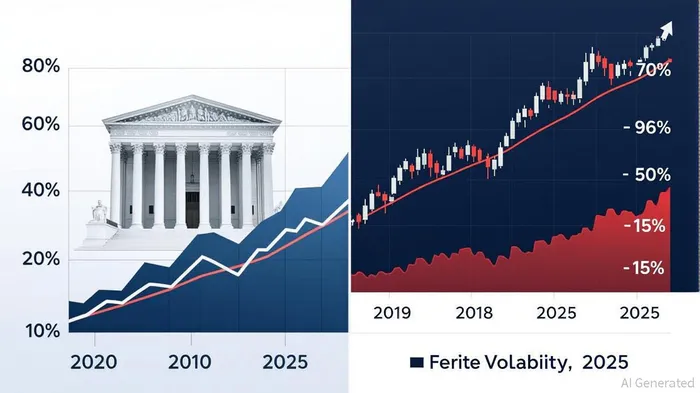
The interplay between U.S. judicial stability and market confidence has become a critical focal point for investors in 2025, as political-judicial tensions continue to erode institutional trust and reshape investment strategies. Recent analyses underscore a clear link between policy uncertainty, judicial polarization, and market volatility, with cascading effects on corporate behavior, sectoral allocations, and global trade dynamics.
Erosion of Institutional Trust and Its Economic Implications
Public confidence in the U.S. judicial system has reached historic lows, with only 47% of Americans expressing a favorable view of the Supreme Court in 2025—a 22-point decline since 2020 [1]. This erosion is exacerbated by perceptions of politicization, particularly following high-profile rulings like Dobbs v. Jackson Women’s Health Organization, which deepened partisan divides and fueled skepticism about judicial impartiality [1]. Such distrust has broader economic ramifications. According to the Federal Reserve, elevated economic policy uncertainty (EPU) and trade policy uncertainty (TPU) have led to delayed corporate investments, tighter credit conditions, and higher sovereign bond risk premia, all of which signal reduced investor confidence in stable governance [2].
The Trump administration’s 2024 return to office amplified these tensions. Tariff hikes—ranging from a baseline 10% on imports to 42% on Chinese goods—introduced volatility into global supply chains, prompting firms to recalibrate production strategies and delay expansions [3]. These policies, coupled with executive actions like the proposed sovereign wealth fund, have raised concerns about governance transparency and corruption risks, further undermining institutional credibility [4].
Investor Behavior in a Climate of Uncertainty
The market’s response to these developments has been marked by risk aversion and sectoral reallocation. U.S. corporate default risk surged to 9.2% by late 2024, a post-financial crisis high, as firms grappled with tighter liquidity and uncertain regulatory environments [5]. Investors have increasingly favored defensive assets, with BlackRockBLK-- noting a shift toward U.S. equities and high-growth sectors like artificial intelligence, while traditional macro anchors lose relevance [4].
Sectoral investment flows reflect this recalibration. Tariff-impacted industries—such as automotive and consumer electronics—have seen capital flight, while sectors insulated from trade tensions, like real estate and education, have attracted defensive inflows [6]. Meanwhile, global capital has sought refuge in international markets, particularly in Europe and emerging economies, as investors diversify against U.S. policy risks [7].
Judicial Decisions and Market Reactions
Supreme Court rulings in 2024–2025 have further complicated the landscape. The Court’s affirmation of Tennessee’s ban on gender-affirming care for minors and its upholding of a federal TikTok ban have introduced regulatory uncertainty in healthcare and technology sectors, prompting legal and market scrutiny [8]. While direct correlations between these rulings and stock index movements remain elusive, broader policy uncertainty—driven by judicial and executive actions—has contributed to a 9.84% year-to-date gain in the S&P 500 as of August 2025, with Communication Services leading gains amid a wait-and-see approach to regulatory shifts [9].
Strategic Implications for Investors
For investors, the path forward requires navigating a fragmented landscape of short-term signals and long-term risks. J.P. Morgan and SchwabSCHW-- recommend low-volatility strategies, defensive equity positions, and diversified multi-asset income portfolios to mitigate exposure to policy-driven volatility [7]. The Federal Reserve’s projected gradual reduction in federal funds rates through 2027 offers some stabilization, but global risks—including geopolitical conflicts and misinformation—remain critical headwinds [2].
Conclusion
The U.S. judicial system’s declining trustworthiness, intertwined with political-judicial tensions, has become a linchpin of market uncertainty. As institutional credibility wanes and policy volatility persists, investors must prioritize adaptability and diversification. The coming years will test not only the resilience of markets but also the ability of policymakers to restore confidence in governance frameworks—a challenge with profound implications for both economic stability and investor returns.
Source:
[1] Favorable views of Supreme Court remain near historic low [https://www.pewresearch.org/short-reads/2025/09/03/favorable-views-of-supreme-court-remain-near-historic-low/]
[2] The Fed - Costs of Rising Uncertainty [https://www.federalreserve.gov/econres/notes/feds-notes/costs-of-rising-uncertainty-20250424.html]
[3] How private capital can thrive amidst tariff uncertainty [https://www.privatecapitalsolutions.com/insights/how-private-capital-can-thrive-amidst-tariff-uncertainty]
[4] 2025 Midyear Investment Outlook | BII - BlackRock [https://www.blackrock.com/us/individual/insights/blackrock-investment-institute/outlook]
[5] US firms' default risk hits 9.2%, a post-financial crisis high [https://www.moodys.com/web/en/us/insights/data-stories/us-corporate-default-risk-in-2025.html]
[6] The macroeconomic backdrop to the private capital market [https://www.privatecapitalsolutions.com/insights/the-macroeconomic-backdrop-to-the-private-capital-market-june-2025]
[7] Mid-year market outlook 2025 | J.P. Morgan Research [https://www.jpmorganJPM--.com/insights/global-research/outlook/mid-year-outlook]
[8] Major Supreme Court Cases from the 2024–25 Term [https://www.britannica.com/topic/Major-Supreme-Court-Cases-from-the-2024-25-Term]
[9] U.S. Equities Market Attributes August 2025 - Commentary [https://www.spglobal.com/spdji/en/commentary/article/us-equities-market-attributes/]





Comentarios
Aún no hay comentarios