
Judicial Backlash and Institutional Erosion: Why Private Prisons Face a Legal Tsunami
The Trump administration's aggressive push to expand immigration detention systems has backfired spectacularly, exposing private prison giants CoreCivicCXW-- (CXW) and GEO GroupGEO-- (GEO) to escalating legal and reputational risks. Federal courts, civil rights advocates, and even former government officials are now targeting these companies for non-compliance, ethical breaches, and systemic failures. This article argues that the combination of judicial pushback and institutional erosion under Trump's policies creates a compelling case to short these stocks.
Legal Risks: A Growing Litigation Storm
Courts are increasingly rejecting the administration's reliance on private prisons, creating a minefield of lawsuits that could drain profits and destabilize operations.
- Contempt of Court and Non-Compliance Suits
While explicit contempt rulings are rare, courts have issued sharp rebukes of detention conditions. For example, a federal judge labeled CoreCivic's Leavenworth, Kansas, facility an “absolute hell hole” due to overcrowding, violence, and inadequate staffing. A 2020 lawsuit by detainees there highlighted systemic failures, including inadequate medical care and punitive isolation. Though CoreCivic claims improvements, the facility's reopening faced a temporary restraining order in 2023 when the city of Leavenworth demanded permits it had previously waived—a legal battle that underscores ongoing compliance risks.
Meanwhile, GEO Group's Adelanto, California, facility faced a federal lawsuit over its use of a toxic disinfectant, Halt, which caused irreversible eye damage to staff. Though the EPA dropped charges under Trump, the Biden administration revived the case in 2024, seeking $4 million in fines. This reversal highlights the vulnerability of private prisons to shifting political winds and judicial accountability.
- Contractual and Environmental Violations
Both companies have faced scrutiny over non-competitive contracts and environmental missteps. ICE's use of “letter contracts”—which bypass standard bidding—has drawn criticism for favoritism. For instance, GEO's 2020 $66 million annual contract for a Georgia facility was awarded without public tender. Critics argue this undermines accountability and exposes firms to future antitrust or fraud claims.
GEO also faced a 2023 lawsuit after detainees alleged the company used another dangerous disinfectant, HDQ Neutral, causing nosebleeds and lung pain. A judge had already banned HDQ in 2020, but GEO switched to Halt without proper safety protocols—a pattern of non-compliance that could lead to contempt findings if courts find ongoing violations.
Reputational Damage: The Trust Deficit
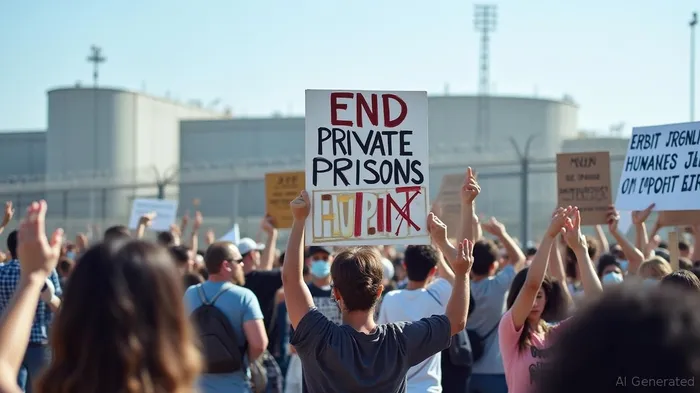
Public and institutional trust in private prisons is collapsing.
- Media and Advocacy Backlash: Stories of toxic chemicals, violence, and mistreatment have fueled outrage. A 2022 ProPublica investigation revealed that GEO paid detainees $1 per day for mandatory labor—arguably forced labor—sparking a class-action lawsuit that could cost the company hundreds of millions.
- Political Fallout: GEO's $3.7 million in GOP donations since 2020, including $1 million to Trump's PAC, have drawn accusations of quid pro quo. A 2024 Senate report highlighted how lobbying ties to the administration's attorney general, Pam Bondi (a former GEO lobbyist), may have influenced decisions like dropping the EPA case.
Operational Disruptions: Courts vs. Detention Targets
Judicial rulings are directly undermining the administration's detention goals.
- Deportation Delays: Federal judges have repeatedly blocked mass deportations, citing due process violations. In 2023, a Texas judge halted removals for 1,200 detainees after ruling their cases were mishandled—a blow to ICE's reliance on detention centers.
- Facility Closures: CoreCivic's Leavenworth facility faced a partial shutdown in 2023 after the city refused to renew its special use permit. Such disruptions strain cash flows and could force write-downs if more facilities face legal or municipal pushback.
Investment Analysis: Shorting the Legal Minefield
The risks to CoreCivic and GEO are existential. Here's why investors should consider shorting:
Legal Costs and Penalties
Lawsuits like the GEO forced labor case (seeking $1 billion in damages) could drain profits. Meanwhile, fines for environmental violations, if imposed, would hit already thin margins.Contract Volatility
While shares rose 73% post-2016 on detention optimism, recent declines reflect investor anxiety. A Democratic shift in 2026 could trigger contract cancellations or stricter oversight.Reputational Downgrades
Major investors, including CalPERS and BlackRockBLK--, have exited private prison stocks over ESG concerns. A 2024 Morgan StanleyMS-- report warned that “moral hazard” risks could render these firms uninvestable.
Conclusion: The End of the “Golden Age”?
The Trump era's boom for private prisons is fading. Judicial pushback, ethical scandals, and political volatility are converging to create a perfect storm of legal and financial risk. Shorting CXW and GEO offers a play on these dynamics—especially as courts and public opinion continue to reject profit-driven detention systems.
Investment Recommendation: Short CoreCivic and GEO Group, targeting a 20–30% decline over 12 months, with a stop-loss at 15% above current prices. Monitor legal settlements and political shifts closely.
This analysis assumes no direct knowledge of non-public information and is for educational purposes only.





Comentarios
Aún no hay comentarios