
JSW Steel's Q2 Crude Steel Production Surge: A Catalyst for Long-Term Market Leadership and Margin Expansion
JSW Steel's Q2 FY26 performance has ignited renewed optimism about its long-term growth trajectory. The company reported a record-breaking consolidated crude steel production of 7.90 million tonnes, a 17% year-over-year increase and 9% quarter-over-quarter growth (as noted in the record quarterly production release). This surge, driven by 92% capacity utilization in India and strategic expansions like the commissioning of JVML's second converter, has raised its Indian operations' total capacity to 34.2 million tonnes per annum (MTPA) (same source). Such aggressive scaling underscores JSW's commitment to leveraging economies of scale-a critical factor in cementing its position as a global steel market leader.
Production Scaling as a Strategic Lever
The production surge is not merely a short-term spike but a reflection of JSW's disciplined capital allocation. By achieving 92% capacity utilization in Q2 FY26, the company has demonstrated operational efficiency that directly reduces per-unit costs (same source). This is particularly significant in an industry where cost competitiveness determines pricing power. For context, JSW's Indian operations alone accounted for 7.66 million tonnes of the total output, with its U.S. facility contributing an additional 0.24 million tonnes (same source). Such geographic diversification, coupled with robust domestic production, positions JSW to capitalize on both local demand and export opportunities.
However, scaling production alone is insufficient without corresponding improvements in profitability. Here, JSW's Q2 FY25 financials reveal a nuanced picture. While EBITDA for the quarter stood at ₹5,437 crore with a 13.7% margin, this figure was flat quarter-on-quarter despite an 8% revenue decline, as noted in the earnings call transcript. The company's net profit plummeted 85% year-on-year to ₹404 crore, primarily due to depressed steel prices and increased import competition (same source as the record quarterly production release). These challenges highlight the delicate balance between scaling operations and managing external headwinds.
Margin Expansion: A Path Forward
JSW's management, however, remains bullish on margin expansion in the second half of FY25. The company attributes this optimism to two key factors: improved pricing and higher utilization rates (same source as the record quarterly production release). The latter is already evident in Q2 FY26, where 92% capacity utilization suggests tighter supply-demand dynamics. Additionally, cost efficiencies-such as reduced coking coal expenses-have provided a buffer against margin compression, according to the earnings call transcript.
The long-term implications of this strategy are clear. By expanding capacity to 34.2 MTPA in India, JSW is positioning itself to meet rising domestic demand while maintaining cost advantages over smaller, less efficient producers. This aligns with broader industry trends, where companies with the lowest cost structures are best positioned to thrive in volatile markets, as discussed in a Business Standard article.
Risks and Mitigants
Critics may point to JSW's Q2 FY25 net profit decline as a red flag. However, this was largely a result of exceptional charges, such as the Jajang iron ore mine closure, and temporary production dips due to maintenance, as noted in a SteelBazaar snapshot. These are short-term disruptions, not structural issues. Moreover, the company's 4.1% quarter-on-quarter increase in Q2 FY25 sales (5.30 million tonnes) indicates resilience in its core markets.
Conclusion: A Compelling Investment Thesis
JSW Steel's Q2 production surge is more than a quarterly achievement-it is a strategic masterstroke. By scaling operations to unprecedented levels while maintaining high utilization rates, the company is laying the groundwork for sustainable margin expansion. While near-term challenges persist, management's focus on pricing discipline and cost optimization provides a clear path to profitability. For investors, this represents a compelling opportunity to back a company that is not only navigating current headwinds but actively reshaping the competitive landscape.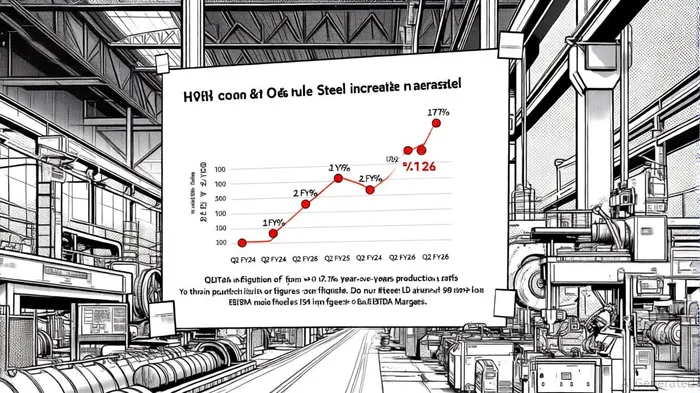







Comentarios
Aún no hay comentarios