
JPMorgan's Global Playbook: How Cross-Border Strategy is Redefining Wealth Management Leadership
The wealth management sector is undergoing seismic shifts. Geopolitical fragmentation, rising ultra-high-net-worth (UHNW) demand for global diversification, and the ascent of fintech disruptors are reshaping the landscape. Amid this turbulence, JPMorgan ChaseJPM-- (JPM) has unveiled a bold strategic overhaul under David Frame, its newly appointed global CEO of private banking. This move isn't just about rebranding—it's a masterclass in positioning to dominate wealth management consolidation while capitalizing on cross-border asset allocation opportunities.
The New Global Playbook: JPMorgan's Structural Overhaul
Frame's leadership marks a pivotal departure from the fragmented regional approach of old. For the first time, JPMorgan's private bank operates under a unified global structure, targeting UHNW clients who demand seamless cross-border services. “The wealthier you get, the more you feel you're a citizen of the world,” Frame stated, underscoring the bank's focus on clients who increasingly view borders as constraints rather than boundaries.
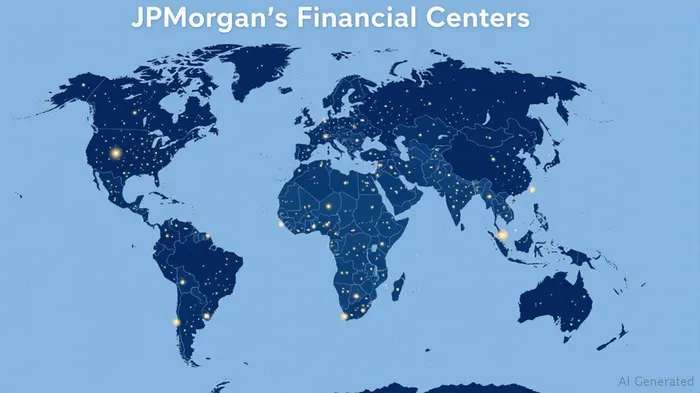
This shift is backed by aggressive physical expansion: 14 new financial centers are set to open in 2025 in U.S. wealth hubs like California and New York, with plans to scale to 31 global locations by 2026. These centers, now rebranded as “J.P. Morgan Financial Centres,” are no ordinary branches—they're hubs for high-touch, bespoke wealth management, requiring a minimum $10 million balance. This exclusionary strategy isn't just about luxury; it's a deliberate move to consolidate relationships with clients who command multi-generational assets.
Cross-Border Asset Allocation: The New Frontier
The real game-changer lies in JPMorgan's integration of geopolitical intelligence into wealth management. The launch of its Center for Geopolitics, led by foreign policy expert Derek Chollet, is a first-of-its-kind initiative. Clients gain actionable insights into trade wars, sanctions regimes, and regional instability—tools critical for navigating cross-border investments. For instance, JPMorgan's 2025 Mid-Year Outlook highlights Europe's rebound (projected 1.5% GDP growth by 梣026) as a prime diversification play, while advising dollar depreciation hedging via Euro, Yen, and gold allocations.
This isn't just advisory fluff. The bank is backing these insights with product innovation. Over 4,500 clients have already invested in evergreen funds, a liquidity-rich private markets vehicle expected to grow to 20% of JPM's private assets by 2035. These structures offer exposure to IPO-starved startups, a stark contrast to competitors like Bank of AmericaBAC-- (BAC) and CitigroupC-- (C), which lag in private market integration.
The Consolidation Play: Why JPMorgan Will Win
The wealth management sector is ripe for consolidation. Smaller banks struggle to compete with JPMorgan's scale ($3 trillion in client assets) and tech prowess. Consider its hybrid model: physical centers for trust-building and AI-driven tools like streamlined digital onboarding to scale efficiency. Meanwhile, fintech upstarts like Revolut's nascent private banking arm (targeting $1M+ clients) lack the institutional heft to match JPM's global reach.
Frame's leadership also signals a strategic pivot toward geopolitical arbitrage. As UHNW clients seek to insulate portfolios from conflicts (e.g., Ukraine, Taiwan), JPMorgan's ability to blend hard data (e.g., currency hedging models) with soft power (e.g., geopolitical advisory teams) creates a moat. This isn't just wealth management—it's wealth preservation in an unstable world.
Investment Takeaways: Betting on JPMorgan's Edge
- Stock Performance: JPM's shares have outperformed peers (BAC, C) over the past year, driven by robust net income growth (+18% in 2024) and aggressive buybacks ($28.7B in 2024). A trailing P/E of 12.88x remains compelling given its 17.27% ROE and expanding private banking margins.
- Dividend Resilience: The $1.40 quarterly dividend (up 12% in 2024) offers stability amid volatility.
- Long-Term Catalysts: Evergreen funds, geopolitical advisory, and cross-border infrastructure are all early-stage revenue drivers with multi-year growth horizons.
Risks to Monitor
- Regulatory Pushback: Global wealth management's complexity could attract scrutiny, especially on transparency for UHNW clients.
- Fintech Disruption: Startups like Revolut or SoFi (SOFI) may erode margins if they replicate JPM's hybrid model faster.
Final Verdict: A Buy for the Long Game
JPMorgan's cross-border strategy isn't just about geography—it's about owning the future of wealth management. In a world where borders blur and risks proliferate, clients will pay premiums for institutions that blend global reach with intimate service. Investors should view JPMJPM-- as a consolidator in a fragmented $200+ trillion global wealth market. While short-term volatility exists, the structural tailwinds—geopolitical fragmentation, UHNW growth, and private market demand—make this a buy for portfolios seeking alpha in financials.
Recommendation: Accumulate JPM on dips below $150/share, with a 12-month target of $180/share. Pair with a long position in gold (GLD) as a complementary hedge against dollar erosion—a theme JPM's own analysts are pushing.
The wealth management game is global now. JPMorganJPM-- just rewrote the rules.







Comentarios
Aún no hay comentarios