

JPMorgan: Expects Powell to Accommodate Trump Rate Cut in the Short Term, Return to Hawkish Stance After Midterm Elections
The Federal Reserve has paused its interest rate cuts in 2026, maintaining the benchmark rate at 3.5% to 3.75%. This decision comes as the central bank faces increasing pressure from President Donald Trump to ease monetary policy. Despite the White House's demands, officials have emphasized that policy decisions should be guided by economic data rather than political preferences. The Fed's first meeting of 2026 took place against a backdrop of internal legal challenges and scrutiny into the leadership of Chair Jerome Powell.
Recent developments have highlighted tensions between the White House and the Federal Reserve. Trump has criticized Powell for not implementing more aggressive rate cuts, which he claims are necessary to stimulate economic growth and reduce borrowing costs. Meanwhile, the Department of Justice has launched an investigation into Powell over his testimony regarding the Federal Reserve's building renovation, which Powell has described as a politically motivated attempt to undermine the central bank's independence.
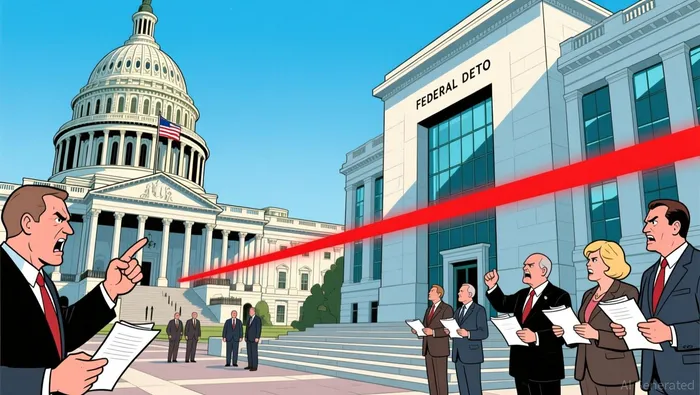
The Federal Reserve faces a critical juncture in 2026 as it navigates a delicate balance between political pressures and economic data. Despite Trump's public demands, the central bank has maintained a cautious approach, focusing on inflation and labor market stability in its decision-making process. The Fed's next steps will be closely watched by investors and analysts, who are evaluating how the administration's push for monetary easing might influence the central bank's decisions.
Will Powell Accommodate Trump's Call for a Rate Cut in the Short Term?
JPMorgan's chief U.S. economist, Michael Feroli, has suggested that Powell may respond to Trump's pressure in the short term by leaning toward a rate cut in 2026. However, he warned that the Fed chair is likely to shift back to a more hawkish stance after the midterm elections. This view is supported by some Fed officials, who believe that Powell's long-term approach will reflect the central bank's data-driven philosophy rather than political demands.
The Fed's January 2026 decision to hold rates steady reflects this cautious stance, as officials pointed to improving economic activity and a stabilizing labor market as justifications for the pause. Nonetheless, the White House has continued to push for faster easing, arguing that higher interest rates are increasing borrowing costs and slowing economic growth.
What Drives the Fed's Rate Path in 2026?
The Fed's decision to maintain the status quo in January was partly influenced by economic data showing that inflation remains above the 2% target, and labor market conditions have not yet fully stabilized. Powell has stated that the Fed will continue to make decisions on a meeting-by-meeting basis, emphasizing the importance of monitoring inflation trends and employment data before making any major policy changes.
JPMorgan's analysts also highlighted the political context surrounding the Fed's decisions. They noted that while Powell is likely to accommodate some of Trump's demands in the near term, the central bank will ultimately prioritize its mandate of price stability and maximum employment. This balance is expected to shift as the election cycle progresses and the Fed enters a potentially more politically sensitive period.
What Analysts Are Watching Next
Analysts are closely monitoring how the Fed's new leadership will shape monetary policy in the coming months. Kevin Warsh, Trump's nominee to succeed Powell, has a more hawkish reputation and may influence the Fed's direction. However, Warsh has also indicated a willingness to consider rate cuts if economic conditions justify them.
Market observers are also keeping an eye on inflation trends, as elevated prices continue to be a key concern for the Fed. The central bank's ability to reduce inflation without triggering a recession will be a critical factor in its decision-making process. In addition, the Fed's independence from political pressure will remain under scrutiny, especially as legal challenges continue to test the boundaries of its authority.
Investors are advised to remain cautious as the Fed navigates a complex economic and political landscape. While rate cuts are expected at some point in 2026, the timing and magnitude will depend on how economic data evolves and how the central bank responds to external pressures. For now, the Fed appears to be maintaining a balanced approach, carefully weighing the risks of both inflation and economic slowdown.





Comentarios
Aún no hay comentarios