
JPMorgan's Expansion into Multi-Chain Infrastructure via Canton: A Strategic Leap for Institutional Finance
In 2026, JPMorganChase's blockchain division, Kinexys, has emerged as a pivotal force in reshaping institutional finance through its multi-chain strategy. The bank's recent announcement to deploy Jpm Coin (JPMD) natively on the Canton Network-a privacy-focused blockchain designed for institutional transactions- marks a significant step in its broader vision to integrate blockchain technology into the core of global capital markets. This move, coupled with its earlier deployment of Jpm Coin on Coinbase's Base network, underscores Jpmorgan's commitment to leveraging cross-chain interoperability to enhance liquidity, operational efficiency, and institutional adoption.
JPMorgan's Multi-Chain Strategy: Bridging Public and Private Chains
Jpmorgan's approach to blockchain is no longer confined to its proprietary Quorum-based networks. By expanding Jpm Coin's availability to public blockchains like Base and Canton, the bankBANK-- is addressing a critical demand from institutional clients: flexibility in collateral management and programmable payments. This strategy aligns with the growing recognition that digital assets must operate seamlessly across both public and private infrastructures to unlock their full commercial potential.
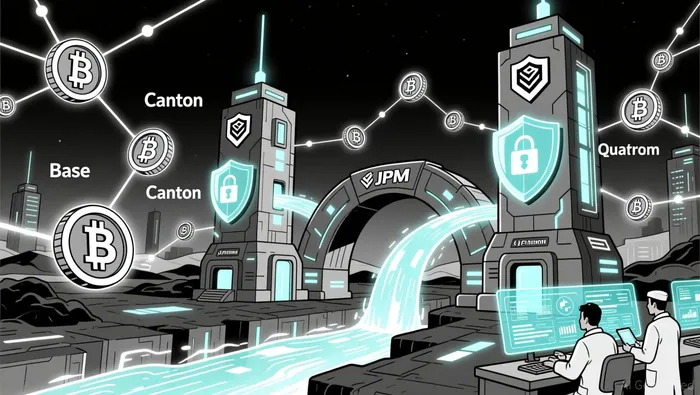
The Canton Network, a consortium-driven platform, offers a unique value proposition for JpmorganJPM--. Unlike public blockchains that prioritize transparency, Canton is engineered for institutional-grade privacy and regulatory compliance, enabling secure cross-chain asset transfers without compromising data confidentiality. This is particularly crucial for applications such as tokenized U.S. Treasuries, where sensitive financial information must remain protected while facilitating real-time collateral reuse.
Canton Network: A Catalyst for Institutional-Grade Interoperability
The Canton Network's recent demonstration of onchain U.S. Treasury financing, involving partners like Bank of America and Tradeweb, highlights its role as a bridge between traditional finance and blockchain innovation. By tokenizing U.S. Treasuries-a move set to be led by DTCC, the custodian of $100 trillion in securities- the network is positioning itself as a cornerstone of the next-generation capital markets infrastructure.
This development is not isolated. The broader interoperability market is witnessing rapid growth, with major financial institutions and blockchain platforms investing in solutions to connect disparate chains. According to a report by industry analysts, cross-chain communication is becoming a "non-negotiable" for enhancing liquidity and operational efficiency in institutional finance. Jpmorgan's collaboration with Canton exemplifies this trend, as the bank seeks to create a financial ecosystem where digital assets can flow freely across public and private networks while adhering to regulatory frameworks.
Strategic Implications for Institutional Finance
Jpmorgan's multi-chain ambitions are not merely technical-they represent a fundamental shift in how institutional finance operates. By deploying Jpm Coin on Canton and Base, the bank is addressing two critical pain points: the need for always-on payment capabilities and the demand for programmable digital cash that can be used in B2B financing and tokenized asset markets.
Moreover, the integration of Jpm Coin into the Canton Network's ecosystem-where DTCC's tokenized Treasuries will soon reside-signals a broader acceptance of blockchain as a tool for modernizing capital markets. As Yuval Rooz, CEO of Digital Asset, noted, this initiative is about "improving the flow of capital between institutions" by reducing friction in asset transfers and collateral management.
Conclusion: A New Era for Institutional Blockchain Adoption
Jpmorgan's expansion into multi-chain infrastructure via Canton is a testament to the maturation of blockchain technology in institutional finance. By prioritizing cross-chain interoperability, the bank is not only enhancing its own digital asset offerings but also setting a precedent for how traditional financial institutions can adopt blockchain without sacrificing privacy or compliance.
For investors, this represents a pivotal moment. The convergence of Jpmorgan's institutional reach, Canton's privacy-first design, and the growing demand for interoperability solutions suggests that blockchain is no longer a speculative experiment but a foundational layer of the financial system. As the integration of Jpm Coin on Canton rolls out in 2026, the market will likely see increased participation from institutional players, further accelerating the tokenization of assets and the evolution of onchain finance.





Comentarios
Aún no hay comentarios