
Jordan's Wheat Tender and Global Grain Market Dynamics: Strategic Sourcing and Investment Opportunities
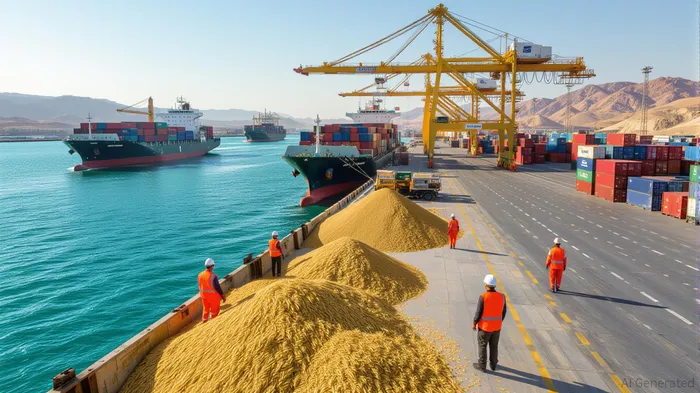
Jordan's August 2025 wheat tender—seeking 120,000 tons of milling wheat with October–November shipment windows—has become a pivotal event in the global grain market. This procurement effort, marked by partial fulfillment in prior bids and a shift toward barley sourcing, reflects broader trends of buyer caution and fragmented supply chains. For grain-exporting nations and agribusiness investors, the tender underscores the interplay of geopolitical risks, pricing volatility, and strategic grain reserve management.
Market Context: Volatility and Oversupply
Global wheat prices have been under pressure in 2025, driven by oversupply and shifting trade dynamics. U.S. Soft Red Winter (SRW) wheat prices have fallen 7.1% year-to-date, while Ukraine's harvest—projected at 56 million metric tons—faces delays due to torrential rains in key regions. Argentina, meanwhile, has redirected focus to soybean exports, with 1.24 million tons shipped to China in July alone. These developments create a fragmented market where Jordan's procurement decisions act as a bellwether for regional demand.
The Jordanian tender's timing is critical. By aligning shipments with October–November windows, the country leverages seasonal export cycles in the Black Sea region, where Ukraine's wheat typically dominates. However, geopolitical bottlenecks—such as Russia's export tariffs and Black Sea port disruptions—have fragmented pricing, pushing buyers to hedge against uncertainty.
Strategic Implications for Exporters
For the U.S., the tender represents an opportunity to regain market share in the Middle East, a region that has increasingly turned to alternative suppliers. However, U.S. wheat faces stiff competition from Ukraine's low-cost exports and Argentina's policy-driven flexibility. Ukraine's recent €600 million EU-backed infrastructure upgrades aim to streamline logistics, potentially making its wheat more competitive in Jordan's next round of procurement.
Argentina's role, though smaller, is gaining attention. Its 97% “Good to Excellent” wheat crop rating and reduced export taxes for soybean byproducts could free up resources for wheat production. Investors should monitor Argentina's ability to balance domestic biofuel policies with global export demands, as this could influence its wheat availability in Q4 2025.
Investment Opportunities and Hedging Strategies
Jordan's procurement strategy—prioritizing barley over wheat—signals a preference for grains with clearer supply chains. This trend has depressed wheat demand in the short term but creates opportunities for arbitrage. Traders can exploit timing differences between barley and wheat tenders, locking in forward contracts to hedge against price dips during Jordan's peak demand periods.
For example, leasing storage facilities at Aqaba Port and pairing this with short volatility options allows investors to capitalize on potential price dips in October and November. Additionally, the tender's alignment with the USDA's August 12, 2025, World Agricultural Supply and Demand Estimates (WASDE) report offers a window to assess global demand shifts and adjust futures positions accordingly.
Geopolitical and Logistical Risks
The tender's success hinges on resolving supply chain bottlenecks. Russia's export tariffs and Black Sea logistics constraints remain significant hurdles, while the U.S. faces trade policy headwinds from retaliatory tariffs. Investors should also consider the expiration of EU temporary trade measures for Ukraine in June 2025, which could introduce new tariffs and quotas.
Jordan's strategic grain reserves—projected to cover 16 months of consumption—add another layer of complexity. By prioritizing long-term stockpiling, the country may suppress near-term demand, further fragmenting global pricing. This dynamic favors investors who adopt diversified sourcing strategies and leverage futures markets to mitigate exposure.
Conclusion: Navigating a Fragmented Market
Jordan's wheat tender is more than a procurement exercise; it is a microcosm of global grain market stress. For agribusiness investors, the key lies in aligning with Jordan's procurement timelines, leveraging arbitrage opportunities, and hedging against geopolitical risks. The U.S., Ukraine, and Argentina each present distinct opportunities: the U.S. offers high-quality wheat with trade policy risks, Ukraine's infrastructure upgrades could stabilize its market share, and Argentina's policy flexibility may unlock new export potential.
As global buyers recalibrate their strategies, Jordan's procurement decisions will continue to shape wheat futures and export economies. Investors who monitor these dynamics closely—and adapt their portfolios to shifting demand patterns—will be well-positioned to capitalize on the volatility of 2025's grain markets.







Comentarios
Aún no hay comentarios