
Jordan's Diplomatic Prowess and the Roadmap to Gaza's Reconstruction: A Geopolitical Investment Outlook
In the volatile landscape of the Middle East, Jordan's strategic diplomacy under King Abdullah II has emerged as a linchpin for regional stability, particularly in the context of Gaza's post-conflict reconstruction. As the world grapples with the aftermath of the 2023–2025 Israel-Hamas conflict, Jordan's dual focus on humanitarian aid and political mediation positions it as a critical actor in shaping investment flows toward rebuilding Gaza. With a reported $53 billion required for Gaza's recovery, according to a World Bank report, the interplay between Jordan's diplomatic initiatives and international funding commitments could redefine emerging market opportunities in the region.
Diplomacy as a Catalyst for Investment
King Abdullah II has consistently leveraged Jordan's regional influence to advocate for a reconstruction plan that prioritizes Palestinian sovereignty and rejects displacement, as he affirmed at the Palestine Summit. At the 2025 Palestine Summit, the King emphasized the need to present a Gaza reconstruction blueprint to global partners, underscoring Jordan's role as a bridge between regional stakeholders and international donors, as UNA-OIC reported. This diplomatic alignment with Egypt, the United States, and Gulf states has not only reinforced Jordan's credibility but also signaled to investors that the country is a stabilizing force in a fractured landscape.
For instance, Jordan's coordination with Egypt to ensure humanitarian aid delivery-via air bridges and field hospitals-has demonstrated operational resilience, as reported by Jordan News. Such efforts, combined with the King's rejection of U.S.-proposed displacement plans, as described in a USIP analysis, have solidified Jordan's reputation as a reliable partner for investors seeking politically stable corridors in the Middle East.
Sectoral Opportunities in Gaza's Reconstruction
The Arab-backed Gaza reconstruction plan, endorsed in March 2025, outlines a two-phase strategy: an immediate $16.3 billion allocation for housing and infrastructure, followed by a five-year $36.7 billion push for economic revitalization (as detailed in the World Bank report). Key sectors include:
- Housing and Urban Development: Rebuilding 1.2 million homes and establishing sustainable urban zones.
- Trade and Industry: Developing industrial zones, a commercial seaport, and Gaza International Airport.
- Healthcare and Education: Modernizing hospitals and educational institutions to address long-term capacity gaps.
While Jordan has not yet secured specific funding commitments, its alignment with the plan positions it to attract foreign direct investment (FDI) in construction, logistics, and renewable energy sectors. For example, Jordan's experience managing cross-border aid operations could translate into contracts for infrastructure firms seeking to enter the Gaza market.
Economic Risks and Regional Spillovers
Jordan's own economic challenges-exacerbated by U.S. aid suspensions and regional instability-pose risks to its reconstruction ambitions. The Jordanian economy contracted by 1.6% in 2025, with tourism revenues plummeting due to conflict-related detours, Al Bawaba reported. However, the government's Economic Modernisation Vision (2022–2025) aims to mitigate these risks by diversifying into tech and green energy sectors. Investors may view Jordan's domestic reforms as complementary to its regional role, creating a dual opportunity for capital deployment.
The Path Forward: Geopolitical Stability as an Asset
For investors, Jordan's diplomatic acumen offers a unique value proposition. By anchoring reconstruction efforts in principles of non-displacement and international law, King Abdullah's leadership reduces the political volatility that often deters FDI in conflict-affected regions. Moreover, Jordan's custodianship of Jerusalem's holy sites and its historical ties to Palestinian communities enhance its legitimacy in multilateral negotiations, as Gulf Today reported.
As global institutions like the World Bank and IMF mobilize funds for Gaza's recovery, Jordan's role as a mediator could unlock access to concessional loans and grants for investors. The upcoming Cairo ministerial conference on Gaza reconstruction, hosted by Egypt with Jordan's participation, may further crystallize partnerships in infrastructure and energy (per the World Bank report).
Conclusion
Jordan's post-conflict reconstruction efforts in Gaza represent more than a humanitarian endeavor-they are a geopolitical investment in regional stability. Under King Abdullah II's stewardship, the country's diplomatic finesse and operational capabilities position it as a key player in channeling capital toward sustainable development. For investors, the alignment of Jordan's strategic interests with global peace-building agendas presents a compelling case for long-term engagement in a region poised for transformation. 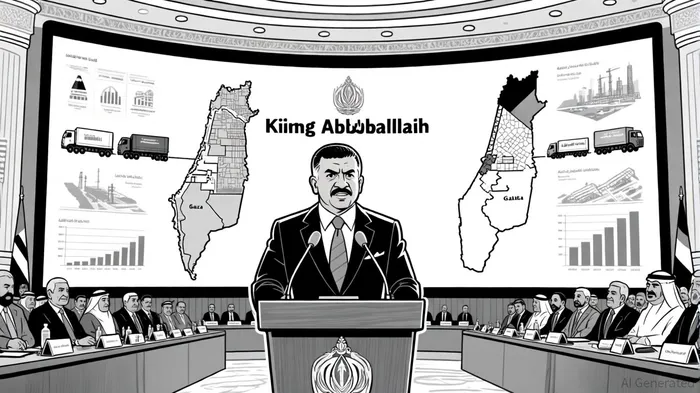







Comentarios
Aún no hay comentarios