
Jollibee's Strategic Spin-Off of Global Business: Unlocking Shareholder Value Through Risk Diversification and Operational Clarity
Jollibee Foods Corporation's decision to spin off its international operations into a separately listed entity, Jollibee Foods Corporation International (JFCI), represents a bold strategic move to accelerate global growth while enhancing investor clarity. By decoupling its domestic and international businesses, the company aims to address evolving market dynamics and unlock latent value for shareholders. This analysis explores how the spin-off aligns with principles of risk diversification, operational clarity, and value creation, supported by recent data and expert insights.
Risk Diversification: Separating Stability from Growth
Jollibee's domestic operations in the Philippines are characterized by stable cash flows and a mature market, whereas its international segment-now accounting for 43% of total revenue-embodies high-growth potential but carries inherent volatility according to a Wall Street Journal report. By isolating these two business lines, the company reduces the risk of conflating the performance of a cash-rich domestic unit with the uncertainties of global expansion. This separation allows investors to allocate capital based on their risk appetite: conservative investors can focus on the domestic entity's predictable earnings, while growth-oriented investors can target the international unit's expansion opportunities as reported.
The international business, which operates over 6,859 stores across 30+ countries under brands like Jollibee, Tim Ho Wan, and Coffee Bean & Tea Leaf, has already demonstrated resilience. System-wide sales in the international segment surged by 32.4% in the first nine months of 2025. However, such growth often comes with operational complexities, such as navigating diverse regulatory environments and currency fluctuations. By spinning off this unit, Jollibee mitigates the risk of these challenges overshadowing the domestic business's performance.
Operational Clarity: Focused Strategies for Each Entity
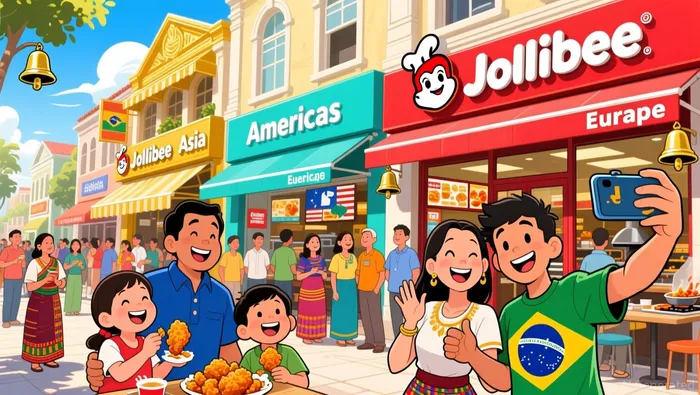
The spin-off creates two distinct entities with tailored strategic priorities. The domestic business will concentrate on deepening its dominance in the Philippines, a market where Jollibee holds a 60% share of the fast-food sector according to food service analysis. Meanwhile, JFCI will pursue aggressive international expansion, particularly in high-potential markets like the U.S., where its first franchised unit opened in New York in late 2025 as reported by Restaurant Dive. This clarity enables each entity to optimize resource allocation, streamline decision-making, and respond more nimbly to regional market conditions.
Analysts highlight that the separation will also simplify investor evaluation. As one report notes, "Investors can now assess the stable, cash-generative Philippine business separately from the higher-growth but more volatile international operations." This distinction is critical in an era where investors increasingly demand transparency and sector-specific insights.
Shareholder Value: Unlocking Potential Through Dual Listings
The spin-off is designed to enhance shareholder value by creating two independently traded entities, each with a clearer value proposition. Existing shareholders will receive shares in JFCI proportional to their current holdings, effectively doubling their exposure to Jollibee's ecosystem according to Philippine Star reporting. This structure not only preserves ownership but also capitalizes on the potential for divergent valuations between the two units.
Market reactions already suggest optimism. Following the spin-off announcement in early 2025, Jollibee's stock surged by its largest single-day gain in over five years. Analysts attribute this to the perceived unlocking of value, particularly for the international segment, which had previously been undervalued when bundled with the domestic business. By 2027, when the U.S. listing is expected to materialize, JFCI could attract a broader investor base, including global funds seeking exposure to emerging market fast-food growth as noted by Branding in Asia.
Market Reaction and Future Outlook
While the spin-off is slated for completion by late 2027, its benefits are already materializing. Jollibee's international revenue has grown from 21% of total sales in 2017 to 43% in 2025 according to Yahoo Finance data, reflecting the segment's accelerating importance. The capital-light model of JFCI-relying heavily on franchising-further reduces financial risk while enabling rapid scalability as reported by The Wall Street Journal.
However, challenges remain. Regulatory hurdles and market conditions could delay the U.S. listing timeline. Additionally, maintaining brand consistency across diverse markets will require robust operational discipline. Yet, given Jollibee's proven track record in international expansion and its strategic alignment with investor preferences, these risks appear manageable.
Conclusion
Jollibee's spin-off strategy exemplifies how corporate restructuring can align with investor priorities. By diversifying risk, clarifying operational focus, and creating dual value propositions, the company positions itself to capitalize on both the stability of its domestic market and the dynamism of global expansion. As the U.S. listing approaches, investors will likely reward this strategic clarity with renewed confidence in Jollibee's long-term potential.






Comentarios
Aún no hay comentarios