
Johnson & Johnson's Talcum Powder Lawsuits: A Catalyst for Reassessment of Long-Term Shareholder Value
Johnson & Johnson (J&J) has long been a cornerstone of the healthcare industry, but its talcum powder litigation has become a defining risk factor for its long-term shareholder value. As of November 2025, the company faces over 67,000 active lawsuits in the U.S. alone, with recent jury verdicts totaling hundreds of millions in damages. These legal challenges, compounded by reputational erosion and shifting consumer trust, have forced investors to reevaluate J&J's risk profile. This analysis examines the interplay of legal, financial, and reputational risks and their implications for the company's future.
Legal Risks: A Prolonged and Costly Battle
The rejection of J&J's third bankruptcy settlement proposal in March 2025-described by a U.S. Bankruptcy Judge as "fundamentally flawed and rushed"-has left the company with no alternative but to litigate thousands of cases individually. This strategy is both costly and unpredictable. Recent jury awards, such as the $40 million compensatory damages in Los Angeles and the $65.5 million verdict in Minnesota, underscore the courts' growing skepticism of J&J's claims that its talc products are safe.
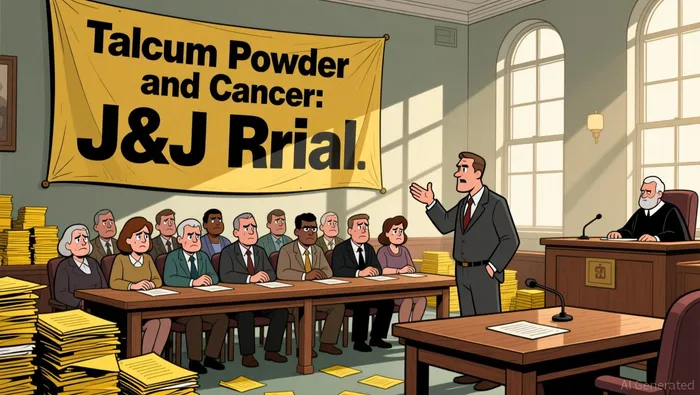
The resumption of pretrial motions and the scheduling of bellwether trials now loom as critical junctures. These trials could set precedents for future settlements or verdicts, with potential liabilities estimated in the tens of billions. Analysts note that the sheer volume of cases-projected to exceed 73,570 by October 2025-creates a compounding risk, as each adverse ruling amplifies the pressure for a global resolution.
Financial Implications: A Double-Edged Sword
While J&J's diversified portfolio and strong cash flow have historically insulated it from short-term volatility, the talc litigation introduces a unique asymmetry. On one hand, the company's recent innovations in MedTech and pharmaceuticals have driven optimism, with analyst price targets rising to $209.29. On the other, the legal uncertainty has prompted bearish warnings. For instance, BofA and Stifel analysts caution that "much of the upside is already priced in," while the risk of additional $100 million+ verdicts remains unquantified.
The financial impact is further compounded by the loss of exclusivity for key products like Stelara, which could erode revenue streams at a time when the company needs to allocate capital for legal defense. Despite J&J's $966 million verdict in a mesothelioma case being appealed, the cumulative effect of these liabilities could strain its balance sheet, particularly if settlements require reserves beyond current projections.
Reputational Damage: Erosion of Trust and Brand Equity
The reputational toll of the talc litigation is arguably as significant as the financial costs. Media analysis reveals a consistent narrative of corporate negligence, with internal documents from the 1960s suggesting J&J was aware of asbestos contamination in its products. This has fueled public outrage, particularly among demographics disproportionately targeted by the company's marketing campaigns, such as African American and Hispanic women.
The UK lawsuits, involving 3,000 plaintiffs, have further globalized the reputational crisis. As noted by The BBC, these cases highlight J&J's alleged failure to act transparently, even as its U.S. legal battles intensify. The appointment of mediator Fouad Kurdi in August 2025 signals a shift toward resolution but also underscores the urgency for J&J to rebuild trust-a process that could take years.
Investor Outlook: Balancing Optimism and Caution
Analysts remain divided on J&J's trajectory. Optimists point to the company's planned orthopedics spin-off and its robust pipeline in innovative medicine as catalysts for growth. However, the talc litigation introduces a wildcard element. As one report notes, "the legal uncertainty could intermittently weigh on valuation and sentiment," particularly if bellwether trials result in precedents that escalate liability.
The stock's 5.22% annual revenue growth projection appears modest in the context of these risks. While J&J's dividend yield and defensive characteristics make it an attractive income play, its long-term growth potential is clouded by the unresolved legacy liabilities. Investors must weigh the company's operational strengths against the possibility of a reputational and financial reckoning.
Conclusion: A Reassessment of Risk and Reward
Johnson & Johnson's talcum powder lawsuits have evolved from a legal liability into a systemic risk that challenges its core brand identity. The rejection of bankruptcy settlements, the surge in adverse verdicts, and the erosion of consumer trust collectively signal a paradigm shift in how investors perceive the company. While J&J's diversified business model and innovation pipeline offer resilience, the talc litigation remains a catalyst for reassessing its long-term shareholder value. For now, the path forward hinges on the outcome of bellwether trials, the company's ability to negotiate a global settlement, and its commitment to restoring public trust-a task that may prove as formidable as the legal battles themselves.





Comentarios
Aún no hay comentarios