
Johnson & Johnson's Oncology Pipeline: A Catalyst for Market Leadership in Multiple Myeloma
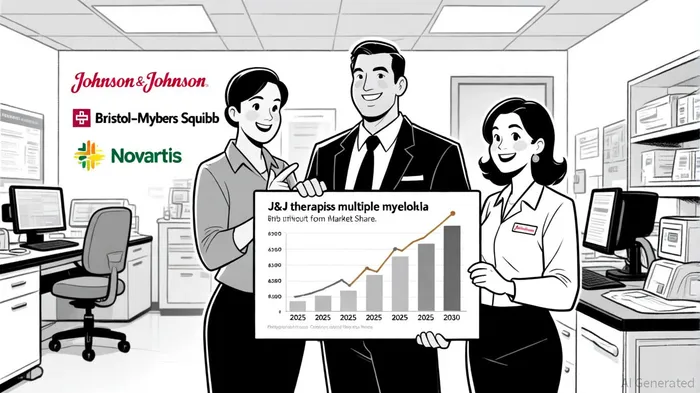
Johnson & JohnsonJNJ-- (J&J) is poised to redefine the hematologic cancer landscape, particularly in multiple myeloma, with a pipeline of innovative therapies that could catalyze a valuation re-rating for its pharmaceutical division. Recent clinical advancements, including groundbreaking results in induction therapy and the development of next-generation immunotherapies, underscore J&J's strategic positioning to dominate a market projected to grow from $25.4 billion in 2025 to $45.7 billion by 2033[5].
Clinical Breakthroughs in Induction Therapy
The Phase 2 MajesTEC-5 trial, combining TECVAYLI (teclistamab) and DARZALEX FASPRO (subcutaneous daratumumab and hyaluronidase), has delivered unprecedented efficacy in transplant-eligible patients with newly diagnosed multiple myeloma. According to a report by Johnson & Johnson, 100% of evaluable patients achieved minimal residual disease (MRD) negativity following induction therapy, with 85.7% reaching complete response or better by Cycle 6[1]. These results are particularly significant given the historical challenges of achieving deep remissions in myeloma, a disease characterized by high relapse rates.
The safety profile, while marked by cytokine release syndrome (65% of patients), was largely manageable, with no Grade 5 adverse events reported[1]. Additionally, 96% of patients successfully completed stem cell mobilization, a critical step for autologous stem cell transplantation. These outcomes position the combination as a front-line standard, potentially expanding J&J's market reach in early-stage myeloma.
Market Dynamics and Competitive Edge
J&J's dominance is further reinforced by its leadership in CAR-T and bispecific antibody therapies. Carvykti, its BCMA-targeting CAR-T cell therapy, is already the top-selling product in the myeloma space, while Tecvayli remains the category leader in bispecifics[2]. Bloomberg Intelligence forecasts that J&J will capture a significant share of the $33 billion myeloma market by 2030, with Darzalex and its subcutaneous formulation, Darzalex Faspro, projected to generate $14.7 billion in sales[2].
This growth is not merely speculative. The MajesTEC-5 results align with J&J's broader “treat-to-cure” strategy, shifting the paradigm from managing myeloma as a chronic disease to pursuing curative outcomes. Analysts note that three out of four myeloma patients will likely initiate treatment with J&J's therapies by 2030[2], a testament to the company's ability to integrate clinical innovation with commercial scalability.
Next-Generation Therapies and Valuation Implications
Beyond induction therapy, J&J's pipeline includes JNJ-5322, a trispecific antibody targeting BCMA and GPRC5D. Early Phase 1 data revealed a 100% overall response rate in patients naive to BCMA or GPRC5D therapies, with a safety profile comparable to existing treatments[3]. This molecule, which combines the convenience of an off-the-shelf therapy with the efficacy of CAR-T, could further solidify J&J's leadership in later-line settings.
The valuation implications of these advancements are profound. With a 5-7% compound annual growth rate target for its Innovative Medicine segment[3], J&J is leveraging its R&D investments to outpace competitors like Bristol-Myers SquibbBMY--, whose Revlimid sales are eroding due to generic competition[4]. The company's focus on personalized medicine—tailoring treatments to individual patient profiles—also aligns with industry trends, enhancing long-term shareholder value.
Conclusion
Johnson & Johnson's oncology pipeline represents a confluence of clinical excellence and strategic foresight. The MajesTEC-5 trial's success in induction therapy, coupled with the promise of JNJ-5322 and a robust commercial portfolio, positions J&J to reshape market dynamics in hematologic cancers. As the myeloma market expands, investors may soon witness a re-rating of J&J's pharmaceutical division, driven by its ability to deliver transformative therapies and sustain growth in an increasingly competitive landscape.





Comentarios
Aún no hay comentarios