
Johnson & Johnson's Master Class in Resilience: Outperforming Tariffs and Peers in 2025
Johnson & Johnson (JNJ) has long been a bellwether of stability in healthcare. But its Q2 2025 earnings reveal something more: a strategic playbook for thriving in an era of global trade volatility. Despite facing $400 million in tariff-related headwinds, the company delivered a 5.8% revenue surge to $23.74 billion, raised its full-year guidance, and reinforced its position as a leader in both pharmaceuticals and medtech. Let's dissect how J&J is turning tariffs into a competitive advantage—and why investors should take notice.
The Tariff Test: J&J's Playbook
The $400 million tariff impact—primarily on its MedTech segment—could have crippled lesser companies. Instead, J&J is mitigating these costs through a three-pronged strategy:
1. Strategic Reinvestment: A $55 billion commitment to U.S. manufacturing through 2028 aims to reduce reliance on imported materials like steel and aluminum. This has already halved the tariff impact to $200 million.
2. Operational Efficiency: Gross profit grew 3.4% year-over-year, thanks to cost controls that outpace peers. The company's geographic diversification also shines: 7.8% U.S. sales growth offset weaker international markets.
3. Diversified Revenue Streams: J&J's three segments—Medicine, MedTech, and Consumer—provide a cushion. MedTech's 6.1% operational sales growth, driven by cardiovascular technologies like Abiomed and vision products, highlights its resilience.
Margin Gains Amid the Storm
While tariffs dented MedTech margins (down to 22.2% from 25.7%), J&J's focus on operational discipline kept the broader ship afloat. Selling, general, and administrative expenses improved by 50 basis points, while R&D spending ($3.5 billion in Q2) fueled innovation in oncology, robotics, and cardiovascular therapies. The company remains confident in its full-year operating margin guidance, a stark contrast to peers like Roche (RHHBY), which faces retaliatory tariffs in China.
Dividend Safety and MedTech's Hidden Engine
With a 3.35% dividend yield and $10 billion in net cash, J&J's payout looks secure. But the real growth driver is MedTech. The segment's 7.3% sales jump was fueled by launches like the KINCISE™ 2 System (for knee/hip surgeries) and the OTTAVA™ robotic surgical system. Meanwhile, pharma stalwarts like CARVYKTI (multiple myeloma) and IMAAVY (myasthenia gravis) are expanding its pipeline.
Why Peers Are Struggling—and J&J Isn't
While J&J adapts, competitors are buckling under trade pressures:
- Pfizer (PFE): Fears over Section 232 tariffs (potentially 50–200% duties on imported drugs) have dragged its stock down 20% year-to-date. Its cost-cutting measures pale against J&J's proactive supply chain moves.
- Merck (MRK): A 40% stock decline over the past year stems from pipeline concerns and weaker exposure to medtech's growth.
- Roche (RHHBY): Despite a 24% stock surge from its pipeline, China's 125% tariffs on its products threaten profitability in critical markets.
Technicals Signal a Sustained Rally
Analysts upgraded JNJ to a Moderate Buy consensus (7 Buys, 8 Holds) with an average price target of $174.50—12.5% above current levels. Technicals back this optimism:
- Price Action: JNJ broke through key resistance at $165, with moving averages (30-day, 150-day, 150-week EMAs) aligning for upward momentum.
- Indicators: The MACD and stochastic oscillators are bullish, signaling a potential breakout above the $171 resistance (the top of a two-year range).
Investment Thesis: Hold for the Long Game
J&J's Q2 results and strategic moves underscore its ability to navigate headwinds through diversification, operational rigor, and capital discipline. With a robust pipeline (FDA approvals in oncology, psoriasis, and robotics in sight), a fortress balance sheet, and dividend safety, this is a stock for investors seeking stability and growth.
Risk Factors: Biosimilar competition for STELARA (down 43.2% in Q2) could weigh on immunology sales. Still, offsetting wins in TREMFYA and SPRAVATO suggest management can pivot effectively.
Final Take
Johnson & Johnson isn't just surviving tariffs—it's using them to accelerate its transition to a U.S.-centric, innovation-driven healthcare giant. For investors, this isn't just about Q2's numbers: it's about a company rewriting the playbook for resilience in an era of global uncertainty.
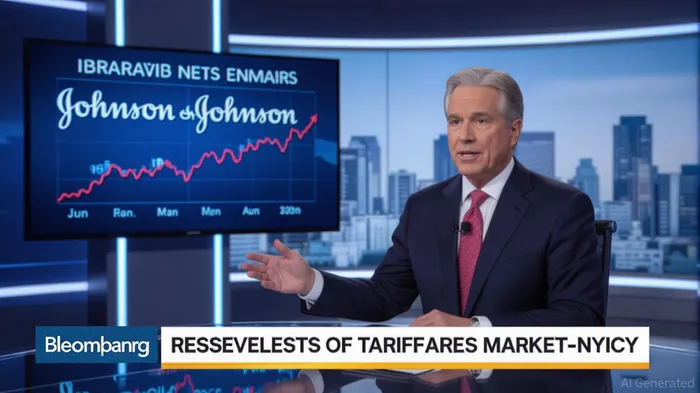
Action Item: Consider adding JNJ to a diversified portfolio for its dividend yield, margin resilience, and growth catalysts. Watch for a close above $171 to confirm a breakout toward $200+ targets.
This analysis is for informational purposes only and does not constitute financial advice.







Comentarios
Aún no hay comentarios