
Why Joby Aviation's Vertical Integration Model Positions It for Long-Term Dominance in the eVTOL Space
The electric vertical takeoff and landing (eVTOL) market is poised to redefine urban mobility, but success in this nascent industry hinges on strategic differentiation. Joby AviationJOBY--, a leader in the air taxi sector, has emerged as a standout contender through its vertically integrated business model, which spans manufacturing, services, and regulatory alignment. By controlling critical aspects of its value chain and forging strategic partnerships, JobyJOBY-- is not only accelerating its path to commercialization but also building a durable competitive moat. This analysis examines how Joby's dual vertical integration-across manufacturing and services-positions it for long-term dominance, contrasting its approach with rivals like Archer Aviation.
Vertical Integration in Manufacturing: A Foundation for Scalability
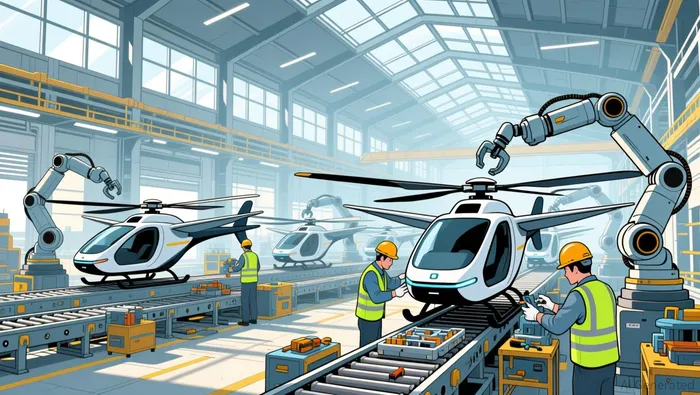 Joby's vertical integration strategy begins with manufacturing, where the company is doubling its production capacity across facilities in California and Ohio. By 2027, this expansion aims to support the production of four electric air taxis per month, with the Marina, California site-now spanning 435,500 square feet-serving as a central hub for assembling up to 24 aircraft annually. This control over production ensures tighter quality oversight, faster iteration cycles, and reduced dependency on third-party suppliers, all critical for scaling in a capital-intensive industry.
The company's partnership with Toyota further amplifies this advantage, leveraging the automaker's expertise in lean manufacturing and supply chain management. This collaboration is not merely tactical but strategic, as it aligns with Joby's goal of achieving cost efficiency and operational reliability-key prerequisites for mass-market adoption. In contrast, Archer Aviation relies on a partnership-driven model, outsourcing manufacturing to Stellantis. While this approach may reduce upfront capital expenditures, it introduces risks related to coordination and quality control, potentially slowing Archer's time to market.
Vertical Integration in Services: From Pilots to Passengers
Beyond hardware, Joby's vertical integration extends to services, including pilot training and certification processes. By managing these elements in-house, the company ensures seamless alignment between aircraft design and operational protocols, accelerating FAA certification timelines. For instance, Joby's S4 aircraft has already completed over 850 test flights in 2025, with test pilots preparing for TIA (Type Inspection Authorization) trials-a critical step toward full regulatory approval according to company updates. This end-to-end control minimizes bottlenecks and enhances the company's ability to meet safety and performance standards, a stark contrast to Archer's Stage 4 FAA certification process, which is expected to conclude only in late 2025 according to market analysis.
Moreover, Joby's integration with existing travel platforms via partnerships with Uber and Delta underscores its focus on user-centric scalability according to industry reports. These alliances enable the company to embed its air taxi services into established mobility ecosystems, reducing customer acquisition costs and leveraging brand trust. For example, Uber's global ride-hailing network provides a ready-made interface for booking air taxi services, while Delta's infrastructure offers potential synergies in airport operations and customer loyalty programs. Archer, by contrast, relies on United Airlines for operations, a partnership that, while valuable, lacks the same breadth of digital integration according to financial analysis.
Certification Progress and Strategic Flexibility
Regulatory hurdles remain a significant barrier for eVTOL firms, but Joby's proactive approach to certification gives it a clear edge. The company is entering the final stages of FAA type certification for its S4 aircraft, with test flights slated for early 2026. This timeline is notably ahead of Archer's, which faces delays due to FAA scrutiny of battery redundancy and autonomy systems according to industry reports. Furthermore, Joby's plan to initiate non-commercial passenger flights in the UAE as early as 2026-potentially before U.S. certification-demonstrates strategic flexibility according to company announcements. Such operations could generate operational data and public trust while serving as a de facto certification runway for its U.S. ambitions.
The U.S. government's eVTOL Integration Pilot Program, launched in September 2025, further bolsters Joby's trajectory by providing a framework for integrating air taxis into existing airspace systems according to official statements. This regulatory support, combined with Joby's vertical integration, creates a flywheel effect: streamlined production, rapid certification, and scalable deployment reinforce one another, reducing systemic risks.
A Comparative Edge: Joby vs. Archer
While both Joby and Archer are vying for leadership in the eVTOL space, their business models diverge sharply. Archer's reliance on external partners for manufacturing and operations introduces execution risks, particularly in an industry where precision and speed are paramount. Its focus on international markets, such as the UAE, is commendable but lacks the immediate scalability of Joby's integrated approach according to market analysis. Meanwhile, Joby's dual vertical integration-spanning hardware, services, and regulatory alignment-creates a more sustainable growth engine. By controlling its value chain, the company can adapt swiftly to market feedback, optimize costs, and maintain quality, all while building a brand synonymous with reliability.
Conclusion: A Compelling Investment Case
Joby Aviation's vertical integration model is not merely a competitive advantage but a strategic imperative in the eVTOL race. By mastering manufacturing, services, and regulatory dynamics, the company is laying the groundwork for a scalable, profitable business. Its partnerships with Uber and Delta, coupled with a head start in FAA certification, position it to capture first-mover benefits in a market still defining its contours. While risks such as public acceptance and infrastructure development persist, Joby's integrated approach mitigates these challenges more effectively than its peers'. For investors seeking long-term value in the air mobility revolution, Joby's disciplined execution and visionary strategy make it a standout bet.







Comentarios
Aún no hay comentarios