
Joby Aviation's Strategic Expansion in the Middle East and Defense Market as a Catalyst for Long-Term Growth
Joby Aviation is emerging as a standout player in the nascent urban air mobility (UAM) and defense aerospace sectors, with its strategic expansion into the Middle East and defense markets poised to drive outsized shareholder returns in 2026 and beyond. By leveraging dual-use vertical takeoff and landing (VTOL) technology, securing regulatory milestones, and forging high-impact partnerships, the company is positioning itself to capitalize on two of the most dynamic growth areas in aviation.
Middle East Partnerships: A Gateway to Global UAM Leadership
Joby's aggressive foray into the Middle East underscores its ambition to dominate the UAM market. In Saudi Arabia, the company has signed a memorandum of understanding with Red Sea Global and The Helicopter Company to conduct pre-commercial evaluation flights of its electric air taxi in 2026, aligning with a "sandbox" initiative to test future operations. This collaboration is further bolstered by an agreement with the General Authority of Civil Aviation (GACA) to harmonize with FAA certification standards, streamlining regulatory pathways for the Kingdom. Meanwhile, a partnership with Abdul Latif Jameel to deliver up to 200 aircraft highlights Saudi Arabia's commitment to adopting Joby's technology.
In the UAE, JobyJOBY-- has secured a six-year exclusive arrangement to launch air taxi operations in Dubai by 2026, while a long-term collaboration with Ras Al Khaimah Transport Authority and Skyports Infrastructure aims to establish a passenger air taxi network by 2027. These partnerships are not isolated; they reflect a broader regional strategy to position Joby as a key enabler of smart city infrastructure. In Kazakhstan, a $250 million letter of intent with Alatau Advance Air Group to supply aircraft and services further diversifies Joby's geographic footprint.
Defense Market: Dual-Use Technology as a Strategic Differentiator
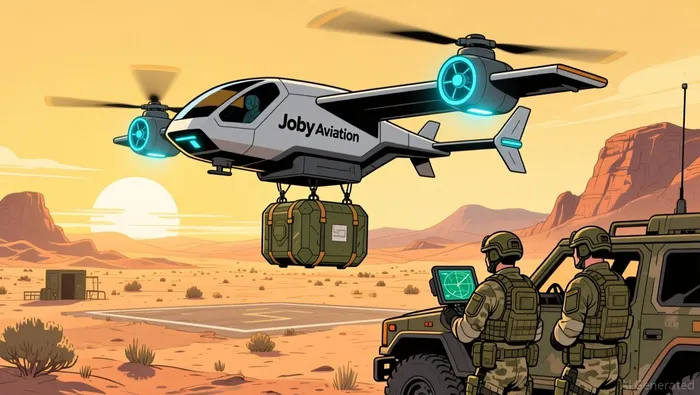 Joby's expansion into defense is equally compelling. The company recently completed the first test flight of its hybrid defense aircraft in partnership with L3Harris, demonstrating rapid development capabilities for military needs. This turbine-electric VTOL aircraft, based on the S4 platform, integrates a hybrid powertrain and SuperPilot autonomy stack, enabling extended range and payload capacity for both civilian and defense applications. The Department of Defense (DoD) has prioritized such dual-use technologies, allocating $9.4 billion in its FY26 budget for next-generation autonomous and hybrid aircraft.
Joby's SuperPilot system has already proven its mettle in military exercises. During the REFORPAC 2025 exercise, the system logged over 7,000 miles and 40 flight hours, validating its utility in cargo delivery, inter-island transport, and ISR missions. L3Harris is now missionizing the aircraft for defense-specific roles, including contested logistics and low-altitude support. This dual-use approach not only diversifies revenue streams but also accelerates regulatory acceptance, as the company leverages its decade-long experience with DoD contracts and certifications.
Regulatory Progress and Financial Resilience: The Path to Commercialization
Joby's regulatory progress is a critical enabler of its growth narrative. The company is in the final stage of FAA certification, having completed power-on testing of its FAA-conforming aircraft and over 600 flights in 2025. Type Inspection Authorization (TIA) testing-a prerequisite for commercial operations-is now underway. Concurrently, Joby has scaled manufacturing, initiating propeller blade production in Ohio and adding over 100 production roles.
Financially, the company has secured $1 billion in additional funding and commitments in Q4 2024, providing a robust runway for certification and scaling. While 2025 revenue stands at $15,000 (attributed to early contract work), the focus on pre-commercial partnerships and defense contracts suggests a transition to revenue-generating operations in 2026.
Investment Thesis: Diversification and Regulatory Momentum
Joby's dual-use VTOL technology and strategic partnerships create a flywheel effect: civilian deployments in the Middle East generate regulatory and operational data, while defense contracts validate the technology's military utility. This synergy reduces risk and accelerates market entry. The company's alignment with the U.S. Air Force's shift toward hybrid platforms and its ability to rapidly iterate-evidenced by the three-month timeline from partnership announcement to hybrid aircraft test flight-further strengthens its competitive edge.
For investors, the convergence of regulatory progress, diversified revenue streams, and high-margin defense contracts presents a compelling case. With commercial operations in Saudi Arabia and the UAE on track for 2026 and DoD funding aligned with its technology, Joby is uniquely positioned to deliver outsized returns as the UAM and defense markets converge.





Comentarios
Aún no hay comentarios