
U.S. Jobless Claims Drop Amid Weakened Hiring Pace: Assessing Labor Market Resilience and Its Implications for Equities and Inflation Expectations
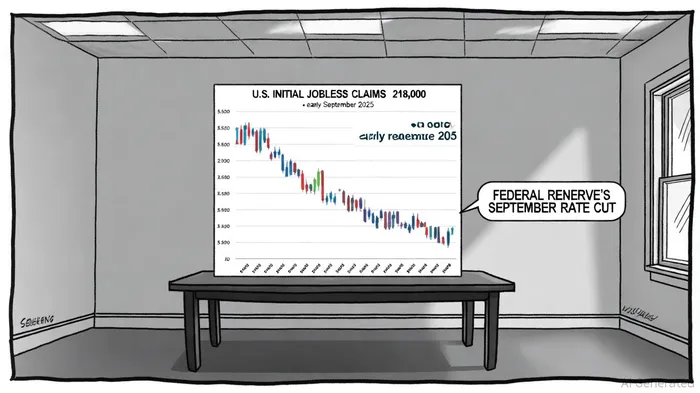
The U.S. labor market has entered a delicate balancing act. On one hand, initial jobless claims fell to 218,000 in early September 2025, well below the expected 235,000 and signaling a temporary stabilization in layoffs [1]. On the other, hiring remains subdued, with nonfarm payrolls averaging just 29,000 new jobs per month from June to August 2025—less than a third of the 82,000 added in the same period in 2024 [2]. This divergence raises critical questions: Is the labor market resilient enough to avoid a downturn, and how will this tug-of-war between job losses and hiring caution ripple through equities and inflation expectations?
Labor Market Resilience: A Mixed Picture
The recent drop in jobless claims offers a glimmer of hope. After spiking to 263,000 in late August—the highest since October 2021—claims retreated sharply, suggesting employers are holding off on layoffs despite broader economic uncertainty [3]. However, this optimism is tempered by deeper structural shifts. The unemployment rate rose to 4.3% in August 2025, driven by a declining labor force participation rate and reduced inflows of foreign-born workers [4]. Meanwhile, the average duration of unemployment hit 24.5 weeks in August, the longest since April 2022, indicating that job seekers are facing longer waits to find new roles [5].
These trends reflect a labor market that is neither collapsing nor rebounding. Employers are cautious, with hiring pace slowing as businesses grapple with trade policy uncertainty and persistent inflation. Yet the stability in continuing claims (1.926 million) and the absence of a surge in layoffs suggest that the labor market is not yet in freefall [6].
Implications for Equities: Resilience Amid Volatility
The equity market has mirrored this duality. While weak labor data initially caused Treasury yields to dip and equity indices to waver, broader markets have shown surprising resilience. For instance, the Precious Metals Equity Index surged 5.59% in late August, reflecting investor appetite for inflation hedges [7]. Similarly, U.S. broad-based indices have benefited from strong fund flows into money market funds and commodities, signaling a shift toward defensive assets [8].
However, the market's optimism is not universal. Large-cap growth stocks, which had outperformed in Q4 2024, have faced headwinds in 2025 as investors recalibrate for slower growth. In contrast, sectors tied to inflationary pressures—such as energy and materials—have gained traction . This bifurcation underscores the market's struggle to price in both the risks of a softening labor market and the Fed's potential interventions.
Inflation Expectations: A Lingering Headache
The Federal Reserve's September 2025 rate cut to 4.00–4.25% underscores its growing focus on labor market risks . Yet inflation remains a stubborn challenge. The PCE price index is projected to stay above 2% until at least 2027, with a median forecast of 3.1% in 2025 . This stickiness is partly attributed to recent tariff policies, which have introduced uncertainty into supply chains and pricing dynamics .
The Fed's dilemma is clear: lower rates could reignite inflationary pressures, while tighter policy risks further labor market deterioration. This tightrope walk has led the FOMC to adopt a cautious stance, projecting only two additional 25-basis-point cuts in 2025 and one in 2026 . For investors, this means inflation expectations will remain a key variable, influencing both equity valuations and bond yields.
The Path Forward: A Delicate Equilibrium
The labor market's resilience, though fragile, has prevented a severe downturn. Corporate balance sheets remain strong, and the Fed's flexibility to ease policy provides a buffer. However, slowing growth and persistent inflation suggest that 2025's second half will be marked by greater market volatility . For long-term investors, this volatility could create opportunities to add equities at attractive valuations, particularly in sectors insulated from labor market shocks.
In the near term, the focus will remain on the interplay between jobless claims, Fed policy, and inflation. A sustained drop in claims could reinforce the Fed's dovish stance, while a resurgence in layoffs might force a more aggressive response. For now, the labor market's ability to avoid a cliffhanger—while keeping both employers and investors on edge—will define the next chapter of this economic story.







Comentarios
Aún no hay comentarios