
Jiangling Motors and Ford's JV Capital Boost: Strategic Implications for China's Auto Market and EV Transition
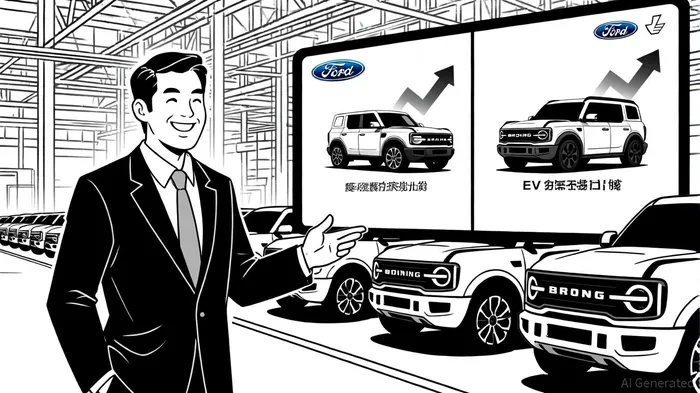
The strategic partnership between Jiangling Motors and Ford Motor CompanyF--, formalized in 2021 as Jiangling FordF-- Automobile Technology (Shanghai) Co., represents a pivotal experiment in China's evolving automotive landscape. With a registered capital of RMB200 million and a 51:49 ownership split favoring Jiangling Motors, the joint venture (JV) aims to harmonize Ford's global brand equity and distribution networks with Jiangling's robust manufacturing capabilities[1]. As China's EV market accelerates—projected to grow at a 32.5% CAGR through 2030[6]—the JV's strategic repositioning toward niche segments like pickup trucks and off-road SUVs offers both opportunities and risks for investors.
Strategic Repositioning: Niche Markets as a Differentiator
In 2023, the JV shifted focus from the saturated passenger vehicle market to less competitive niches, launching the Ford Ranger (pickup trucks) and Ford Beyond (SUVs) brands[3]. This pivot aligns with regulatory changes in China, where 97% of small and medium cities have relaxed urban pickup truck restrictions, unlocking new demand[2]. The Ford Ranger, priced below CNY160,000, is positioned to capitalize on this trend, while the Ford Beyond targets the burgeoning off-road lifestyle segment. By 2025, the JV plans to expand its retail footprint to over 200 experience stores in major cities, enhancing customer engagement[3].
This strategy mirrors broader industry trends. For instance, BYD and Geely have dominated the EV market by focusing on affordability and localized innovation[1]. The JV's reliance on Jiangling's manufacturing and Ford's design expertise could enable it to replicate this success, particularly in segments where Chinese consumers prioritize utility over pure EV adoption. However, the EV segment remains a minor contributor to the JV's revenue—accounting for just 5% of sales in recent reports[1]—highlighting the need for aggressive scaling.
Financial Dynamics and Valuation Challenges
Jiangling Motors' standalone financials suggest resilience: trailing twelve-month revenue of $5.32 billion and a net income of $188.86 million as of March 2025[1]. However, the JV's specific financial performance remains opaque, with no disclosed revenue or EV market share data for 2025[5]. This lack of transparency complicates valuation efforts, though Jiangling's broader growth trajectory—projected net sales rising from RMB33.096 billion in 2021 to RMB45.883 billion in 2025[3]—offers indirect optimism.
Ford's global EV segment, meanwhile, faces headwinds. The company anticipates a $5–5.5 billion loss in 2025, driven by high R&D costs and unprofitable models like the Mustang Mach-E[2]. Yet, the JV's focus on cost-effective EREV and BEV variants—such as the Ford Bronco with a BYD-supplied 105.4 kWh battery—could mitigate these challenges. By leveraging local supply chains and Ford's export infrastructure, the JV aims to become a regional hub for affordable EVs and ICE commercial vehicles[3].
Competitive Positioning in the EV Era
The JV's EV initiatives, including the Bronco's 650 km CLTC range BEV and 1,220 km EREV variants, underscore its commitment to technological differentiation[1]. However, competing with domestic giants like BYD and Wuling remains daunting. In May 2025, these brands dominated China's EV sales, with models like the Geely Geome Xingyuan and Wuling Mini EV capturing over 50% of the market[1]. The JV's EV market share is currently negligible, but its pivot to niche segments and export-oriented strategies could carve out a unique value proposition.
Ford's broader “China 2.0” strategy—emphasizing agility, AI integration, and localized production—further strengthens the JV's long-term potential[3]. By studying Chinese automakers' operational efficiencies, Ford aims to streamline its global operations, a move that could indirectly benefit the JV. Additionally, the framework agreement signed in 2023 to boost exports positions the JV as a critical node in Ford's global supply chain[2].
Risks and Uncertainties
Despite its strategic merits, the JV faces significant risks. Ford's global EV losses and its decision to prioritize smaller, affordable vehicles over large SUVs[2] could strain resources. Moreover, the absence of detailed financial metrics for the JV—such as EV segment revenue or EBITDA—limits investor confidence. Regulatory shifts, including U.S. tax credit uncertainties and potential tariffs, also pose threats to Ford's EV strategy[4].
Conclusion: A Calculated Bet on Niche and Export Markets
The Jiangling-Ford JV embodies a calculated approach to China's EV transition: leveraging niche markets, local supply chains, and export potential to navigate a fiercely competitive landscape. While financial opacity and Ford's global EV losses present risks, the partnership's strategic alignment with market trends—such as urban pickup truck liberalization and EV affordability—offers growth potential. For investors, the JV's success will hinge on its ability to scale EV production, secure market share in niche segments, and capitalize on Ford's global distribution network.





Comentarios
Aún no hay comentarios