
JGB Yield Movements and BOJ Policy Implications: Strategic Timing for Bond Allocation in a Shifting Monetary Landscape
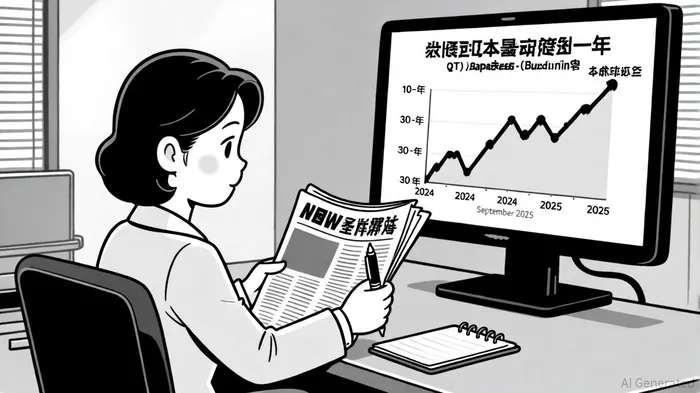
The Japanese government bond (JGB) market has experienced a seismic shift in 2025, driven by the Bank of Japan's (BOJ) pivot away from ultra-accommodative policies and the normalization of monetary conditions. With the 30-year JGB yield surging to a record 3.286% in September 2025 and the 10-year yield hovering near its highest level since 2008 at 1.633% [1], investors are recalibrating their strategies to navigate a rapidly evolving landscape. This analysis examines the interplay between BOJ policy adjustments, quantitative tightening (QT), and yield dynamics, offering insights into optimal timing for JGB allocation.
Drivers of the Yield Surge
The BOJ's decision to end its negative interest rate policy and yield curve control (YCC) program in March 2024 marked a turning point. By allowing market forces to dictate yields, the central bank inadvertently triggered a 100-basis-point spike in the 30-year JGB yield by May 2025 [2]. Concurrently, the BOJ's QT program—reducing monthly JGB purchases from 4.1 trillion yen in early 2025 to a target of 2 trillion yen by March 2027—has amplified upward pressure on yields [3]. Japanese life insurers, the second-largest holders of JGBs, further exacerbated the trend by cutting their holdings by 1.35 trillion yen through March 2025 [4].
Persistent inflation, which remains above 3% despite wage growth lagging behind, has forced the BOJ to adopt a cautious wait-and-see approach. At its September 2025 meeting, the BOJ maintained the policy rate at 0.5%, citing uncertainties around U.S. tariffs and domestic political developments [5]. This hesitation underscores the central bank's balancing act: normalizing policy while avoiding destabilizing market volatility.
Quantitative Tightening and Market Functionality
The BOJ's QT strategy has accelerated in 2025, with total assets falling to ¥729 trillion by March 2025—the lowest since December 2022 [6]. However, the central bank has signaled a slower tapering pace starting April 2026, reducing JGB purchase cuts from 400 billion yen per quarter to 200 billion yen [7]. This adjustment reflects concerns about Japan's fiscal sustainability and the need to test private sector demand for JGBs.
Historically, the BOJ's interventions—particularly under QQE and YCC—distorted the yield curve by flattening it and narrowing bid-ask spreads [8]. As the BOJ scales back purchases, liquidity risks are emerging. Transaction volumes may decline, and bid-ask spreads could widen, complicating market efficiency. For instance, the 35-year JGB yield briefly exceeded 4.6% in May 2025, signaling a troubling decline in demand for long-term debt [9].
Strategic Timing for JGB Allocation
Investors must weigh the BOJ's gradual QT against the potential for continued yield normalization. The central bank's slower tapering from April 2026 provides a window for private buyers to adjust to higher yields, but this also means volatility may persist. Key considerations include:
- Entry Strategies:
- Short-to-Medium Term: The 10-year JGB yield, currently at 1.633%, remains below its 2008 peak of 2.6%. Investors seeking exposure to a more normalized yield curve may prioritize shorter-duration bonds, which are less sensitive to QT-driven volatility [10].
Long-Term: The 30-year yield's surge to 3.286% reflects market expectations of inflation and fiscal risks. However, the BOJ's cautious QT suggests yields may stabilize by mid-2026, offering opportunities for long-term investors willing to tolerate near-term fluctuations [11].
Exit Strategies:
- Hedging Liquidity Risk: Given the potential for wider bid-ask spreads, investors should consider hedging strategies such as options or futures to mitigate liquidity shocks.
Diversification: Allocating to non-JGB Japanese sovereign debt (e.g., 40-year bonds) or corporate bonds could provide diversification benefits, as these instruments may react differently to QT and fiscal policy shifts [12].
Risk Assessments:
- Fiscal Sustainability: Japan's government debt-to-GDP ratio remains among the highest in the G20. A sharp rise in yields could increase debt servicing costs, potentially forcing fiscal adjustments that could impact bond prices [13].
- Global Spillovers: The JGB market's volatility has already influenced U.S. Treasuries and German Bunds. Investors should monitor global central bank policies and trade negotiations, which could amplify or dampen JGB yield movements [14].
Conclusion
The BOJ's transition from YCC to QT has created a complex environment for JGB allocation. While the central bank's slower tapering from 2026 offers a degree of predictability, investors must remain vigilant about liquidity risks and fiscal pressures. Strategic entry into the JGB market should prioritize shorter-duration instruments in the near term, with a gradual shift toward longer-term bonds as the BOJ's normalization path becomes clearer. As Governor Kazuo Ueda emphasized, the BOJ's focus on market stability will likely temper yield spikes, but the path to equilibrium remains fraught with uncertainties.







Comentarios
Aún no hay comentarios