
JetBlue's Strategic Position in the Post-Pandemic Airline Recovery: Navigating Operational Efficiency and Investor Sentiment Amid Sector Consolidation
The post-pandemic airline recovery has been a tale of resilience and recalibration. For JetBlue AirwaysJBLU--, the journey has been marked by a dual focus on operational efficiency and strategic reinvention, as the airline contends with rising costs, shifting consumer preferences, and a sector-wide push toward consolidation. While its strategy has delivered measurable progress, investor sentiment remains cautious, reflecting broader industry headwinds and the challenges of competing in a landscape where premiumization and cost discipline are paramount.
Operational Efficiency: A Foundation for Recovery
JetBlue's operational efficiency has been a focal point of its post-pandemic strategy. In Q3 2023, the airline
under GAAP, . This highlighted the need for structural cost savings, which the airline has since prioritized. By 2024, , .
Central to this effort is the JetForward strategy, launched in late 2024 to cut unprofitable routes and restructure the network.
according to its financial results. Operational metrics have improved, with
. These gains are critical for an airline that
in on-time performance in 2023.
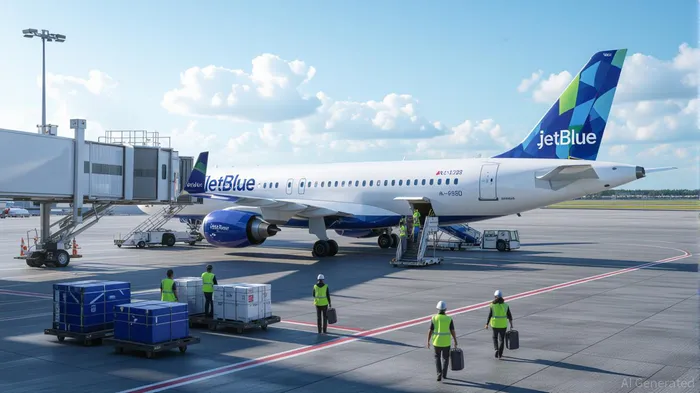
Fleet modernization further underscores JetBlue's efficiency drive. By prioritizing Airbus A220 deliveries over A321neos and retiring Embraer E190 aircraft, the airline aims to reduce unit costs and
. Additionally,
as reported in Q4 2024 results. However, challenges persist, including
, driven by rising labor costs.
Investor Sentiment: Caution Amid Strategic Progress
Despite these strides, investor sentiment toward JetBlueJBLU-- has been volatile. In Q3 2025,
following a conservative 2025 outlook, as management flagged rising operational costs and soft demand in the core cabin segment. ,
concerns over capacity optimization and cost management linger.
The broader industry context exacerbates these concerns. , with United Airlines potentially benefiting from Spirit's distress
according to industry analysis. Meanwhile,
JetBlue's 2025 Airline Quality Rating ranking at sixth place reflects mixed performance, with customer satisfaction and service quality remaining areas of focus.
Yet, there are signs of optimism. JetForward's emphasis on premium services, such as the Mint® offering and the upcoming domestic first-class cabin,
according to investor reports. Additionally, partnerships like Blue Sky with United Airlines aim to enhance loyalty engagement and expand market reach
as detailed in strategy documents. These initiatives align with industry trends toward premiumization, where full-service carriers (FSCs) increasingly prioritize high-yield products to offset lower-margin segments
as analyzed by Oliver Wyman.
Industry Consolidation: A Double-Edged Sword
The airline sector's trajectory in 2025 is defined by consolidation and evolving business models. Global capacity growth, led by the Asia-Pacific region, contrasts with North American carriers grappling with economic slowdowns and reduced government-related travel
as per industry analysis. For JetBlue, this dynamic underscores the importance of disciplined capacity management and network optimization.
Low-cost carriers (LCCs) face particular challenges, as profitability remains elusive despite capacity increases
according to economic forecasts. JetBlue's hybrid model-balancing cost efficiency with premium offerings-positions it to navigate this convergence of LCC and FSC strategies. However, the airline must contend with aircraft supply constraints and geopolitical risks, which could delay its fleet modernization goals
as noted in capacity reports.
Conclusion: A Path to Profitability?
JetBlue's strategic initiatives, particularly JetForward, have laid the groundwork for improved operational efficiency and customer satisfaction. The airline's focus on premium services, AI-driven cost controls, and network optimization aligns with broader industry trends toward premiumization and consolidation. Yet, investor skepticism persists, fueled by rising labor costs, soft demand, and the competitive pressures of a sector in flux.
For JetBlue to achieve its goal of a positive operating margin in 2025
as stated in Q4 2024 results, it must sustain its cost discipline while capitalizing on high-margin opportunities. The success of its JetForward strategy-and its ability to adapt to a consolidating industry-will ultimately determine whether it emerges as a resilient player in the post-pandemic era.







Comentarios
Aún no hay comentarios