
Jet.AI's Strategic Move into High-Demand AI Infrastructure: Assessing the Long-Term Value of Energy-Advantaged Data-Center Locations in North America
The global AI infrastructure boom is reshaping the data-center landscape, with energy efficiency and scalability emerging as critical determinants of long-term value. Jet.AI's recent strategic investments and partnerships in energy-advantaged regions highlight a forward-looking approach to capitalizing on this transformation. By anchoring its growth in locations with abundant, low-cost power and robust connectivity, Jet.AI is positioning itself to meet surging demand for AI compute while aligning with sustainability goals-a combination that could redefine its competitive edge.
Energy-Advantaged Regions: The New Gold Standard for AI Infrastructure
North America's data-center hubs are increasingly defined by their access to affordable, renewable energy and infrastructure resilience. Northern Virginia, for instance, remains the continent's most concentrated data-center market, with nearly 6,000 MW of active capacity and another 6,300 MW planned by 2025. Its appeal lies in low electricity costs (averaging $0.06–$0.07 per kWh), sub-terrestrial fiber connectivity, and proximity to major population centers according to Brightlio. Similarly, Phoenix and Dallas-Fort Worth are rising stars: Phoenix offers competitive rates ($0.065–$0.075 per kWh) and over 1,380 MW of power, while Dallas-Fort Worth is projected to grow its capacity by 355% to meet 4,396 MW of demand by 2025. Reno-Las Vegas, meanwhile, is set to expand by 953%, leveraging its cool climate to reduce cooling costs and its high elevation to avoid flood risks according to Bluesignal.
These regions exemplify how energy-advantaged locations are becoming linchpins for AI infrastructure. As global data-center demand is forecast to triple by 2030, with the U.S. alone growing at 20–25% annually, the ability to secure scalable, low-cost power will determine which operators thrive.
 Jet.AI's Strategic Pivot: Canada's Hidden Gem and North American Synergies
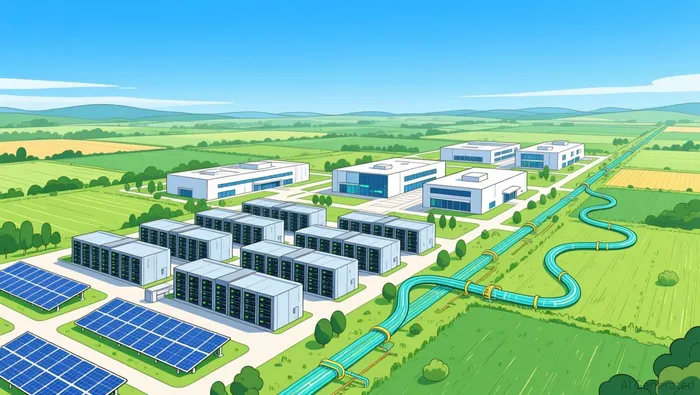
While Jet.AI's recent focus has been on Canada, its joint venture with Consensus Core Technologies Inc.-Convergence Compute LLC-reveals a masterstroke in leveraging energy-advantaged geography. The venture's phased hyperscale campus near Winnipeg, Manitoba, taps into 2,000 MW of hydroelectric power via the Bipole III HVDC line, low-latency fiber, and proximity to natural gas infrastructure according to Nasdaq. This site, with its 350-acre footprint and immediate access to 115-kV transmission corridors, is designed to deliver 1.5 gigawatts of power capacity, directly addressing North America's AI compute needs.
Critically, this Canadian investment complements the U.S. energy-advantaged hubs. For example, Northern Virginia's dominance is underpinned by its ability to scale rapidly, but its proximity to renewable energy sources remains limited compared to Winnipeg's hydroelectric abundance. Phoenix and Dallas-Fort Worth, while growing, face challenges in securing long-term power contracts at stable rates. Jet.AI's Canadian site, with its combination of renewable energy, infrastructure, and scalability, could serve as a regional hub for AI workloads that require both high-density compute and sustainability credentials.
Long-Term Value: Energy, Economics, and Strategic Positioning
The long-term value of Jet.AI's strategy hinges on three pillars: energy cost stability, economic output, and alignment with AI's evolving demands.
- Energy Cost Stability: Hydroelectric power in Manitoba offers a predictable cost structure, a stark contrast to fossil-fuel-dependent regions where volatility is a risk. For AI workloads, which require 24/7 high-density compute, this stability reduces operational costs and enhances profit margins according to InvestorShangout. 2. Economic Output: Virginia's data-center sector already generates $31 billion in economic output annually according to VisualCapitalist, demonstrating the multiplier effect of such investments. Jet.AI's Canadian project, with its $20 million initial commitment and potential for gigawatt-scale AI capacity, could replicate this model while diversifying its geographic exposure.
- Strategic Positioning: By targeting energy-advantaged regions, Jet.AI avoids the congestion and regulatory hurdles of saturated markets like Northern Virginia. Its Winnipeg site, for instance, is 10 miles from major infrastructure, minimizing latency while avoiding urban land-price pressures according to Yahoo Finance.
Conclusion: A Blueprint for Future-Proof AI Infrastructure
Jet.AI's strategic pivot underscores a broader trend: the winners in AI infrastructure will be those that marry energy efficiency with scalability. While U.S. hubs like Northern Virginia, Phoenix, and Dallas-Fort Worth remain critical, Canada's Winnipeg offers a compelling alternative with its renewable energy abundance and infrastructure readiness. By anchoring its growth in such locations, Jet.AI is not only addressing immediate demand but also future-proofing its operations against energy price shocks and sustainability pressures.
As AI's computational demands continue to outpace traditional infrastructure, the ability to secure energy-advantaged sites will become a defining factor in market leadership. Jet.AI's investments suggest it is ahead of this curve-and its long-term value may well be measured in the gigawatts it deploys and the AI ecosystems it powers.







Comentarios
Aún no hay comentarios