
Jerash Holdings (JRSH): A Deep Dive into Undervaluation and Growth Catalysts in the Apparel Manufacturing Sector
Jerash Holdings (NASDAQ: JRSH) has emerged as a compelling case study in the apparel manufacturing sector, where a combination of operational resilience, strategic partnerships, and forward-looking sustainability initiatives positions it for long-term growth. Despite a current share price of $3.295 as of September 26, 2025[1], the stock appears undervalued when analyzed through the lens of its financial trajectory, margin improvements, and industry positioning.
Valuation Metrics: A Tale of Two P/E Ratios
JRSH's trailing price-to-earnings (P/E) ratio of 47.07[1] appears elevated compared to industry peers like Lululemon (11.69) and VF Corporation (16.93)[2]. However, this metric is skewed by a negative EPS of -$0.00047[1], resulting in a misleadingly high trailing P/E. The forward P/E of 10.46[1], derived from expected 2026 earnings, paints a more optimistic picture. Analysts have set a fair price of $4.50[3], implying a 26.8% undervaluation, while Morningstar's $1.16 estimate[3] reflects a more cautious view. This divergence highlights the stock's potential for mean reversion as earnings normalize.
Financial Performance: Margin Expansion and Strategic Adaptability
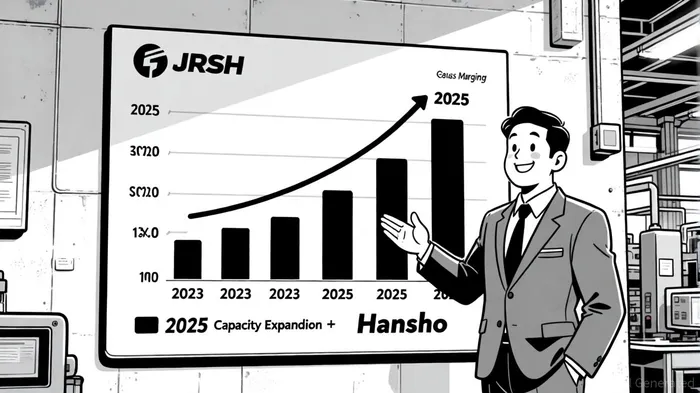
JRSH's fiscal 2025 results underscore its operational strength. Annual revenue surged 24.4% to $145.81 million[1], driven by a 35.6% Q4 revenue increase to $29.3 million[4]. This growth was achieved despite logistical disruptions at Israel's Haifa port, which the company mitigated by rerouting shipments through Jordan's Aqaba port[4]. Gross profit expanded nearly 250% to $5.2 million in Q4[4], with gross margin widening to 17.9% from 7.0% in the prior year[4]. These improvements stem from economies of scale and a strategic focus on high-margin contracts, such as the $29.3 million order secured through its collaboration with Hansho, a South Korean apparel group[4].
Growth Catalysts: Capacity, Partnerships, and Sustainability
JRSH's core business—manufacturing sportswear and outerwear for global brands like VF Corporation, New Balance, and Skechers[5]—is being fortified by three key catalysts:
1. Capacity Expansion: A 15% increase in production capacity at its Amman facility[4], expected to contribute meaningfully in 2026, will support higher revenue and margin stability.
2. Strategic Partnerships: The Hansho collaboration[4] has opened doors to U.S. multinational retailers, diversifying JRSH's client base and reducing reliance on a single market.
3. Sustainability Initiatives: The Jerash Newtech joint venture[5], which introduces eco-friendly dyeing technology, aligns with global ESG trends and could reduce costs by minimizing dependency on external suppliers.
Risk Mitigation and Liquidity
JRSH's debt-to-equity ratio of 0.08[1] remains conservative, though it has risen 20% from its 12-month average[1]. This low leverage provides flexibility for reinvestment. The company also announced a $0.05 quarterly dividend in June 2025[4], signaling confidence in its cash flow trajectory. While Q4 2025 net income of $144,000[4] marked a significant improvement from a $3.1 million loss in 2024[4], investors should monitor the November 12, 2025 earnings report[2] for further validation of the turnaround.
Conclusion: A High-Conviction Long-Term Play
JRSH's combination of margin expansion, strategic adaptability, and sustainability-driven innovation positions it as a compelling long-term investment. While short-term risks—such as geopolitical logistics and client concentration—persist, the company's proactive approach to capacity, partnerships, and ESG integration suggests a path to earnings normalization. At current levels, the stock appears undervalued relative to its forward P/E and analyst fair value estimates, making it a high-conviction opportunity for investors with a 12- to 18-month horizon.





Comentarios
Aún no hay comentarios