
Jefferies' 8% Share Price Drop: A Reassessment of Risk and Value in the Post-Moomoo Earnings Climate
The recent 8% plunge in JefferiesJEF-- Financial Group's (JEF) stock price following its Q2 2025 earnings report has sparked renewed debate about the firm's strategic positioning in a volatile financial landscape. This decline, juxtaposed with Moomoo's parent company Futu Holdings Ltd.'s robust performance-marked by 69.7% year-over-year revenue growth and a 105.2% surge in non-GAAP net income, according to Futu's Q2 results-raises critical questions for investors. Is Jefferies' share price drop a mispricing opportunity, or a warning sign of deeper structural challenges?
A Mixed Earnings Picture: Revenue vs. Profitability
Jefferies' Q2 results reflected a classic tug-of-war between revenue resilience and profitability pressures. While total net revenues of $1.63 billion slightly exceeded expectations, according to EY's Private Equity Pulse, adjusted earnings per share (EPS) fell to $0.40, missing forecasts by $0.04, according to a FinancialContent analysis. The disconnect stemmed from sharp declines in Fixed Income trading (-37% quarter-over-quarter) and Equity Underwriting (-51% YoY), coupled with a 14% rise in non-compensation expenses to $645 million, as reported in a Nasdaq article. These headwinds were partially offset by a 61% surge in Advisory revenue, driven by a robust M&A market, as Morningstar reported.
According to an Investing.com report, CEO Richard Handler attributed the underperformance to "macroeconomic and geopolitical volatility," emphasizing the firm's focus on client-centric strategies and liquidity preservation. However, analysts remain skeptical. Jefferies' average return on equity (ROE) of 8.5% over the past five years lags behind the sector average of 10%, while its net-debt-to-EBITDA ratio of 35.4× highlights significant leverage risks, as FinancialContent noted.
Valuation Metrics: A Tale of Two Ratios
Jefferies' valuation appears to straddle optimism and caution. As of October 10, 2025, its forward price-to-earnings (P/E) ratio stands at 15.10, down from a trailing P/E of 25.11, according to FinancialContent. This suggests a potential discount, particularly when compared to Moomoo's forward P/E of approximately 12.3x (based on its 69.7% revenue growth and 105.2% net income increase reported by Morningstar). Meanwhile, Jefferies' price-to-book (P/B) ratio of 1.02 indicates the market values its assets marginally above their accounting value, per CompaniesMarketCap, a neutral signal in a sector where intangible assets often dominate.
Analyst Opinions: Cautious Optimism or Bearish Realism?
The analyst community is divided. Morgan Stanley lowered its price target to $55, citing weak fixed-income trading results, while Goldman Sachs maintained a "Buy" rating with a $62 target, citing Jefferies' strong advisory pipeline. The average 12-month price target of $58.25 implies a potential 36% upside from its October 10 closing price of $42.75. However, critics highlight the firm's reliance on M&A activity, which remains sensitive to interest rate cycles and geopolitical risks, as Investing.com observed.
Strategic Investment Opportunism: Lessons from Industry Trends
The broader financial sector offers context for assessing Jefferies' prospects. Private equity exits hit a three-year high in H1 2025, with $308 billion in transactions, according to EY's pulse, suggesting a market primed for consolidation. Jefferies' advisory segment, which grew 61% YoY per Morningstar's coverage, could benefit from this trend, particularly as sponsors and corporate acquirers seek to capitalize on undervalued assets.
Moreover, Deloitte's 2025 financial services predictions highlight a shift toward tokenized currency platforms and retail investor participation in private capital. While Jefferies' traditional brokerage model may lag in these areas, its M&A expertise and capital markets resilience position it to capture a niche in a fragmented market.
Risk vs. Reward: A Calculated Approach
For strategic investors, Jefferies' 8% drop presents a nuanced opportunity. The firm's strong advisory pipeline and resilient equities segment offer growth potential, particularly in a low-interest-rate environment. However, its high leverage and exposure to volatile trading markets necessitate a cautious approach.
Investors should monitor two key metrics:
1. M&A Pipeline Execution: Can Jefferies sustain its 61% advisory revenue growth in H2 2025?
2. Expense Management: Will non-compensation costs stabilize, or continue to erode margins?
Conclusion: A Reassessment of Value
Jefferies' share price decline reflects both near-term challenges and long-term strategic potential. While the firm's mixed Q2 results and high debt levels warrant caution, its advisory strength and capital return initiatives (e.g., a 14% dividend hike) suggest a path to recovery. In a market where underperforming financial firms are increasingly targeted for consolidation or strategic repositioning, Jefferies' stock may represent a calculated bet for investors willing to navigate macroeconomic headwinds. 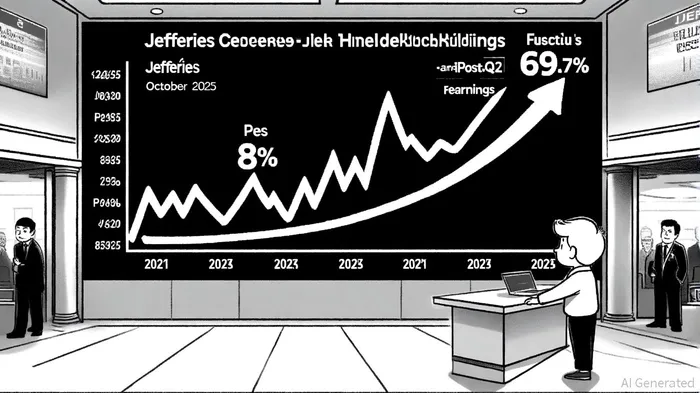





Comentarios
Aún no hay comentarios