
JCPenney's $1 Billion Divestiture: A Bellwether for Retail Real Estate's Private Equity Pivot
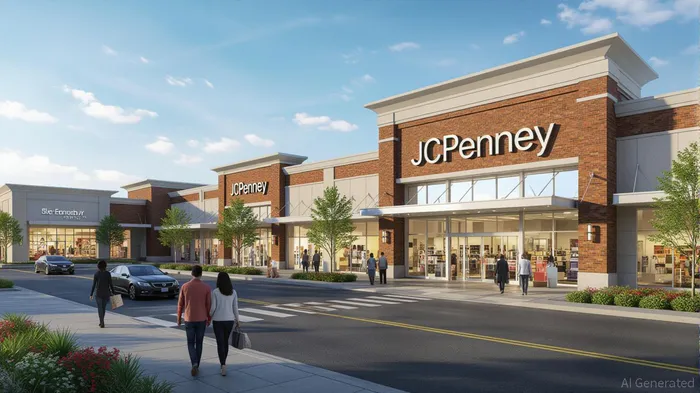
In 2025, the retail real estate sector is witnessing a seismic shift as mall anchors like J.C. Penney pivot toward private equity-backed divestitures to unlock liquidity and operational efficiency. JCPenney's $947 million sale of 119 stores to Onyx Partners, Ltd.—a Boston-based private equity firm—has become a case study for how legacy retailers are reimagining their physical footprints in the post-pandemic era. This transaction, part of a broader Chapter 11 restructuring, underscores a trend where mall operators are trading long-term ownership for flexible leases, enabling cost savings and capital redeployment. For investors, the move signals a maturation of the private equity-driven retail real estate model, where underperforming assets are repurposed into logistics hubs, mixed-use developments, or experiential retail spaces.
The JCPenney Playbook: From Anchors to Leases
JCPenney's strategy contrasts sharply with the aggressive store closures of competitors like Sears and Macy'sM--. While Sears has effectively exited the mall retail space through bankruptcy and brand liquidation, and Macy's is shuttering 150 stores by 2026, JCPenney is preserving its anchor tenant status by retaining 650+ stores while selectively divesting underperforming locations. The 119 sold stores, leased under a triple-net (NNN) structure, were marketed as “flexible-use assets” with potential for conversion into logistics centers or mixed-use projects. This approach allows JCPenney to reduce debt (the sale nets ~$930 million post-fees) while maintaining a critical mass of mall presence, which supports tenant traffic and property values.
The sale also highlights the growing role of private credit lenders in real estate. With traditional banks retreating from mall financing due to high interest rates and debt maturities, firms like Peachtree Group are stepping in with tailored loans for mall redevelopment. JCPenney's partnership with Onyx Partners reflects this dynamic, as private equity buyers can offer more flexible terms to repurpose retail spaces. For example, the Teas Crossing location in Conroe, Texas, and the Glendale Galleria in California—both part of the sale—could transition into co-working spaces or micro-housing units, aligning with urbanization trends.
Operational Efficiency: Reno's $40M Bet and AI-Driven Gains
JCPenney's operational reinvention is equally compelling. A $40 million investment in its Reno, Nevada, distribution center, equipped with automated sorting systems, is projected to reduce shipping times and boost online order accuracy. This aligns with a $1 billion self-funded reinvestment plan focused on digital upgrades and store modernizations. Meanwhile, AI-driven analytics from partners like Metrical have cut cart abandonment by 15% and boosted revenue by 11%, demonstrating how tech can offset physical retail declines.
These efficiency gains are critical for investors to note. While JCPenney's stock has traded sideways post-divestiture, the company's focus on reducing fixed costs (e.g., by transitioning to leases) and improving online conversion rates could drive EBITDA growth.
Broader Trends: Mall REITs and Private Equity Synergies
The JCPenney divestiture is part of a larger $4.5 trillion commercial real estate debt wave maturing by 2028, with malls and retail properties increasingly becoming private equity playthings. REITs like Simon Property GroupSPG-- (SPG) and BrookfieldBN-- (BAM) have capitalized on this shift by acquiring JCPenney's parent trust, leveraging their mall expertise to reposition assets. For example, Simon's ownership of JCPenney during bankruptcy helped stabilize mall foot traffic, which is now a key metric for valuing retail real estate.
Investors should also monitor how private equity firms optimize these assets. Onyx Partners, for instance, could redevelop the acquired JCPenney stores into logistics hubs or experiential retail formats, a trend that has boosted mall occupancy rates by 8% in 2025.
Investment Takeaways
For investors, the JCPenney case underscores three key themes:
1. Private Equity as a Retail Rescuer: Firms with mall redevelopment expertise (e.g., Onyx, Peachtree Group) are prime candidates for growth as they transform legacy retail into adaptive-use assets.
2. Mall REITs as Stabilizers: REITs like Simon PropertySPG-- and Brookfield are well-positioned to benefit from anchor tenant stability and rising mall occupancy.
3. Operational Efficiency as a Lifeline: Retailers integrating AI and automation (e.g., JCPenney's Reno center) are better equipped to compete with e-commerce giants, making their stocks compelling long-term plays.
In a market where mall retail is evolving from “retail” to “real estate,” JCPenney's divestiture isn't just a survival tactic—it's a blueprint for future-proofing retail assets. Investors who recognize this shift early may find lucrative opportunities in private equity-driven mall repositioning and tech-savvy retailers navigating the transition.





Comentarios
Aún no hay comentarios