
JBS's NYSE Debut: A Bold Move in a Risky Protein Market
The Brazilian meat giant JBSJBS-- made history on June 12, 2025, when it debuted on the New York Stock Exchange (NYSE) under the ticker "JBS," valuing the company at roughly $30 billion—surpassing U.S. rival Tyson Foods' $19.8 billion market cap. This milestone marks the culmination of a 15-year journey to access global capital markets, but it also thrustes JBS into the spotlight amid mounting scrutiny over its governance, environmental footprint, and geopolitical risks in the protein sector.
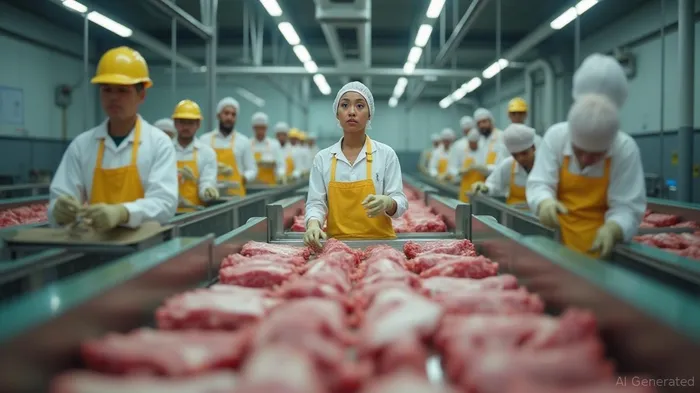
The Strategic Play: Global Ambitions and Governance Challenges
JBS's NYSE listing is as much about financial strategy as it is about geopolitical positioning. By dual-listing on the NYSE and São Paulo's B3, JBS aims to tap into U.S. investor pools, diversify its shareholder base, and reduce its cost of capital. The restructuring into a Dutch holding company (JBS N.V.) was designed to align governance standards with international norms, though critics argue the dual-class share structure—which grants the Batista family 85% voting control—undermines that goal.
The Batista brothers, Joesley and Wesley Batista, have a fraught history. Their 2017 bribery scandal led to a $3.2 billion Brazilian fine and a $27 million U.S. SEC settlement, yet they returned to JBS's board after being acquitted of insider trading in 2024. This governance controversy has sparked backlash from environmental groups like Mighty Earth and U.S. lawmakers, who question how a firm with such unresolved legal baggage can be trusted to adhere to international standards.
Risks: Legal Liabilities, Environmental Pressures, and Trade Volatility
JBS's environmental record is a red flag. In October 2024, Brazil's government fined the company for purchasing cattle linked to illegal Amazon deforestation—a recurring issue that could invite stricter regulations or consumer boycotts. Meanwhile, global trade dynamics are shifting. Rising protectionism, particularly in Asia and Europe, threatens JBS's export-heavy model. For instance, China's sporadic meat import bans and the EU's push for sustainable sourcing standards could disrupt supply chains.
The dual-class share structure also poses a governance risk. While it concentrates decision-making power with the Batistas, it could deter institutional investors who prioritize voting equity. This tension was evident in the narrow 52% shareholder approval for the NYSE listing, with minority investors and ESG-focused funds voting against it.
Market Dynamics: Protein's New Landscape
The protein sector is undergoing a seismic shift. Plant-based alternatives, lab-grown meat, and sustainability-driven consumer preferences are reshaping demand. JBS, as a traditional meat processor, must navigate this evolution while addressing its own environmental liabilities.
JBS's $30 billion valuation signals confidence in its scale—$77.2 billion in annual revenue and 250 global facilities—but its reliance on commodity pricing and volatile markets leaves it exposed. The U.S. poultry division (via Pilgrim's Pride) and Australian operations provide geographic diversification, yet commodity price swings and trade disputes could destabilize margins.
Investment Takeaways: A High-Reward, High-Risk Bet
For investors, JBS's NYSE debut presents a compelling opportunity—but only for those willing to tolerate significant risks. The valuation reflects JBS's dominance in scale and global reach, but its governance, environmental, and regulatory risks are non-trivial. Here's how to approach it:
- Watch Governance Evolution: Track whether JBS adopts shareholder-friendly reforms, such as simplifying its dual-class structure or enhancing transparency. A shift toward alignment with ESG standards could improve its appeal.
- Monitor Trade Policy: China's import policies and U.S.-Brazil trade relations will directly impact JBS's top line. A pro-trade administration in Brazil post-2026 elections could be a tailwind.
- Assess Environmental Progress: JBS must demonstrate measurable progress in reducing deforestation-linked cattle sourcing. Failure here could lead to activist campaigns or regulatory fines that dent profitability.
- Technical Trading: JBS's stock price fell 3.9% on its NYSE debut, reflecting initial skepticism. A sustained rebound above $15 per share would signal investor confidence.
Final Verdict
JBS's NYSE listing is a bold move that underscores its ambition to become a global protein powerhouse. However, its success hinges on resolving governance concerns, mitigating environmental liabilities, and navigating trade headwinds. For now, JBS is a high-risk, high-reward play best suited for investors with a long-term horizon and a tolerance for volatility. Monitor it closely—but tread carefully.





Comentarios
Aún no hay comentarios