
Japanese Rubber Futures: Riding Geopolitical Waves and Weather Storms for Short-Term Gains
The rubber market is at an inflection pointIPCX--. Geopolitical tensions in the Middle East, weather-driven supply risks in Thailand, and structural oversupply in China have created a volatile landscape for traders. While long-term headwinds persist, short-term opportunities abound for those nimble enough to navigate the chaos. Here's how to capitalize.
1. Geopolitical Volatility: The Strait of Hormuz as a Trigger
The Strait of Hormuz, through which 20% of global oil flows, has become a flashpoint in June 2025. Iran's parliamentary threat to close the strait—a move analysts deem economically self-destructive—has kept markets on edge. Even a partial disruption could spike crude prices to $120/bbl, indirectly boosting synthetic rubber costs (as petrochemical feedstock prices rise). This creates a short-term bullish catalyst for natural rubber, as buyers pivot to the cheaper alternative.
Investors should monitor geopolitical developments closely. A long position in Tokyo Commodity Exchange (TOCOM) rubber futures could yield gains if tensions escalate. However, traders must pair this with tight stops, as a resolution or de-escalation could trigger a sharp sell-off. The U.S.-China trade war's impact on Asian supply chains further amplifies volatility, making geopolitical headlines a daily must-watch.
2. Thai Weather: The Monsoon's Double-Edged Sword
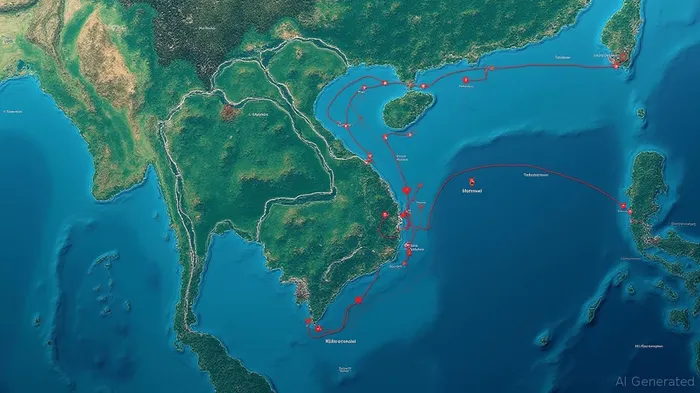
Thailand's delayed southwestSWX-- monsoon—critical for latex production—has already cut yields by 8–12%, per the ANRPC. Farmers are delaying tapping to withhold supply, reducing global output by 300,000+ tons. This short-term supply crunch could push prices higher, especially if the monsoon remains erratic. SICOM futures' Q3 premium of $15/ton reflects this risk.
Trade Idea: Go long TOCOM futures if the monsoon delay extends beyond July. However, beware of excessive rains or flooding—a 30% output collapse would trigger a price correction. Use options to hedge: buy a put option at the 280 yen/kg strike to protect against a drop below that level.
3. Structural Oversupply: The Qingdao Inventory Watch
Qingdao's rubber inventories—currently at 569,000 tons—are a bearish overhang. Analysts warn of a potential 600,000-ton breach by year-end, which would suppress prices. But here's the twist: if inventories drop below 500,000 tons by Q4, a supply deficit could ignite a rally. China's weak tire demand (due to price wars) and sluggish commercial vehicle production are prolonging oversupply, but Thai supply shocks could flip the script.
Hedging Strategy: Pair a long position in TOCOM futures with a collar strategy: buy a put (to protect downside) and sell a call (to offset costs). This allows participation in upside gains while capping losses if inventories remain high.
4. USD/JPY: The Exchange Rate Wildcard
The USD/JPY rate at 145.35 in early June offers a dual opportunity. A weaker yen (lower rate) makes Japanese rubber exports cheaper, boosting demand. Conversely, a stronger yen (closer to 155) raises input costs for synthetic rubber producers, squeezing margins. Traders can exploit this via carry trades: go long TOCOM futures while shorting the yen via FX futures.
Risk Alert: A sudden yen rally (e.g., BoJ tightening expectations) could reverse trends. Monitor Japan's inflation data and BoJ policy statements closely.
Putting It All Together
- Short-Term Play: Long TOCOM futures with stops below 280 yen/kg, targeting a 300 yen/kg breakout if geopolitical/monsoon risks escalate.
- Hedge Against Oversupply: Use put options and collar strategies to mitigate Qingdao inventory risks.
- Leverage the Yen: Pair rubber positions with USD/JPY carry trades, but avoid overexposure to yen volatility.
Final Call
The rubber market is a high-wire act between short-term catalysts and long-term overhangs. Traders who focus on timing geopolitical events (e.g., Strait of Hormuz flare-ups), weather patterns (Thai monsoon timing), and inventory thresholds (Qingdao's 500k-ton mark) can profit handsomely. Stay nimble, set stops, and hedge—this is not a buy-and-hold game.
The next few months could see prices swing from $1,200/ton to $1,600/ton. The question isn't whether to trade, but how to trade smart.







Comentarios
Aún no hay comentarios