
Japan's XRP Integration and Its Implications for Global Capital Flows: Regulatory Innovation and Cross-Border Payment Disruption
Japan's strategic embrace of XRPXRP-- as a cross-border payment solution is reshaping the global financial landscape, driven by a unique confluence of regulatory innovation, institutional adoption, and economic necessity. By 2025, nearly 80% of Japanese banks are projected to integrate XRP into their systems, a development that could redefine the efficiency and cost structure of international remittances and liquidity management. This shift is not merely a domestic experiment but a potential blueprint for how blockchain technology can disrupt traditional financial infrastructure on a global scale.
Japan as a Testbed for XRP: A Convergence of Demand and Innovation
Japan's deep remittance corridors to Southeast Asia-particularly the Philippines, Vietnam, and Indonesia-have created a high-demand use case for XRP's fast, low-cost transactions. SBI Remit, a subsidiary of SBI Holdings, has already launched XRP-based remittance services, enabling direct payouts into foreign bank accounts and reducing pre-funding costs for liquidity providers. These corridors, which represent some of the most consistent and high-volume flows in the region, are being optimized through RippleNet's xRapid and xCurrent solutions, which leverage XRP's near-instant settlement times.
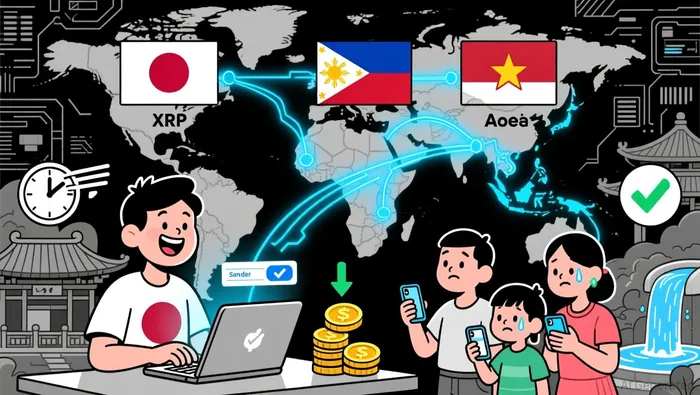
The country's financial structure further amplifies XRP's utility. Japan's historical role as a hub for offshore currency balances, coupled with its gradual exit from near-zero interest rates, has created a pressing need for tools to manage foreign-currency liquidity. Ripple's XRP Ledger is being explored as a solution to reduce the costs associated with pre-funding accounts in multiple currencies-a critical advantage in an era of rising interest rates and volatile capital flows.
Regulatory Innovation: A Framework for Sustainable Adoption
Japan's regulatory environment has been instrumental in enabling XRP's integration. The Financial Services Agency (FSA) is actively reclassifying crypto assets as financial products under the Financial Instruments and Exchange Act by 2026, placing them under the same regulatory umbrella as traditional securities. This move, which aligns with global trends toward tighter crypto oversight, aims to mitigate risks such as fraud and money laundering while fostering investor confidence.
Complementary reforms, including stricter anti-money laundering (AML) measures and a proposed reduction in crypto gains tax from 55% to 20%, further signal Japan's commitment to creating a sustainable framework for digital assets. These policies not only attract institutional investors but also position Japan as a leader in structuring a regulatory model that balances innovation with risk management.
Global Capital Flows: Efficiency Gains and Network Effects
The adoption of XRP in Japan is poised to have cascading effects on global capital flows. By 2025, partnerships between Ripple and major Japanese institutions-such as Mizuho Bank, SMBC Nikko, and Securitize Japan-are embedding the XRP Ledger into the country's financial infrastructure. This institutional-grade adoption is shifting XRP from speculative experimentation to a practical tool for liquidity management, cross-border payments, and even tokenized securities.
The efficiency gains are already measurable. For instance, a 1% adoption rate of XRP in Japan could potentially increase its market capitalization by $63.72 billion, pushing its price toward $3.50. Such a scenario underscores the transformative potential of XRP in a market where major banks are prioritizing blockchain-based solutions to streamline operations.
Comparative Regulatory Approaches: Japan vs. Global Peers
Japan's structured approach to XRP stands in stark contrast to regulatory uncertainty in other financial hubs. While the U.S. remains embroiled in legal battles over XRP's classification, Japan has taken a proactive stance by filing for a dual Bitcoin–XRP ETF-a first in the country. This regulatory clarity has fostered innovation, allowing institutions like SBI Holdings to experiment with XRP-based products without legal ambiguity.
In contrast, jurisdictions like the European Union and the U.S. are grappling with fragmented frameworks, creating a competitive disadvantage for their financial institutions. Japan's model-combining regulatory foresight with institutional adoption- could serve as a template for other countries seeking to integrate blockchain into their financial systems.
Conclusion: A Strategic Inflection Point
Japan's integration of XRP represents more than a technological upgrade; it is a strategic repositioning in the global financial ecosystem. By leveraging its deep remittance corridors, regulatory agility, and institutional expertise, Japan is demonstrating how blockchain can address long-standing inefficiencies in cross-border payments. For investors, this trend highlights the importance of monitoring regulatory developments and institutional adoption in markets like Japan, where innovation is being translated into real-world financial infrastructure.
As the FSA's reclassification of crypto assets nears completion and XRP adoption accelerates, Japan's experience will likely influence broader international approaches to blockchain-based finance. The implications for global capital flows-reduced transaction costs, faster settlement, and enhanced liquidity-are profound, and the ripple effects (pun intended) will extend far beyond its borders.





Comentarios
Aún no hay comentarios