
Japan's Wage Growth Strategy Under Koizumi: Equity Market Volatility and Consumer Sector Reforms
Japan's economic landscape in the early 2000s was defined by deflation, stagnant growth, and a public sector riddled with inefficiencies. Prime Minister Junichiro Koizumi's tenure (2001–2006) marked a bold attempt to reverse this trajectory through structural reforms, including postal privatization, deregulation, and labor market adjustments. While these policies aimed to stimulate private enterprise and restore public trust, their implications for equity markets and consumer-driven sectors remain a subject of debate. This analysis examines how Koizumi's wage growth strategy and broader reforms shaped Japan's economic trajectory, offering insights for investors navigating the interplay between policy and market dynamics.
Wage Growth and Structural Reforms: A Double-Edged Sword
Koizumi's reforms sought to address Japan's labor market rigidities by reducing barriers to hiring and firing, weakening union dominance, and promoting flexibility. According to a report by the OECD, these measures were intended to enhance the efficiency of labor allocation and stimulate economic growth [1]. However, the outcomes were mixed. While deregulation attracted foreign investment and spurred competition, it also led to a more precarious labor environment. As noted in a study published in ScienceDirect, the reforms contributed to suppressed wage growth, as workers faced increased pressure to accept lower wages in a flexible market [2]. The privatization of state services, such as the postal sector, further exacerbated uncertainty among public-sector employees, potentially constraining broader wage increases [3].
This wage stagnation had ripple effects on consumer-driven sectors. With households facing reduced job security and limited income growth, spending in retail and services remained subdued. A 2006 analysis by the Japan Institute of Labour highlighted that while reforms laid the groundwork for long-term structural changes, they failed to immediately resolve the underlying issues of economic stagnation and public debt [4]. For investors, this underscores the tension between short-term market volatility and long-term policy goals.
Equity Market Reactions: Mixed Signals and Structural Uncertainty
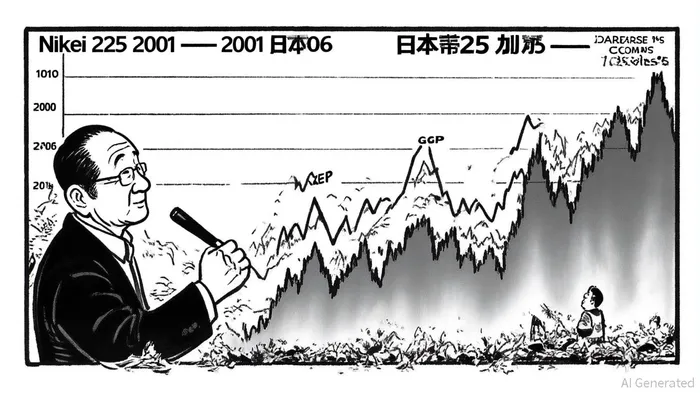
The Nikkei 225, Japan's benchmark equity index, reflected the ambiguity of Koizumi's reforms. While deregulation and privatization were expected to boost corporate efficiency and attract foreign capital, the immediate benefits were limited. A 2008 study in Springer noted that the reforms “laid a foundation for future structural changes” but did not deliver substantial gains in equity markets during Koizumi's tenure [5]. The privatization of Japan Post, for instance, created uncertainty among investors about the long-term viability of newly independent entities, leading to mixed market reactions [6].
Corporate earnings also showed uneven progress. Sectors that adapted to deregulation, such as telecommunications and finance, saw modest gains, while traditional industries like manufacturing and retail struggled with heightened competition. As stated by a 2019 OECD report, the reforms “prompted innovation in some sectors but left others vulnerable to market pressures” [7]. This divergence highlights the importance of sector-specific analysis for investors seeking to capitalize on structural shifts.
Consumer-Driven Sectors: Innovation and Disruption
Koizumi's deregulation agenda had a profound but uneven impact on consumer-driven sectors. In retail, increased competition led to the closure of less competitive small and medium-sized enterprises (SMEs), while larger firms leveraged economies of scale to innovate [8]. The automotive sector, however, faced headwinds due to Japan's broader economic stagnation and global market challenges, limiting the benefits of deregulation [9].
The services sector, particularly in logistics and finance, benefited from postal privatization, which improved service efficiency but also created short-term instability as workers adjusted to new employment models [10]. For investors, these dynamics illustrate the dual nature of structural reforms: while they can unlock long-term growth, they often entail short-term pain for both businesses and consumers.
Conclusion: Lessons for Investors
Koizumi's reforms underscore the complexity of balancing wage growth, market flexibility, and consumer confidence. While the privatization of public corporations and deregulation aimed to foster a more dynamic economy, their immediate effects on equity markets and consumer sectors were mixed. Investors today must consider these historical lessons when evaluating Japan's ongoing structural challenges. The key takeaway is that policy-driven reforms often require time to materialize into tangible market gains, and sector-specific resilience varies widely. For those with a long-term horizon, the post-Koizumi era offers a cautionary tale: structural change is rarely linear, but its cumulative impact can redefine economic landscapes.







Comentarios
Aún no hay comentarios