
U.S.-Japan Trade Normalization: Unlocking Opportunities in the Automotive Sector for Investors
The U.S.-Japan trade normalization agreement, finalized in July 2025, marks a pivotal shift in the global automotive landscape. By reducing tariffs on Japanese auto imports from 25% to 15%, the deal has created a ripple effect across supply chains, manufacturing ecosystems, and investor strategies. For those attuned to pre-market movers and long-term industrial beneficiaries, this agreement offers a roadmap to capitalize on a sector poised for transformation.
Tariff Reductions: A Tailwind for Japanese Automakers
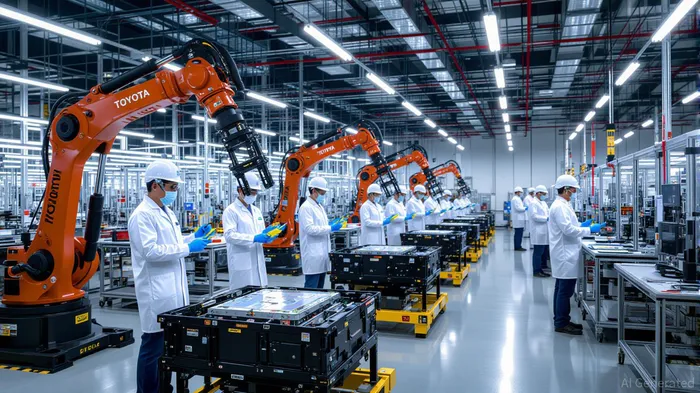
The immediate beneficiaries of the tariff cut are Japanese automakers like ToyotaTM-- (TM), HondaHMC-- (HMC), and Nissan (NSANY). With tariffs slashed by 10 percentage points, these firms have seen a direct boost to profit margins and U.S. market competitiveness. Toyota's stock, for instance, has surged 12% year-to-date, reflecting investor optimism about its Texas-based EV plant and broader U.S. expansion.
However, the implications extend beyond automakers. The reduced cost of importing Japanese vehicles has indirectly pressured U.S. manufacturers to innovate or risk losing market share. This dynamic creates a dual opportunity: short-term gains for Japanese firms and long-term investment potential in U.S. companies that adapt to the new trade reality.
Supply Chain Reconfiguration: The $550 Billion Investment Playbook
The agreement's $550 billion investment pledge from Japan into U.S. infrastructure and energy projects is a game-changer. This funding is accelerating the shift toward localized manufacturing, particularly in semiconductors and green energy—sectors critical to the EV revolution.
For example, Denso (7212.T) and Aisin Seiki (7242.T) are redirecting production to the U.S. and Mexico to comply with USMCA rules, reducing their exposure to tariffs. Denso's $200 million investment in a Tennessee EV inverter plant is a case in point. Such moves not only secure supply chains but also position these firms to dominate the $250 billion EV parts market by 2030.
Investors should also watch Japanese energy firms like JFE Steel (3402.T) and Taiyo Nippon Sanso (5335.T), which stand to benefit from U.S. green energy projects. The normalization of trade has reduced tariffs on Japanese equipment used in U.S. chip manufacturing, further boosting demand for companies like Tokyo Electron (8035.T) and SCREEN Holdings (6833.T).
Pre-Market Movers: Logistics and Semiconductor Suppliers
The surge in cross-Pacific trade has already driven demand for logistics providers. West Coast Shipping, a key player in U.S.-Japan parts shipments, reported a 20% increase in 2025 activity. For pre-market investors, this sector offers immediate gains as customs compliance and secure shipping solutions become critical.
Semiconductor suppliers, meanwhile, are seeing renewed momentum. The reduced tariffs on Japanese equipment are enabling U.S. chipmakers to scale production, creating a tailwind for firms like ASMLASML-- (ASML) and TSMCTSM-- (TSM), which supply tools and wafers to Japanese partners.
Strategic Positioning for Investors
- Short-Term Focus: Prioritize Japanese automakers and logistics providers. Toyota, Honda, and West Coast Shipping are prime candidates for pre-market gains due to their direct exposure to tariff reductions and increased trade volume.
- Long-Term Focus: Target supply chain innovators. Denso, Aisin Seiki, and Japanese energy firms are well-positioned to capitalize on the EV and green energy transition.
- Diversification: Hedge against U.S. manufacturer risks by investing in companies that support EV infrastructure, such as charging networks and battery recycling firms.
The U.S.-Japan trade normalization is more than a policy shift—it's a strategic reset that favors firms aligned with the EV and green energy transition. For investors, the key lies in identifying both the immediate winners and the long-term industrial beneficiaries. By leveraging the data and trends outlined here, a well-structured portfolio can navigate the evolving automotive sector with confidence.





Comentarios
Aún no hay comentarios