
Japan's Topix Rally and Bond Slump: How Geopolitical Trade Agreements Are Reshaping Asian Markets
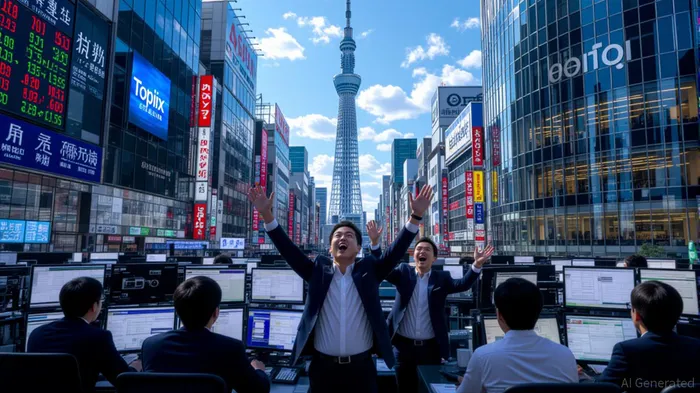
The U.S.-Japan trade agreement finalized in July 2025 has sent shockwaves through Asian financial markets, triggering a sharp rally in Japan's Topix index and a sell-off in government bonds. This seismic shift underscores how geopolitical trade agreements are becoming pivotal forces in reshaping equity and debt markets across the region. For investors, the deal offers both opportunities and risks, particularly in a landscape where trade policy volatility and political uncertainty remain persistent.
The Trump-Ishiba Agreement: A Trade Reset with Market Implications
The Trump-Ishiba trade deal, which caps U.S. tariffs on Japanese exports at 15%—far below the initially threatened 25%—has been a lifeline for Japan's export-dependent economy. The immediate impact was evident: the Topix index surged 3.55% on the day of the announcement, with ToyotaTM-- shares jumping 16% and the Topix Autos Index rallying 11%. This relief-driven rally reflects a broader shift in investor sentiment, as markets priced in reduced trade tensions and a more predictable economic environment.
The agreement's structure, however, is complex. Japan's $550 billion investment pledge into U.S. infrastructure and technology sectors, coupled with expanded U.S. market access for autos and rice, has created a two-way flow of capital and goods. While this deal stabilizes short-term trade relations, it also introduces new risks, such as the U.S. reserving the right to impose sector-specific tariffs if Japan fails to meet its investment commitments.
Equity Markets: A Strategic Entry Point for Asian Investors?
The Topix rally has sparked debates about whether this is a sustainable buying opportunity. Historically, Japanese equities have traded at a discount to global benchmarks, with the Topix's forward P/E at 14.64—below its 10-year average of 14.0xZRX--. The trade deal's emphasis on industrial and tech sectors has further bolstered this case.
- Automotive and Industrial Sectors: Toyota, HondaHMC--, and Daikin Industries have emerged as key beneficiaries. Daikin's expansion into U.S. HVAC markets and Toyota's renewed U.S. exports position these firms to capitalize on the 15% tariff framework.
- Technology and Energy: TDK and Inpex are poised to gain from U.S. infrastructure investments and energy sector realignments. TDK's multilayer ceramic capacitors are critical for AI-driven data centers, while Inpex's discounted valuation (P/E of 9.8x) offers long-term upside.
Investors are advised to adopt a diversified approach, allocating 40% to industrials and technology, 30% to consumer cyclicals, and 30% to energy and financials. Dollar-cost averaging into underperforming but fundamentally strong stocks like TDK and LY Corporation (parent of Line) could mitigate short-term volatility.
Bond Markets: A Shorting Opportunity Amid Political Uncertainty
While equities rallied, Japanese government bonds (JGBs) faced a sell-off, with 5-year yields rising 9 basis points to 1.11%. This move reflects improved economic expectations but also highlights underlying vulnerabilities. Prime Minister Shigeru Ishiba's recent political challenges—stemming from an upper house election loss—have left Japan's trade negotiations in a precarious position. Analysts warn that a weakened Ishiba government could struggle to enforce the deal's terms, potentially triggering a return of higher tariffs.
Short-term bond investors may find opportunities in this environment. Quantum Strategy and Oxford Economics have flagged Japan's political instability as a risk, suggesting that U.S. tariffs could revert to 25% if the investment pledge falters. A sell-off in JGBs could push yields toward 1.5% by year-end, making shorting strategies attractive for those willing to hedge against geopolitical risks.
Regional Trade Dynamics: A New Era of Cooperation?
The U.S.-Japan deal has catalyzed broader regional optimism. Asian markets like Hong Kong, Singapore, and South Korea saw inflows as investors recalibrated portfolios to account for reduced U.S.-Japan friction. The MSCIMSCI-- Asia-Pacific index rose 3.5% post-announcement, driven by expectations of supply chain realignments and cross-border capital flows.
However, the deal's success hinges on its extension to other Asian partners. Trump's simultaneous negotiations with Indonesia and the Philippines suggest a pattern of securing investment pledges in exchange for tariff relief. For now, Japan's agreement serves as a blueprint, but its long-term sustainability remains tied to political stability in Tokyo and U.S. trade policy consistency.
Conclusion: Navigating the New Trade Landscape
The Trump-Ishiba deal marks a turning point in U.S.-Japan economic relations, offering both strategic entry points and cautionary signals for investors. Asian equities, particularly in Japan's industrial and technology sectors, present compelling opportunities, while bond markets reflect the fragility of political and trade dynamics.
For investors, the key lies in balancing optimism with prudence. Overweighting sectors poised to benefit from the deal—autos, energy, and tech—while hedging against political risks through bond shorting or options strategies could yield robust returns. As geopolitical trade agreements continue to reshape markets, agility and diversification will remain critical.





Comentarios
Aún no hay comentarios