
Japan's Stagflation Crossroads: Navigating Risks and Opportunities in a Wage-Inflation Divide
Japan's economy is at a precarious crossroads. Persistent inflation, stagnant real wages, and a weakening yen have created a classic stagflationary cocktail—one that threatens domestic consumption but offers opportunities in export-driven industries. For investors, the challenge lies in distinguishing between sectors that can weather the storm and those likely to falter.
The Stagflationary Dilemma: Wages Lag, Inflation Rises
Japan's headline inflation rate has hovered above 3% since early 2025, with core inflation (excluding fresh food) hitting 3.7% in May—the highest in over two years. The primary driver? A rice price surge of over 100% year-on-year, exacerbated by poor harvests and tourism demand. Meanwhile, real wages have declined for four consecutive months through April 2025, with April's 1.8% year-on-year drop marking the fourth straight monthly contraction.
The disconnect between nominal wage growth and real purchasing power is stark. While companies agreed to average pay hikes exceeding 5% during spring labor negotiations, these gains are being eroded by inflation. The result? A 1.2% real wage decline in February and a 2.1% drop in March, even as nominal wages grew 3.1% and 2.1%, respectively.
This divergence spells trouble for domestic consumer staples. Households, already burdened by rising food and energy costs, are cutting back on discretionary spending. 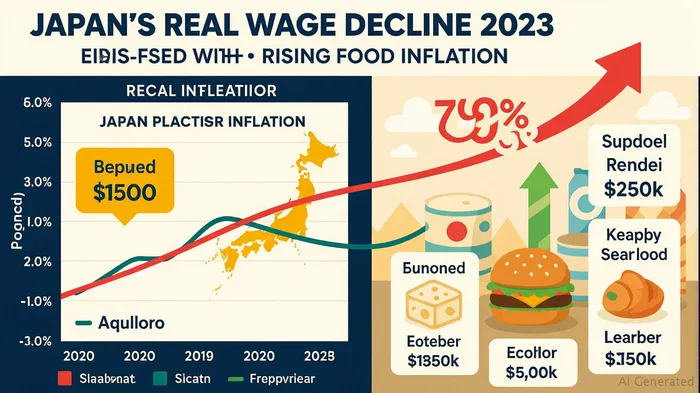 .
.
Opportunities in Export-Driven Sectors: Riding the Yen's Slide
While domestic demand falters, Japan's export-oriented industries—automotive, electronics, and machinery—are thriving. The yen's 38-year low against the U.S. dollar (approaching 160) has made Japanese goods cheaper abroad. . ToyotaTM--, for instance, reported a 12% rise in overseas sales in Q1 2025, buoyed by strong demand in the U.S. and Europe.
The weak yen also boosts repatriated profits for exporters. SonySONY--, which generates 60% of its revenue overseas, saw its fiscal 2025 net profit jump 18% due to currency tailwinds. For investors, these sectors offer a hedge against domestic stagnation and inflation.
Sectors with Pricing Power: A Safe Harbor
Not all domestic industries are vulnerable. Companies with pricing power—luxury goods, healthcare, and niche industrial suppliers—can pass inflation costs to customers.
- Automotive: Toyota and HondaHMC-- are raising prices on premium models (e.g., hybrids) while maintaining volume through cost-efficient sub-brands.
- Healthcare: Drugmakers like Takeda PharmaceuticalTAK-- benefit from inelastic demand and steady pricing.
- Tech: Sony's PlayStation and semiconductor divisions command premium pricing, shielding them from consumer spending cuts.
The Cautionary Tale: Domestic Consumer Staples
Investors should tread carefully in sectors reliant on domestic consumption. Food retailers, convenience stores, and household goods firms face a double whammy: rising input costs and shrinking consumer budgets.
- Uniqlo's parent Fast Retailing saw same-store sales dip 2% in Q1 2025 as cost-conscious shoppers traded down to generics.
- Matsushita Electric (Panasonic) reported margin compression in its appliances division due to steel and copper price spikes.
.
Investment Strategy: Long Exports, Short Domestic Staples
Long Positions:
1. Export Powerhouses: Toyota, Honda, Sony, and Mitsubishi Heavy Industries (MHI) benefit from yen weakness and global demand resilience.
2. Pricing-Power Plays: Takeda Pharmaceutical, Olympus Corp (medical devices), and Nintendo (premium gaming hardware).
Short Positions:
1. Domestic Consumer Staples: Fast Retailing, Seven & I Holdings (7-Eleven), and Ajinomoto (food products).
2. Wage-Sensitive Equity: Banks and real estate firms, which face slower loan growth and stagnant income.
Risks on the Horizon
- Trade Tensions: U.S. tariffs on Japanese exports could reverse the yen's advantage.
- Global Growth Slump: A slowdown in Europe or China would hit exporters.
- BOJ Policy Shift: If inflation becomes entrenched, the Bank of Japan might raise rates, hurting debt-heavy sectors.
Conclusion
Japan's stagflationary pressures are a double-edged sword. While domestic consumption struggles, export-driven industries and firms with pricing power are carving out gains. Investors who align their portfolios with this divide—betting on global demand and avoiding wage-sensitive sectors—can navigate Japan's economic crossroads with confidence.
The key takeaway: In a world of weak yen and strong global demand, Japan's economic future lies overseas—and so should your investment bets.





Comentarios
Aún no hay comentarios