
Japan's Nikkei 225 Futures: A Barometer of Global Equity Sentiment in 2025
The Nikkei 225 Futures have emerged as a critical barometer for global equity market sentiment in 2025, with early trading momentum reflecting a confluence of macroeconomic, geopolitical, and technical factors. As Japan's premier equity index, the Nikkei 225 has not only outperformed major global benchmarks but also demonstrated predictive power for broader market trends, driven by its unique exposure to international trade dynamics and monetary policy shifts.
Drivers of 2025 Momentum: A Convergence of Forces
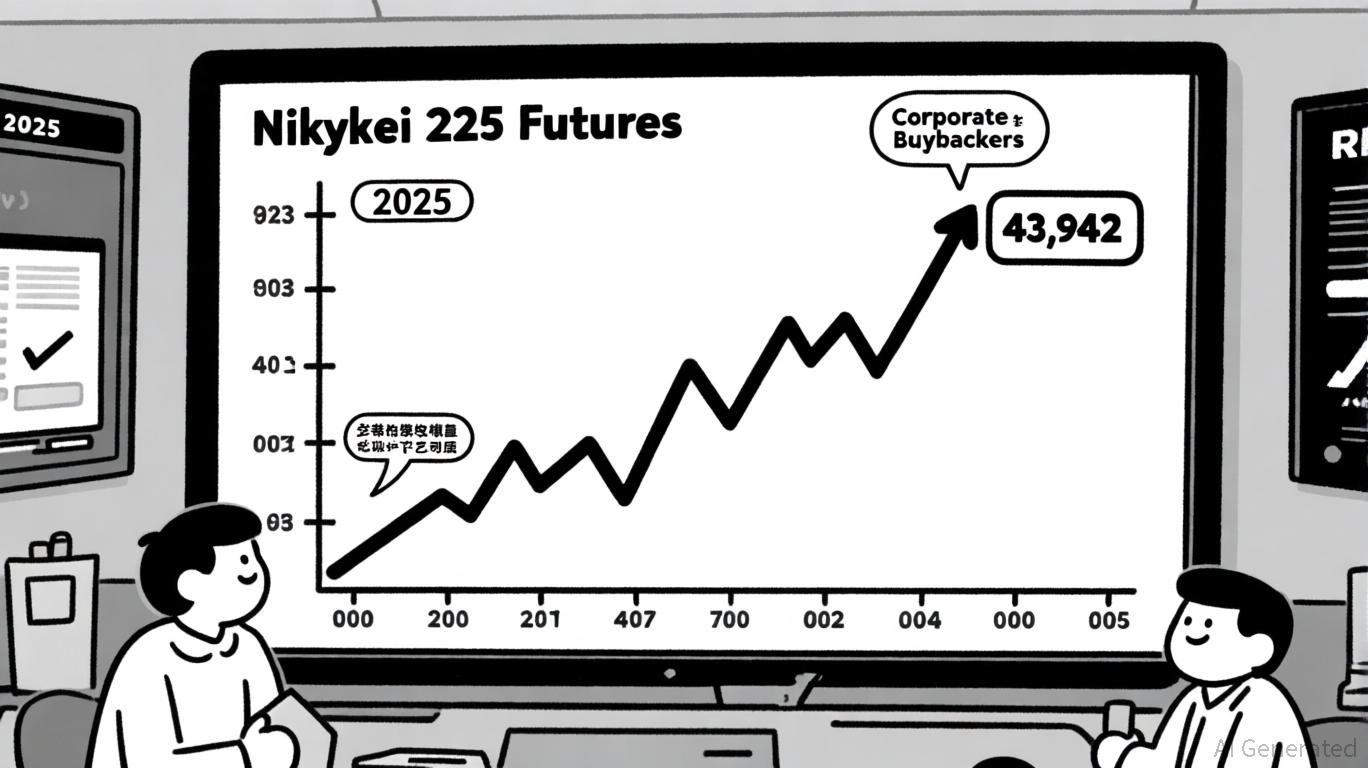
The Nikkei 225 Futures surged 13.44% year-to-date as of October 2025, outpacing indices like the S&P 500, HayInsights analysis. This performance stems from a combination of factors:
1. Global Trade Optimism: Improved manufacturer sentiment and tariff negotiations between Japan and the U.S. have bolstered export-driven sectors, the HayInsights analysis noted.
2. Yen Weakness: A weaker yen has enhanced Japanese exporters' competitiveness while attracting foreign capital inflows, as shown in MarketPulse technicals.
3. Corporate Buybacks: Major firms have accelerated share repurchase programs, directly inflating equity valuations, MarketPulse reported.
4. Monetary Policy: The Bank of Japan's accommodative stance, including prolonged ultra-low interest rates, has underpinned investor confidence, according to Investing.com futures data.
Technical indicators further reinforce this bullish narrative. For instance, the index's retest of the 41,760 support level in September 2025 triggered a 3.6% rally, with prices surging to 43,850—a near-all-time high, as MarketPulse observed. The Relative Strength Index (RSI) has remained in overbought territory without bearish divergence, suggesting sustained upward momentum, a pattern MarketPulse also documented.
Technical and Machine Learning Insights: Predictive Power Validated
Quantitative analysis underscores the Nikkei 225 Futures' role as a leading indicator. A 2022 study by Byung-Kook Kang demonstrated that optimized Moving Average Convergence Divergence (MACD) parameters in the Nikkei 225 Futures market could enhance predictive accuracy for equity trends, Kang's 2022 study. This aligns with a ScienceDirect study showing that machine learning models, such as logistic regression and long short-term memory (LSTM) networks, achieve high accuracy in forecasting Nikkei movements.
For example, logistic regression models have outperformed traditional technical tools like ANNs and SVMs in predicting directional movements of the Nikkei 225, the ScienceDirect study concluded. Meanwhile, the index's correlation with global indices—strong with the S&P 500 but weaker with emerging market benchmarks like the Hang Seng—highlights its dual role as both a regional and global sentiment proxy, a point HayInsights emphasized.
Global Sentiment Linkages: Beyond Japan's Borders
The Nikkei 225's interconnectedness with global markets is evident in its response to geopolitical and monetary shifts. In late 2025, anticipation of U.S.-China trade negotiations and Federal Reserve policy pivots drove synchronized rallies across equities, an outcome MarketPulse attributed to cross-border risk-on flows. Additionally, the index's performance has mirrored movements in the USD/JPY exchange rate, with a weaker yen acting as a tailwind for both exporters and equity valuations, an effect the ScienceDirect study observed.
However, domestic political volatility—such as Prime Minister Ishiba's resignation—has introduced short-term corrections. For instance, the index dipped following profit-taking in August 2025, illustrating how local factors can temporarily disrupt broader trends, as HayInsights noted.
Future Outlook: Sustaining the Bullish Momentum
Analysts project the Nikkei 225's upward trajectory to persist through 2025 and beyond, contingent on maintaining key technical levels. A sustained close above 36,000 JPY is seen as critical for retesting the 40,000 JPY resistance level, according to Kagels' forecast. Long-term forecasts suggest a potential secular bull market, driven by Japan's AI-driven innovation and structural reforms like the NISA tax incentive program, a scenario HayInsights has highlighted.
Investors should monitor three key variables:
1. Monetary Policy Divergence: The Bank of Japan's exit from negative rates could amplify the yen's weakness and equity inflows.
2. Geopolitical Risks: Escalating U.S.-China tensions or trade disputes could disrupt export sectors.
3. Corporate Earnings: Sustained buybacks and AI-related revenue growth will be pivotal for maintaining momentum, a theme MarketPulse emphasized.
Conclusion: A Strategic Asset for Global Portfolios
The Nikkei 225 Futures' early trading momentum in 2025 has proven to be more than a regional phenomenon—it is a predictive lens through which global equity sentiment can be assessed. By synthesizing technical indicators, macroeconomic trends, and machine learning insights, investors can harness this momentum to navigate broader market cycles. As Japan's economy continues to recalibrate under the twin forces of innovation and globalization, the Nikkei 225 remains a must-watch for those seeking to align with the next phase of global equity growth.







Comentarios
Aún no hay comentarios