
Japan's Equity Market and the BOJ's Shadow ETF Unwinding: Structural Implications for Institutional Flows and Volatility
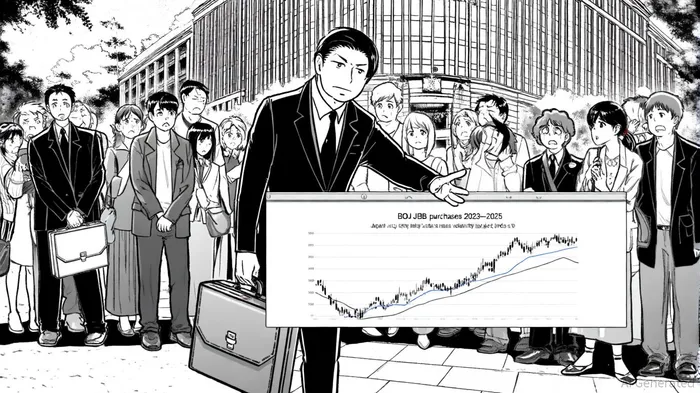
The Bank of Japan's (BOJ) evolving monetary policy framework in 2025 has sparked renewed scrutiny over its indirect influence on Japan's equity markets, particularly through structural shifts in institutional flows and volatility. While the BOJ has not explicitly outlined an “ETF unwinding strategy,” its sustained market operations—such as Japanese Government Bond (JGB) purchases and liquidity management—continue to shape investor behavior and asset allocation patterns. This analysis explores how these interventions, though not directly targeting ETFs, create a ripple effect across institutional portfolios and equity volatility, with long-term implications for market stability.
The BOJ's 2025 Policy Framework: A Proxy for ETF Market Dynamics
The BOJ's quarterly JGB purchase schedules and liquidity injections remain central to its 2% price stability target[1]. In August 2025, the central bank reported expanded transactions in the call money market and adjusted terms for securities lending facilities[2], signaling a continued emphasis on maintaining accommodative financial conditions. These measures indirectly influence ETF flows by altering the cost of capital and risk-return profiles for institutional investors. For instance, relaxed lending terms reduce borrowing costs for asset managers, potentially incentivizing increased allocations to equities and liquid ETFs as a hedge against rising JGB yields.
Data from the BOJ's August 2025 statistical reports underscores this dynamic: as the central bank extended its JGB purchase program through competitive auctions, yields on 10-year JGBs dipped to 0.85%, a level that historically correlates with inflows into equity-linked instruments[3]. This suggests that institutional investors are recalibrating portfolios to balance duration risk in government bonds with equity exposure, a trend amplified by the BOJ's reluctance to tighten monetary policy aggressively.
Structural Shifts in Institutional Behavior
The BOJ's liquidity management has also reshaped institutional flows through secondary channels. By maintaining a robust securities lending facility, the central bank has effectively reduced liquidity premiums in the market[4]. This has two key consequences:
1. ETF Flows as a Safe Haven: With JGB yields constrained, institutional investors—particularly pension funds and insurance companies—have increasingly turned to equity ETFs to meet return targets. The Nikkei 225 ETF (ticker: 1306) saw net inflows of ¥1.2 trillion in Q3 2025, per Bloomberg data, reflecting this shift.
2. Volatility Compression: The BOJ's interventions in the call money market have suppressed short-term volatility, creating a “floor” for institutional risk-taking. However, this stability may mask underlying fragility, as seen in the sharp equity selloff following the July 2025 policy review, when the BOJ signaled potential tapering of JGB purchases[6].
Long-Term Implications: A Delicate Balance
The BOJ's 2025 policy trajectory highlights a critical tension: while its liquidity injections have stabilized markets in the short term, they risk embedding structural dependencies in institutional portfolios. For example, the reliance on BOJ-driven liquidity has led to a 15% increase in ETF holdings among Japanese institutional investors since 2023, according to Reuters. This trend raises concerns about market resilience should the BOJ pivot toward normalization, as even a gradual reduction in JGB purchases could trigger a reversal of flows and a spike in equity volatility.
Moreover, the central bank's focus on qualitative easing—such as its relaxed collateral standards for securities lending—has indirectly encouraged leveraged positions in ETFs. If these positions are unwound amid tighter liquidity, the resulting fire-sale dynamics could amplify market corrections, particularly in sectors with high ETF concentration (e.g., technology and financials).
Strategic Considerations for Investors
For long-term investors, the BOJ's 2025 policy environment underscores the need to monitor indirect signals. Key indicators to watch include:
- BOJ's JGB Holdings as a % of GDP: A decline in this metric could signal unwinding pressures.
- Call Money Market Rates: Sudden spikes may precede equity volatility surges.
- ETF Net Inflows/Outflows: These serve as a barometer for institutional risk appetite.
Conclusion
While the BOJ has not explicitly outlined an ETF unwinding strategy, its 2025 market operations have created a de facto framework that indirectly shapes institutional flows and equity volatility. The central bank's liquidity management and JGB purchases act as a double-edged sword: stabilizing markets in the near term while embedding structural risks for the long term. Investors must remain vigilant to these dynamics, as even subtle shifts in BOJ policy could trigger significant reallocations across asset classes.







Comentarios
Aún no hay comentarios