
Japan's Dual-Pronged Strategy: Navigating USD/JPY Volatility and Green Infrastructure Growth in 2025–2026
Japan's economic playbook in 2025 is a masterclass in balancing short-term forex agility with long-term strategic vision. As the yen grapples with range-bound volatility against the U.S. dollar and the Bank of Japan (BOJ) tightens its grip on monetary policy, investors are presented with a unique duality: tactical forex opportunities and a burgeoning green infrastructure boom in the Asia-Pacific. This article unpacks how Japan's dual-pronged approach—leveraging foreign exchange interventions to stabilize the yen while channeling capital into sustainable infrastructure—offers a compelling investment thesis for 2025–2026.
The USD/JPY Tightrope: Range-Bound Volatility and Tactical Entry Points
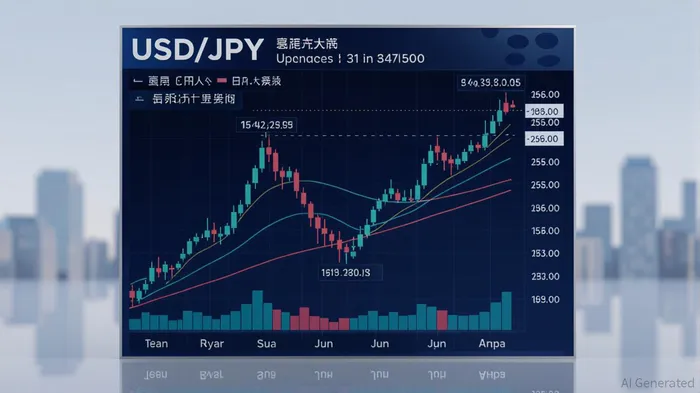
The USD/JPY pair has oscillated within a narrow corridor in 2025, reflecting the BOJ's calculated interventions to prevent excessive yen depreciation. Despite a 1.03% weakening of the yen over the past month and a 0.74% decline over the last 12 months, the BOJ's gradual rate hikes (projected to reach 0.75% by Q2 2025) and fiscal stimulus measures have created a “soft floor” for the yen.
The BOJ's JGB purchase tapering—reducing monthly bond buying from ¥4.9 trillion to ¥4.5 trillion in January 2025—has signaled a shift toward normalization, yet policymakers remain cautious. Recent meeting minutes emphasize flexibility, with officials open to further tightening if trade tensions ease. This duality creates a range-bound environment for USD/JPY, currently projected to trade between 141.00 and 156.00 in Q2 2025, with a likely closing level near 150.00.
For forex traders, this volatility is a goldmine. The yen's sensitivity to global dollar strength—driven by U.S. rate expectations and Trump-era trade policies—offers opportunities to capitalize on mean reversion. A strategic approach would involve short-term range trading, with key support levels at 147.00 (current levels) and resistance near 154.00.
The Green Infrastructure Gambit: Asia-Pacific's Long-Term Growth Engine
While the forex market dances on a tightrope, Japan's green infrastructure investments are laying the groundwork for a transformative decade. The Asian Infrastructure Investment Bank (AIIB) and Keppel Ltd.'s $1.5 billion partnership to fund renewable energy, digital infrastructure, and transport projects across the Asia-Pacific is a case in point. This initiative, aligned with Japan's Green Transformation (GX) strategy, aims to mobilize $1 trillion in clean energy investments by 2050.
Japan's GX initiative is not just aspirational—it's actionable. The government's JPY 20 trillion in public funding is designed to leverage private capital, with a focus on solar energy (e.g., Obton Japan's 1,000MW target by 2030), hydrogen, and carbon capture technologies. The recent issuance of the world's first sovereign transition bond—now valued at $37.6 billion—further underscores Japan's commitment to decarbonization.
For investors, this represents a long-term allocation opportunity. The Asia-Pacific green infrastructure sector is projected to grow at a 7–9% CAGR through 2030, driven by Japan's fiscal stimulus, U.S.-Japan clean energy partnerships, and the region's energy transition needs. Thematic allocations in renewable energy funds, green bonds, and infrastructure ETFs could yield compounding returns over the next decade.
The Dual-Pronged Play: Balancing Short-Term Gains and Long-Term Resilience
The key to unlocking Japan's investment potential lies in harmonizing these two strategies. Here's how:
- Forex Tactical Plays:
- Range Trading: Use the BOJ's policy rate hikes and fiscal stimulus as a floor for the yen. Short-term traders can target 147.00–154.00 ranges, with stop-loss orders to mitigate sudden volatility from U.S. trade policies.
Hedging Green Investments: Investors in Asia-Pacific green infrastructure can hedge currency risk by locking in yen-dollar rates using forward contracts or options, ensuring exposure to long-term growth without being overly exposed to yen depreciation.
Green Infrastructure Allocations:
- Thematic ETFs: Consider funds like the iShares Global Clean Energy ETF (ICLN) or regional green infrastructure ETFs focused on Japan and Southeast Asia.
- Private Partnerships: Allocate capital to AIIB-backed projects or Japanese renewables firms like Obton Japan, which are scaling solar capacity to meet the 50% renewable target by 2040.
Risks and Mitigation
- Forex Volatility: A sudden U.S. rate hike or Trump-era tariffs could push USD/JPY above 156.00. Traders should monitor BOJ policy statements and trade data.
- Green Infrastructure Delays: Regulatory hurdles or technological bottlenecks in hydrogen or CCUS projects could slow returns. Diversify across sectors (solar, wind, hydrogen) to mitigate this.
Conclusion: A Strategic Duality for 2025–2026
Japan's dual strategy—stabilizing the yen through calculated forex interventions while turbocharging green infrastructure—offers a rare combination of tactical agility and long-term vision. For investors, this duality translates into a playbook that balances the immediacy of forex markets with the enduring promise of Asia-Pacific decarbonization. As the yen dances and the green revolution gains momentum, the time to act is now.







Comentarios
Aún no hay comentarios