
Japan's Banking Sector and the AI Transformation: A Strategic Opportunity for Investors
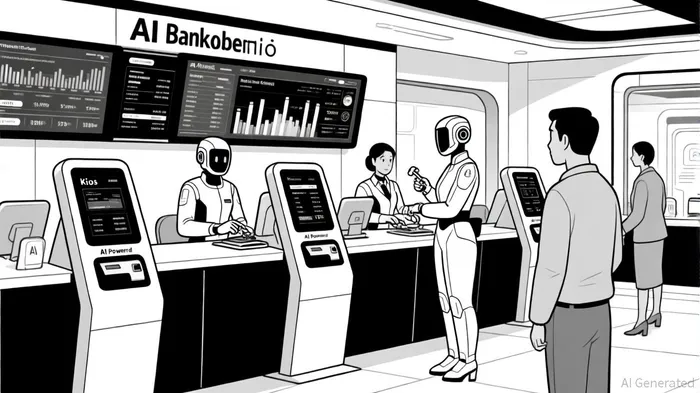
Japan's banking sector is undergoing a seismic shift driven by artificial intelligence (AI), presenting a compelling investment opportunity for forward-thinking investors. As the nation's top financial institutions-Sumitomo Mitsui Financial Group (SMBC), Mitsubishi UFJ FinancialMUFG-- Group (MUFG), and MizuhoMFG-- Financial Group-leverage AI to reshape operations, reduce costs, and unlock new revenue streams, the strategic implications for capital allocation are profound. This analysis explores how AI-driven efficiency and workforce adaptation are redefining Japan's banking landscape, offering actionable insights for investors.
AI as a Strategic Multiplier: Efficiency Gains and Cost Reduction
Japan's banks are deploying AI to automate repetitive tasks, optimize workflows, and enhance decision-making. For instance, SMBC Group has integrated AI tools like SMBC-GAI across its organization, reducing operational costs and improving productivity, according to a Bloomberg report. Similarly, MUFG's partnership with OpenAI and its development of proprietary large language models (LLMs) are streamlining customer service and network management, as described in MUFG's insight. Mizuho's acquisition of Upsider, a FinTech firm specializing in AI-based credit modeling, underscores its ambition to capture high-growth markets, as noted in a Kapronasia analysis.
Quantifiable benefits are emerging. SMBC's FY2025 financial results highlight an 8% return on equity (ROE), driven by a 58.2% overhead ratio-a testament to cost discipline amid macroeconomic headwinds, according to SMBC's FY3/25 results. Meanwhile, MUFG's AI initiatives are projected to yield a 34.7% year-over-year profit increase for the nine months ending December 2024, per MUFG's consolidated report. Mizuho's cloud-based solutions, such as the Mizuho Cloud, reportedly generate cost savings of up to 70% in certain operations, according to Mizuho's Integrated Report. These metrics, while not fully disclosing AI-specific ROI, align with broader digital transformation investments that prioritize efficiency.
Workforce Adaptation: Complementing Humans, Not Replacing Them
Contrary to fears of job displacement, Japan's banks are framing AI as a collaborative tool. CEOs like Mizuho's Masahiro Kihara and MUFG's Hironori Kamezawa emphasize AI's role in augmenting human capabilities-handling routine tasks while employees focus on strategic, empathetic, and ethical work, as reported by a Bloomberg piece. For example, SMBC's "AI-CEO" and "AI Supervisor" initiatives aim to enhance decision-making and customer service without replacing human roles, per SMBC's AI-CEO announcement.
This human-AI partnership is critical in a sector grappling with an aging population and labor shortages. By 2025, 70% of banking transactions in Japan are projected to be digital, according to QuantA Intelligence, yet banks remain committed to maintaining a human touch in high-value interactions. This balance not only mitigates workforce disruption but also positions banks to retain customer trust-a key differentiator in a competitive market.
Risk Management and Long-Term Resilience
AI's impact extends beyond cost savings. Advanced analytics and generative AI (GenAI) tools are revolutionizing fraud detection, risk assessment, and regulatory compliance. A BOJ survey notes that 30% of financial institutions already use GenAI, with 60% in trials. For instance, SMBC's AI-driven fraud detection systems have improved accuracy in identifying suspicious activities, addressing Japan's ¥3.22 trillion in 2024 fraud losses, as discussed in a Nucamp article.
However, challenges persist. Risks such as AI hallucination, data leakage, and third-party dependencies require robust governance. Japan's banks are proactively developing policies to address these issues, ensuring AI adoption aligns with long-term resilience.
Investment Implications: Capitalizing on the AI Wave
For investors, the strategic imperative is clear: Japan's banks are not merely adopting AI-they are redefining their business models. Key opportunities include:
1. Infrastructure Plays: Banks investing in cloud partnerships (e.g., MUFGMUFG-- with Google) and proprietary AI platforms (e.g., SMBC-GAI) are positioned to scale efficiently.
2. FinTech Synergies: Mizuho's acquisition of Upsider highlights the value of integrating AI-driven FinTech solutions to expand market reach.
3. Shareholder Returns: SMBC's FY2025 results, including a 10% profit growth target and a JPY 100 billion share buyback program, demonstrate capital allocation discipline (see SMBC's FY3/25 results above).
While exact ROI figures for AI initiatives remain opaque in many reports, the macroeconomic impact is measurable. Japan's AI adoption has already boosted labor productivity by 0.58% as of 2024, with potential for a 2% increase if adoption rates rise, according to a Visive analysis. For banks leading this charge, the upside is substantial.
Historical context from a simple buy-and-hold strategy around earnings releases reveals divergent outcomes. A backtest from 2022 to 2025 shows that MUFG delivered the strongest performance (≈34% total return, Sharpe ≈0.58), while Mizuho achieved similar returns (≈33%) but with higher drawdowns. SMBC, however, showed minimal gains (≈0.7%), underscoring the importance of liquidity and market dynamics in capitalizing on earnings events (see SMBC's FY3/25 results above). These insights reinforce the need for investors to align with banks that demonstrate both technological leadership and robust execution.
Conclusion: A Win-Win for Banks and Investors
Japan's banking sector is at the forefront of a global AI revolution, combining technological innovation with strategic workforce adaptation. As SMBC, MUFG, and Mizuho demonstrate, AI is not a disruptive force but a catalyst for sustainable growth. For investors, the message is clear: those who align with banks embracing AI will reap the rewards of enhanced efficiency, resilience, and long-term value creation.





Comentarios
Aún no hay comentarios