
Japan's Automotive Sector Under Fire: Labor Costs and Tariffs Threaten Profitability and Investor Returns
The Wage Hike Tsunami: A Double-Edged Sword
According to a report by Reuters, Japan's largest companies have agreed to average wage hikes of 6.09% in 2025, following 5.1% in 2024 and 3.58% in 2023. While these increases aim to boost consumer spending and offset inflation, they've placed immense pressure on automakers' operating income. ToyotaTM--, for instance, has already committed to a 23,500 yen monthly raise per employee and a bonus equivalent to 6.3 months of wages according to Reuters. Such moves, while socially responsible, come at a cost: Japan's seven largest automakers are projected to lose ¥2.7 trillion ($18.4 billion) in operating profit in 2025, with Toyota alone facing a ¥1.4 trillion ($9.5 billion) hit.
The dilemma for management is stark. Absorb these costs by lowering export prices, and profitability erodes. Pass them on to consumers, and sales risk stagnating in a saturated U.S. market. As one industry analyst puts it, "Japanese automakers are stuck between a rock and a hard place."
Tariffs as a Catalyst for Crisis
The U.S. tariffs on Japanese auto exports have compounded the wage-driven pain. Data from FutureTransport-News reveals that in the first half of fiscal 2025, Japan's top automakers collectively lost ¥1.5 trillion ($9.7 billion) due to these tariffs. Toyota's North American operating profit plummeted by 18.6%, marking its first loss in that region since 2008 according to China Daily Asia. HondaHMC-- and Subaru saw net profits decline by 37% and 45%, respectively according to China Daily Asia.
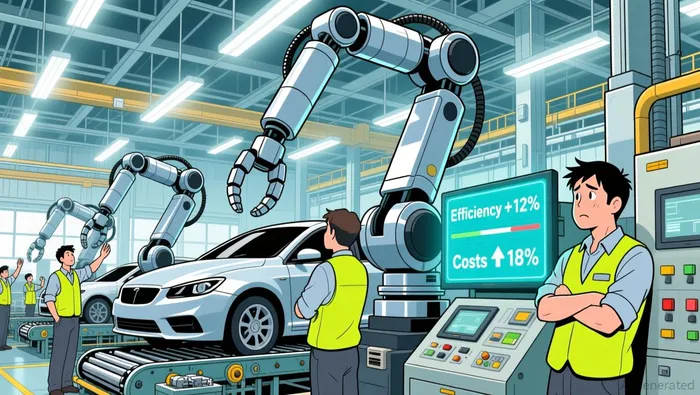
While automation has helped mitigate some costs-Japan installed over 14,000 industrial robots in 2024 alone-it remains a partial solution. Investors are watching closely to see if these investments can offset the dual pressures of tariffs and wages.
Investor Returns: A Mixed Bag
The impact on investor returns is nuanced. On one hand, the auto and transport machinery sector's sentiment index hit a three-year high in August 2025, driven by strong order inflows. On the other, dividend yields and stock performance have been volatile. For example, Toyota's shares underperformed peers like Tesla and BYD in 2025, despite its dominant market share.
Reuters' Tankan poll highlights the tension: manufacturers acknowledge robust orders but express caution over inflation's drag on consumer spending. This duality has left dividend policies in flux. While Toyota and Honda have maintained payouts, smaller automakers like Mazda and Mitsubishi have cut dividends to preserve cash according to China Daily Asia.
The Path Forward: Innovation or Retreat?
For Japanese automakers, the road ahead hinges on two strategies: accelerating automation and diversifying into high-margin segments like EVs. However, the EV segment remains a weak spot, with low adoption rates in Japan. This creates a paradox: the need to invest in the future while defending current profitability.
Investors should also monitor how the sector navigates U.S. tariff negotiations. A recent trade deal briefly boosted sentiment, but long-term stability depends on resolving these tensions.
Final Take
Japan's automotive sector is at a crossroads. While its legacy of efficiency and quality remains intact, the confluence of wage hikes and tariffs is testing its resilience. For investors, the key is to balance optimism about automation and trade deals with caution about near-term profit erosion. Those willing to bet on long-term innovation may find opportunities, but short-term volatility is inevitable.





Comentarios
Aún no hay comentarios