
James Halstead's Rising Dividends: A Sustainable Income Play for 2025?
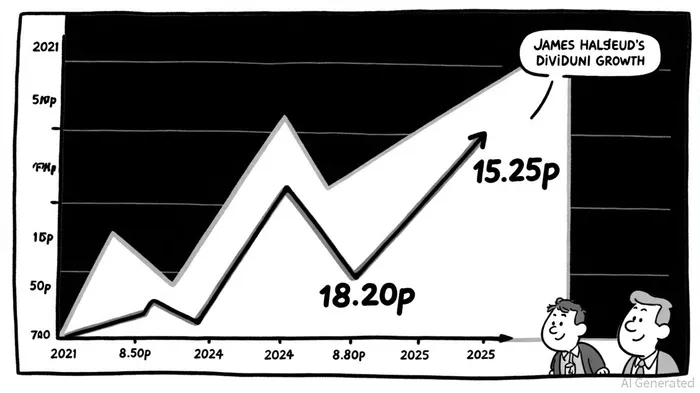
James Halstead (LON:JHD) has once again demonstrated its commitment to income-focused investors by raising its final dividend to £0.0605 per share for 2025, marking the 49th consecutive year of dividend increases, according to Simply Wall St. This 0.8% year-on-year hike, coupled with a projected total annual dividend of 8.80p, positions the company as a stalwart in the UK's high-yield landscape. However, the sustainability of this growth-amid a backdrop of declining revenue and a near-91% dividend payout ratio-demands closer scrutiny.
Dividend Growth and Financial Performance: A Delicate Balance
The 2025 dividend increase reflects James Halstead's long-standing strategy of rewarding shareholders, even as its top-line revenue has contracted from £303.56 million in 2022 to £261.96 million in 2025, according to an LSE report. While net income has remained relatively stable (ranging between £40.6 million and £41.5 million over the past three years, per Simply Wall St), the company's earnings per share (EPS) dipped slightly to 9.7p in 2025 from 10.0p in 2024 (also per Simply Wall St). This marginal decline, combined with a total dividend of 8.80p, implies a payout ratio of approximately 90.7% (dividend per share divided by EPS). Such a high ratio raises questions about the company's ability to maintain this trajectory if earnings face further pressure.
Data from Simply Wall St and MarketBeat underscores the tension between dividend growth and financial resilience. For instance, the 2021 dividend of 15.25p-bolstered by an 11.00p final payout-was supported by a robust EPS of 10.0p. However, the subsequent years saw a recalibration, with total dividends ranging between 7.75p and 8.50p as the company navigated economic headwinds, according to Simply Wall St. The 2025 increase, while modest in percentage terms, brings the total dividend to its highest level since 2021, signaling a cautious optimism about the company's ability to balance shareholder returns with operational realities.
Strategic Implications for Income Investors
For income-focused investors, James Halstead's 5.8% projected dividend yield is undeniably attractive, particularly in a low-interest-rate environment (per Simply Wall St). The company's consistent dividend growth-despite a 13% revenue decline since 2022-suggests a disciplined approach to capital allocation. Its return on equity (ROE) of 23.72% and return on investment (ROI) of 24.63% in 2025, reported by Simply Wall St, further highlight operational efficiency, which could buffer against short-term revenue volatility.
However, the sustainability of this model hinges on two critical factors: earnings stability and capital structure discipline. The company's shares outstanding increased by 0.45% in 2025, per Simply Wall St, a minor shift that does not significantly dilute earnings but underscores the need for continued cost management. Meanwhile, the declining revenue trend-despite stable net income-suggests that margin preservation, rather than top-line growth, is currently driving performance. This dynamic could limit flexibility in the face of macroeconomic shocks, such as a prolonged UK economic slowdown or sector-specific disruptions.
Historical backtesting of dividend announcements from 2022 to 2025 reveals nuanced insights for investors. While short-term performance (first 10 trading days post-announcement) showed mild underperformance relative to the benchmark, cumulative abnormal returns turned positive (~3%) from day 26 onward, with statistical significance on several days, according to Simply Wall St. Notably, the win rate for holding periods exceeding 4–6 weeks reached 80%, suggesting a favorable risk-reward profile for investors willing to hold beyond the immediate post-announcement period. These findings underscore the potential for delayed positive momentum following dividend declarations, aligning with the company's long-term shareholder reward strategy.
A Cautionary Outlook
While James Halstead's dividend history is a testament to its resilience, investors must weigh the risks of its high payout ratio. A 91% payout ratio leaves little room for error, particularly as EPS dipped in 2025. Historical context reveals that the company has navigated similar challenges before: the 2022 dividend reduction (from 8.00p to 7.75p) occurred during a period of revenue contraction, indicating that management is willing to adjust payouts if necessary (per Simply Wall St). For now, the 2025 increase appears feasible, but future sustainability will depend on the company's ability to stabilize revenue and maintain its strong ROE.
Conclusion
James Halstead's rising dividends offer a compelling case for income investors seeking high yields with a track record of reliability. The 49-year dividend growth streak and 5.8% yield are hard to ignore, particularly for those prioritizing regular cash flow over capital appreciation. However, the high payout ratio and declining revenue trend necessitate a cautious approach. Investors should monitor the company's 2025 earnings closely and assess whether its operational efficiency can offset broader economic risks. For now, James Halstead remains a viable option for conservative income portfolios-but not without its caveats.







Comentarios
Aún no hay comentarios