
Jabil's Strategic Expansion and Financial Resilience Position It as a Key Player in the Manufacturing and AI Supply Chain Revolution
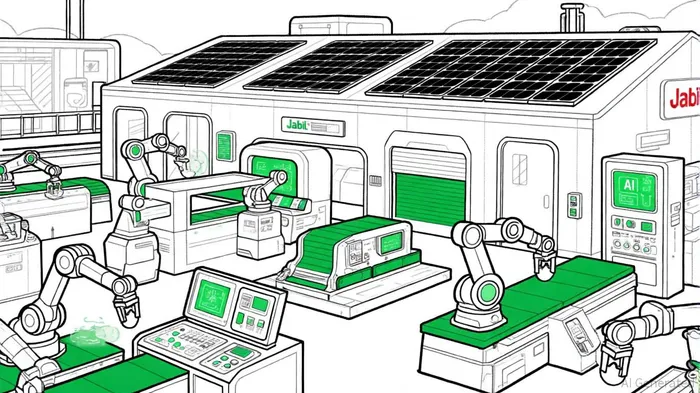
Jabil Inc. has emerged as a standout performer in the manufacturing and supply chain transformation landscape, driven by its robust Q4 and FY2025 financial results and a forward-looking strategic vision. The company's ability to align its operational strengths with macroeconomic trends—particularly in AI infrastructure and localized production—positions it as a critical player in the evolving industrial ecosystem.
Financial Performance: Core Metrics Outpace GAAP, Guidance Reflects Confidence
Jabil's Q4 2025 results underscored its financial resilience, with net revenue of $8.3 billion and core (Non-GAAP) operating income of $519 million, translating to a core diluted earnings per share (EPS) of $3.29[1]. For the full fiscal year, the company reported $29.8 billion in revenue and core operating income of $1.6 billion, with core EPS reaching $9.75[1]. These figures outpace U.S. GAAP metrics, reflecting Jabil's disciplined cost management and focus on high-margin segments.
Looking ahead, Jabil's guidance for FY2026—$31.3 billion in revenue, core operating margins of 5.6%, and core EPS of $11.00[1]—signals confidence in sustaining growth. The projected 3.5% revenue increase from FY2025 to FY2026 aligns with industry trends toward localized manufacturing and AI-driven infrastructure, which JabilJBL-- is uniquely positioned to serve.
Strategic Investments: $500 Million U.S. Expansion and AI Infrastructure Synergies
Jabil's recent announcement of a multi-year $500 million investment in U.S. manufacturing[2] is a pivotal move to capitalize on the surging demand for cloud and AI data center infrastructure. This initiative, focused on the Southeast U.S., will expand the company's footprint to 31 sites and enhance capabilities in automation, robotics, and workforce development. The new facility, expected to be operational by mid-2026, complements Jabil's recent acquisition of Mikros Technologies, a leader in liquid cooling solutions for AI and semiconductor testing[2].
This strategic alignment with AI infrastructure is critical. As data centers account for an estimated 9% of U.S. electricity generation by 2030[2], Jabil's integration of energy-efficient technologies—such as Mikros' thermal management systems—positions it to meet both performance and sustainability demands. CEO Mike Dastoor emphasized that the investment will help global brands navigate geopolitical risks while maintaining agility[2], a key differentiator in an era of supply chain fragmentation.
Industry Trends: AI, Localization, and Digital Transformation
Jabil's initiatives are closely tied to broader industry shifts. The manufacturing sector is witnessing a rapid transition from global to localized supply chains, driven by rising transportation costs and geopolitical instability[3]. Jabil's U.S. expansion directly addresses this trend, reducing dependency on overseas production and enabling faster response times to customer needs.
Simultaneously, AI adoption is reshaping operational efficiency. Over 50% of manufacturers plan to deploy AI at scale by 2026[3], with applications in predictive maintenance, quality control, and supply chain optimization. Jabil's use of AI-driven insights to simplify complexity and enhance decision-making[4] aligns with these advancements, ensuring its supply chain remains agile and data-driven.
Long-Term Positioning: A Model for Resilience and Innovation
Jabil's dual focus on financial discipline and strategic innovation creates a compelling long-term outlook. By investing in U.S. manufacturing, AI infrastructure, and supplier collaboration[4], the company is future-proofing its operations against macroeconomic volatility. Its core operating margins of 5.6% for FY2026[1] suggest that these investments will not come at the expense of profitability, a rare balance in capital-intensive industries.
Moreover, Jabil's emphasis on sustainability—through renewable energy partnerships and energy-efficient technologies—addresses investor priorities in an era of ESG (Environmental, Social, and Governance) scrutiny. As data centers become energy-intensive hubs, Jabil's ability to integrate clean energy solutions will likely attract both corporate and institutional clients.
Conclusion: A Strategic Leader in the New Industrial Era
Jabil's Q4 and FY2025 results, coupled with its $500 million U.S. expansion and AI-focused acquisitions, demonstrate a clear-eyed strategy to dominate the next phase of manufacturing. By leveraging automation, AI, and localized production, the company is not only addressing current market demands but also building a resilient framework for future growth. For investors, Jabil represents a rare combination of financial strength, strategic foresight, and operational agility—a trifecta that positions it as a leader in the manufacturing and supply chain transformation.





Comentarios
Aún no hay comentarios