
Italy's €11 Billion Capital Levy: A Test of European Financial Resilience and Investor Risk
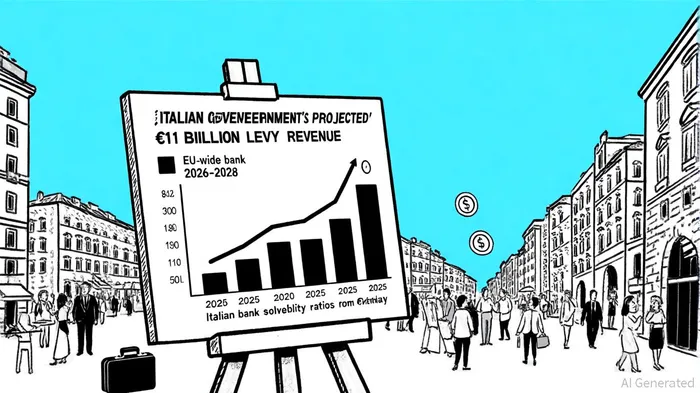
The Italian government's decision to impose an €11 billion capital levy on banks and insurers over 2026–2028 represents a bold fiscal strategy to fund public services while navigating EU deficit constraints. This measure, part of a broader €30 billion fiscal package, aims to avoid direct taxation on citizens by temporarily removing deductions for deferred tax assets and increasing levies on bankers' stock options, according to a Euronews report. While the government frames this as a "sacrifice" by the financial sector, the long-term implications for European financial resilience and investor risk exposure warrant careful scrutiny.
The Rationale and Design of the Levy
Italy's 2025 budget includes an initial €3.5 billion levy, with plans to scale up to €11 billion over three years, according to a Reuters report. Finance Minister Giancarlo Giorgetti emphasizes that this is not a new tax but a strategic adjustment to existing tax frameworks, targeting deferred tax assets and executive compensation, as reported by Euronews. The rationale aligns with Prime Minister Giorgia Meloni's pledge to prioritize low-income earners while addressing Italy's structural deficit. However, the design mirrors historical precedents, such as post-2008 bank levies, which often led to unintended consequences, including reduced credit availability and asset-side risk-shifting, according to an Oxford study.
Implications for European Financial Resilience
The levy's impact on financial resilience hinges on how banks and insurers respond. Under Basel III, European banks are already navigating stricter capital adequacy requirements, with an EBA update projecting a 16.1% increase in Tier 1 capital needs by 2028. Italy's levy could exacerbate liquidity pressures, particularly for smaller institutions. Historical evidence suggests that such levies may incentivize banks to restructure balance sheets by favoring riskier assets or off-balance-sheet activities, potentially undermining systemic stability; the Oxford study raises similar concerns. For example, post-2008 levies in Germany and Spain led to a reallocation of credit from commercial loans to liquid assets, reducing access to credit for businesses, a dynamic also highlighted in EBA commentary.
Moreover, the levy's focus on deferred tax assets-a tool banks use to smooth earnings-could distort financial reporting and investor perceptions of solvency. If banks defer deductions, their reported profits may temporarily inflate, creating a misleading picture of health. This could erode trust in financial statements, a critical concern for European markets where transparency is paramount, as Euronews noted.
Investor Risk Exposure: A Double-Edged Sword
For investors, the levy introduces both risks and opportunities. On one hand, it may heighten volatility in the Italian banking sector, particularly if institutions respond by retrenching from riskier loans or seeking foreign capital. The 2024 selloff in Italian banking stocks following a similar levy proposal underscores this vulnerability, as reported by Euronews. On the other hand, the government's emphasis on public spending-particularly in healthcare and disaster insurance-could stimulate long-term economic growth, indirectly benefiting financial institutions through a stronger domestic economy, as discussed in an InsurTech piece.
However, the levy's potential to trigger a "flight of capital" cannot be ignored. If banks shift assets or operations to jurisdictions with lighter regulatory burdens, Italy's ability to meet its fiscal targets may falter. This risk is amplified by the recent Decreto Capitali reforms, which allow listed companies to issue shares with up to 10 times voting rights, potentially enabling foreign investors to influence governance structures, according to a GT Law analysis. Such dynamics could fragment ownership and complicate regulatory oversight.
Regulatory Responses and Systemic Considerations
The European Central Bank (ECB) has long emphasized the need for financial resilience in an era of geopolitical fragmentation and cyber threats, in an ECB speech. While the levy aligns with the ECB's goal of internalizing systemic risk-akin to Pigouvian taxes-it also tests the limits of regulatory coordination. The ECB's role as a backstop during crises, as seen during the pandemic and the Silicon Valley Bank collapse, highlights the fragility of modern financial infrastructures; if Italy's levy destabilizes its banking sector, the ECB may face pressure to intervene, potentially straining its credibility and resources.
Furthermore, the levy's reliance on deferring tax deductions raises questions about its sustainability. Unlike one-off wealth taxes, which were more effective historically when spread over years, according to an Economics Observatory analysis, Italy's approach could create cyclical liquidity challenges. This is particularly concerning given the EU's deficit reduction targets, which leave little room for fiscal slippage.
Conclusion: Balancing Fiscal Needs and Stability
Italy's €11 billion levy is a high-stakes experiment in fiscal policy, aiming to fund public services without burdening citizens. Yet, its success depends on the government's ability to mitigate unintended consequences for financial resilience and investor confidence. Historical precedents suggest that levies can shift risk rather than eliminate it, necessitating complementary regulatory safeguards. For investors, the key will be monitoring how banks adapt-whether through prudent restructuring or risky gambles-and how regulators respond to preserve stability.







Comentarios
Aún no hay comentarios