
Itafos Delivers Q1 2025 Earnings Surge Amid Market Volatility – Is This a Buy Signal?
Itafos Inc. (ITAF) has delivered a robust first-quarter 2025 earnings report, outperforming expectations with revenue growth, debt reduction, and strategic asset sales. Despite headwinds like rising sulfur costs and trade policy uncertainties, the company’s operational resilience and financial flexibility position it as a contender in the phosphate sector. Let’s dissect the numbers and implications for investors.
Operational Performance: Scaling Production, Managing Costs
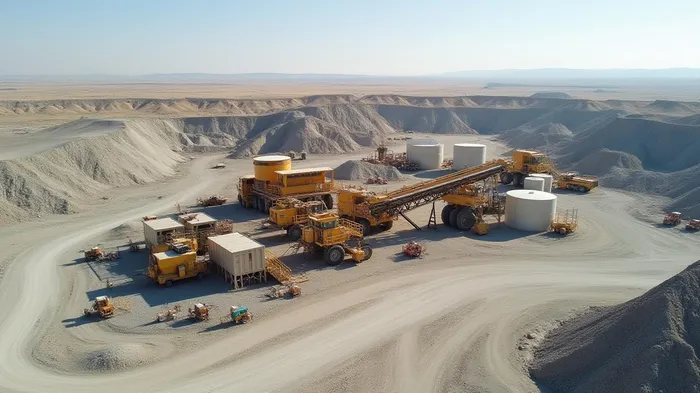
The Conda mine in Idaho, Itafos’ flagship asset, produced 91,200 tonnes of phosphate (P2O5), a 1% increase over Q1 2024. This reflects steady execution at a site critical to the company’s MAP (Monoammonium Phosphate) production. Meanwhile, the Arraias facility in Brazil marked a milestone by producing its first 533 tonnes of P2O5 under its Fertilizer Restart Program, signaling progress toward full utilization of its SSP (Single Superphosphate) capacity.
However, sulfur costs—critical for fertilizer production—compressed margins. Conda’s adjusted EBITDA fell 12% to $40.9 million, while Arraias saw a modest $2 million EBITDA improvement. The company’s multi-year exploration plan for the H1/NDR mine extension (budgeted at $6–8 million annually) aims to secure long-term reserves, though permitting delays could pose a risk.
Financial Highlights: Cash Generation and Debt Reduction
Revenue rose 6% to $135.7 million, driven by higher production and the Araxa project sale. Net income surged 51% to $35.9 million, fueled by a $27.9 million gain from the Araxa disposal and lower financing costs. While adjusted EBITDA dipped to $39.3 million, free cash flow soared 77% to $31.3 million, enabling net debt reduction to negative $1.7 million (net cash). Liquidity remains robust at $180.3 million, with $100.3 million in cash and an undrawn $80 million credit facility.
Investors should note that the Araxa gain and special dividend (C$0.05/share) were non-recurring. Yet, the company’s focus on debt reduction and liquidity is a positive sign for capital allocation flexibility.
Strategic Moves: Capitalizing on Asset Sales and Shareholder Returns
The February sale of the Araxa project for $21 million in cash and St. George Mining securities was a masterstroke. It unlocked value from non-core assets while providing immediate cash flow. The special dividend, paid in late April, demonstrated Itafos’ commitment to returning capital to shareholders—a welcome move for income-seeking investors.
Looking ahead, the Farim (Guinea-Bissau) and Santana (Brazil) projects remain in development. While these are long-term opportunities, their success hinges on geopolitical stability and permitting timelines.
Market Outlook: Phosphate Prices Face Volatility, but Fundamentals Are Bullish
Phosphate prices were mixed in Q1, with MAP NOLA prices down 4% to $596/short ton. However, the company anticipates stronger pricing in 2025 due to:
1. US tariff uncertainties: Limited imports from China and Morocco could tighten domestic supply.
2. Chinese export restrictions: Beijing’s policies to retain phosphate for domestic use could further reduce global supply.
3. Crop fundamentals: Declining global grain inventories may spur fertilizer demand as farmers prioritize yields.
Risks to Monitor
- Sulfur cost pressures: Sulfur prices have risen 20% since 2023, squeezing margins.
- Trade policy risks: US-China trade disputes and tariff decisions could disrupt pricing stability.
- Project execution: Delays in H1/NDR permitting or exploration could hamper reserve growth.
Conclusion: A Balanced Buy with Upside Potential
Itafos’ Q1 results underscore its operational and financial discipline. With $31.3 million in free cash flow, net cash position, and strategic asset sales, the company is well-positioned to navigate near-term challenges. Key positives include:
- Revenue growth: 6% Y/Y despite cost headwinds.
- Debt reduction: Net debt turned positive, lowering financial risk.
- Strong liquidity: $180 million in cash and credit capacity.
While risks like sulfur costs and trade policies linger, the phosphate market’s structural bullishness—driven by crop demand and supply constraints—supports long-term optimism. Investors should monitor ITAF’s sulfur hedging strategies and H1/NDR progress. For those willing to accept volatility, Itafos’ valuation (trading at ~8x EV/EBITDA) offers an entry point to capitalize on a tightening fertilizer market.
Final Takeaway: Itafos’ Q1 performance validates its strategy to de-risk its balance sheet and capitalize on phosphate’s fundamentals. While not a “no-brainer” play, it’s a compelling option for investors with a 2–3 year horizon.







Comentarios
Aún no hay comentarios