
Itaú's Strategic Move into Crypto and the Implications for Institutional Adoption: A Deep Dive into Institutional Validation and Product Diversification
The Brazilian financial landscape is undergoing a seismic shift as Itaú Unibanco, the country's largest private bankBANK--, accelerates its foray into the crypto and digital asset ecosystem. With a strategic focus on institutional validation and product diversification, Itaú's initiatives are not only reshaping its own business model but also signaling a broader acceptance of digital assets in traditional finance. This analysis explores how Itaú's proactive approach-spanning custody services, tokenization, and CBDC collaboration-positions it as a leader in institutional adoption while offering a blueprint for other financial institutions navigating the crypto frontier.
Institutional Validation: Compliance, Partnerships, and Regulatory Leadership
Itaú Unibanco's entry into crypto is underpinned by a rigorous commitment to regulatory compliance, a critical factor in institutional validation. In 2023, the bank launched Itaú Digital Assets, a dedicated division offering custody services for BitcoinBTC-- and EthereumETH--, leveraging blockchain technology while adhering to traditional banking security protocols according to the bank's announcement. This move aligned with Brazil's evolving regulatory framework, which in early 2026 introduced three pivotal resolutions (519, 520, and 521) by the Banco Central do Brasil (BCB). These rules mandated that virtual asset service providers (VASPs) operate as authorized Sociedades Prestadoras de Serviços de Ativos Virtuais (SPSAVs), imposing anti-money laundering (AML) measures, cybersecurity safeguards, and governance standards as research shows. By offering custody services ahead of these regulations' full implementation, Itaú demonstrated foresight and compliance leadership, earning credibility among regulators and institutional clients according to reports.
Partnerships further bolster Itaú's institutional validation. The bank has collaborated with Amazon Managed Blockchain to streamline custody operations, ensuring scalability and security as per AWS documentation. Additionally, Itaú's participation in the DREX pilot program-Brazil's central bank digital currency (CBDC) initiative-highlights its role in shaping the future of digital finance. DREX, expected to launch in 2024, aims to enhance transaction efficiency and explore programmable money applications according to project insights. Itaú's involvement in testing asset tokenization and international payment solutions under DREX underscores its alignment with cutting-edge financial innovation as reported in analysis.
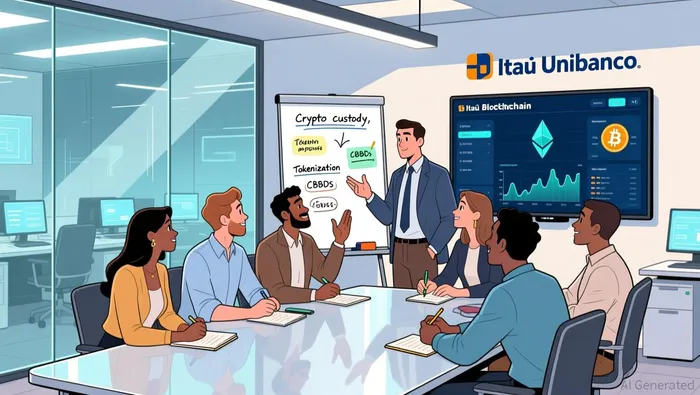
Product Diversification: From Custody to Tokenization and Beyond
Itaú's product portfolio in digital assets reflects a deliberate strategy to diversify offerings and cater to a broad spectrum of investors. The bank now provides direct cryptocurrency trading via its ÍON app, allowing clients to buy and sell Bitcoin and Ethereum. Complementing this, Itaú has launched a Bitcoin ETF, a retirement plan with BTC exposure, and custody services for institutional and retail clients as per industry reports. These products address varying risk appetites and investment horizons, democratizing access to crypto while mitigating volatility risks through diversified portfolio strategies.
A standout innovation is Itaú's foray into asset tokenization. In 2023, the bank tokenized trade finance receivables, with plans to expand to real-world assets such as real estate and commodities as detailed in the report. This initiative aligns with global trends in tokenization, which promise to unlock liquidity in traditionally illiquid markets. By leveraging blockchain technology, Itaú is positioning itself as a bridge between traditional finance and decentralized ecosystems, offering clients novel ways to allocate capital as outlined in financial analysis.
Implications for Institutional Adoption and Market Growth
Itaú's strategic moves have broader implications for institutional adoption in Brazil and beyond. First, the bank's compliance with BCB regulations sets a benchmark for other financial institutions, reducing perceived risks associated with crypto. As noted by a Chainalysis report, Brazil's regulatory framework now mirrors global standards, fostering trust in the sector as research indicates. Itaú's early adoption of custody services and tokenization has thus accelerated institutional confidence, encouraging other banks to follow suit.
Second, Itaú's product diversification addresses a critical gap in the crypto market: accessibility. By integrating crypto into retirement plans and ETFs, the bank is normalizing digital assets as part of mainstream investment strategies. This aligns with Itaú's advisory to allocate up to 3% of portfolios to Bitcoin as a hedge against currency devaluation-a strategy that could influence broader investor behavior according to financial guidance.
Finally, Itaú's collaboration on DREX highlights the potential for CBDCs to coexist with private digital assets. The pilot program's focus on asset tokenization and international payments suggests that CBDCs could enhance, rather than compete with, existing crypto ecosystems as reported in analysis. This synergy between public and private innovation is likely to drive Brazil's position as a regional leader in digital finance.
Conclusion
Itaú Unibanco's strategic pivot into crypto exemplifies how institutional validation and product diversification can catalyze market growth. By aligning with regulatory frameworks, forging strategic partnerships, and innovating across custody, trading, and tokenization, the bank is not only future-proofing its business but also reshaping Brazil's financial landscape. For investors, Itaú's initiatives signal a maturing crypto market where institutional-grade solutions and regulatory clarity are becoming the norm. As the DREX pilot progresses and tokenization gains traction, Itaú's role as a bridge between traditional and digital finance will likely become even more pivotal.






Comentarios
Aún no hay comentarios