
The ISM Services Index as a Leading Indicator for U.S. Equity Market Momentum
The ISM Services Index: A Macroeconomic Compass
The ISM Services PMI, which tracks non-manufacturing business activity, has historically served as a forward-looking indicator of economic trends. Readings above 50 signal expansion, while those below 50 indicate contraction. For instance, in August 2025, the index rose to 52.00, reflecting robust growth in business activity and new orders, despite ongoing employment challenges, according to Trading Economics data. Such data points often influence investor sentiment, as they provide early signals about inflationary pressures and Federal Reserve policy direction. According to a ScalpingDukes report, the ISM Services PMI tends to lead U.S. CPI by approximately three months, making it a valuable tool for anticipating inflationary trends.
However, the ISM Services Index is not without its limitations. Compared to the S&P Global services PMI, it exhibits higher volatility due to differences in sample size and sector coverage. The ISM survey includes government-administered services, which can dampen signals during downturns, whereas the S&P Global PMI focuses on private-sector activity, offering a smoother trend, according to an S&P Global comparison. This divergence underscores the need for investors to contextualize ISM data within broader economic indicators.
Sector Rotation and the ISM Services Index
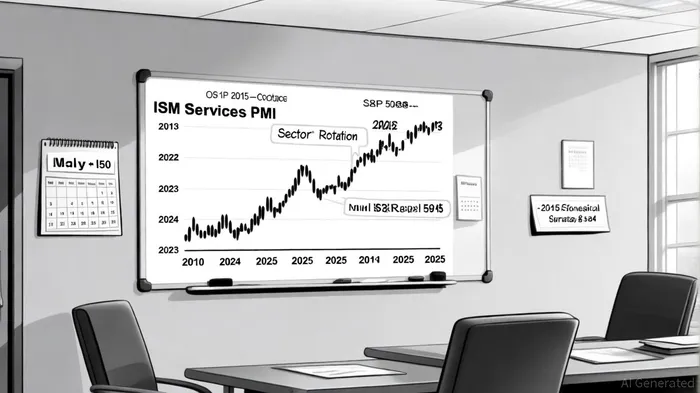
The ISM Services Index's influence on equity markets is most evident in sector rotation strategies. When the index signals expansion, cyclical sectors such as consumer discretionary, financials, and industrials tend to outperform. For example, in May 2024, a surge in the ISM Services Index to 53.8-well above expectations-coincided with a rise in the S&P 500 as investors anticipated potential Fed rate cuts, according to an Investors Business Daily article. Conversely, periods of contraction, such as the July 2025 reading of 50.1, which indicated near-stagnation in the services sector, often prompt a shift toward defensive sectors like utilities and healthcare, as noted in the ScalpingDukes report.
Historical case studies further illustrate this dynamic. In December 2024, the ISM Services PMI surged to 58.5, driven by end-of-year demand and tariff-related optimism. This expansion coincided with gains in the S&P 500 and record highs in the Nasdaq 100, as investors favored growth-oriented sectors like technology, according to a Benzinga report. Conversely, in July 2025, a contraction in employment and input prices within the services sector led to a rotation into defensive assets, reflecting heightened caution about inflationary pressures reported by Trading Economics.
Methodological Considerations and Strategic Implications
While the ISM Services Index is a powerful tool, its methodological differences from the S&P Global PMI must be acknowledged. The ISM survey, based on responses from purchasing executives, tends to overstate business activity compared to the S&P Global PMI, which includes a broader range of job titles and company sizes. The S&P Global comparison noted above highlights this distinction. For instance, since 2010, the ISM Services Index has averaged 58.4, while the S&P Global services PMI averaged 54.2. This discrepancy highlights the importance of cross-referencing ISM data with other indicators to avoid misinterpretation.
Investors leveraging the ISM Services Index for sector rotation must also consider external factors such as trade policy and global macroeconomic conditions. In 2022, for example, the ISM Services Index showed continued expansion, but the S&P 500 experienced volatility as inflationary pressures and shifting investor sentiment overshadowed the positive data reported by Trading Economics. This underscores the need for a nuanced approach that integrates qualitative factors alongside quantitative metrics.
Conclusion
The ISM Services Index remains a pivotal leading indicator for U.S. equity market momentum, offering insights into macroeconomic positioning and sector rotation dynamics. While its volatility and methodological nuances require careful interpretation, its ability to signal shifts in economic activity-particularly in the services sector-makes it an indispensable tool for investors. By aligning portfolio allocations with the index's trends, market participants can better navigate the cyclical forces shaping the S&P 500.







Comentarios
Aún no hay comentarios