
IRS Crypto Tax Letters Surge: Strategic Opportunities Amid Regulatory Scrutiny
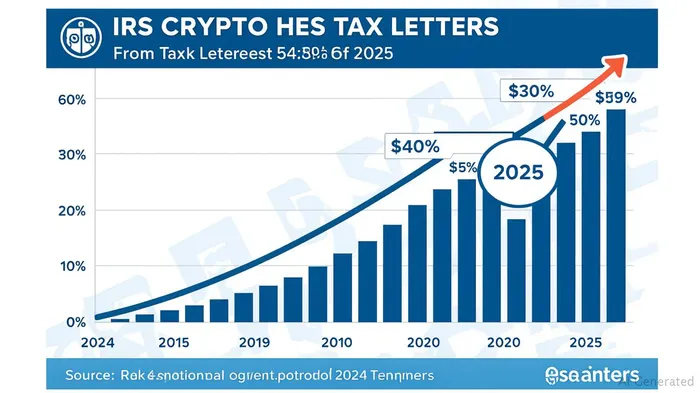
The U.S. Internal Revenue Service (IRS) has intensified its crackdown on crypto tax non-compliance in 2025, issuing a ninefold surge in informational and demand letters to U.S. investors compared to 2024. This regulatory push, driven by new reporting requirements like Form 1099-DA and advanced blockchain analytics, is reshaping the crypto market. While the scrutiny has introduced volatility, it also creates strategic opportunities for investors to capitalize on undervalued assets and tax-compliant platforms as the industry consolidates.
The Regulatory Landscape: A Catalyst for Market Consolidation
The IRS's 2025 campaign reflects a broader shift toward enforcing crypto tax compliance. By mandating exchanges to report transactions on Form 1099-DA and leveraging data from platforms like Poloniex, the agency is closing loopholes that once allowed underreporting. This has led to a tripling of support inquiries on platforms like CoinLedger and a surge in tax attorney consultations.
The result? A market-wide reckoning. Non-compliant players—whether individual investors or decentralized exchanges—are being weeded out, creating space for regulated platforms and crypto assets with strong fundamentals to dominate.
Identifying Strategic Opportunities
1. Tax-Compliant Platforms: The New Gatekeepers
As regulators demand transparency, exchanges and software providers that simplify compliance are poised to thrive.
Example: CoinbaseCOIN-- (COIN) has invested heavily in compliance tools, including automated tax reporting and integration with Form 1099-DA. Despite recent volatility, its long-term positioning as a trusted intermediary may offer value.
Emerging Players: Crypto tax platforms like CoinLedger and ZenLedger, though not yet public, are critical for investors managing complex transactions. Their growth could mirror that of fintech firms during the 2008 regulatory reforms.
2. Undervalued Crypto Assets: Focus on Utility and Stability
The regulatory shakeout will reward assets with clear use cases, stable fundamentals, or inherent compliance advantages.
Stablecoins: Assets like USD Coin (USDC) and Tether (USDT) are less speculative and more aligned with traditional financial systems. Their dominance in transactional volumes and partnerships with regulated entities make them safer bets.
Layer-2 Protocols: Networks like Polygon (MATIC) or SolanaSOL-- (SOL) offer scalability and lower fees, reducing compliance risks tied to high transaction volumes. Their adoption by institutional players signals long-term value.
Privacy-Conscious Assets: While the IRS targets non-compliance, privacy coins like Monero (XMR) face heightened scrutiny. However, privacy-focused protocols with transparent compliance frameworks—such as Zcash (ZEC)'s shielded transactions with audit trails—could carve out niches.
3. Undervalued “Blue-Chip” Cryptos
Bitcoin (BTC) and EthereumETH-- (ETH) remain underappreciated in light of their market dominance and institutional adoption. Despite price fluctuations, their network effects and utility-driven demand suggest they could outperform during consolidation.
Navigating Risks and Due Diligence
- Regulatory Tailwinds: Track the progress of Form 1099-DA compliance and the IRS's enforcement actions. Platforms and assets that proactively align with these rules will outlast competitors.
- Tax Efficiency: Use software like Crypto Tax Calculator to track cost basis and capital gains. Avoid assets tied to unregulated exchanges or opaque protocols.
- Geopolitical Risks: Monitor global regulatory alignment. The EU's MiCA framework and U.S. SEC actions could amplify or mitigate regional opportunities.
Investment Strategy: A Balanced Approach
- Core Holdings: Allocate to BitcoinBTC-- and Ethereum for diversification and liquidity.
- Growth Plays: Invest in tax-compliant platforms (e.g., Coinbase) and layer-2 protocols with clear utility.
- Hedging: Use stablecoins to manage volatility and capitalize on arbitrage opportunities during market corrections.
Conclusion
The IRS's 2025 crackdown is not just about penalties—it's a call for crypto's evolution into a mature, regulated asset class. For investors, this means prioritizing compliance-driven platforms and assets with real-world utility. While the path forward is bumpy, the consolidation phase will reward those who focus on transparency, scalability, and alignment with regulatory trends.
In this environment, the winners will be the ones who see beyond the noise—and bet on the future of crypto as a mainstream financial tool.





Comentarios
Aún no hay comentarios