
Iron Ore Market Volatility Amid Mixed Steel Output Cuts in China: A Long-Term Investment Perspective
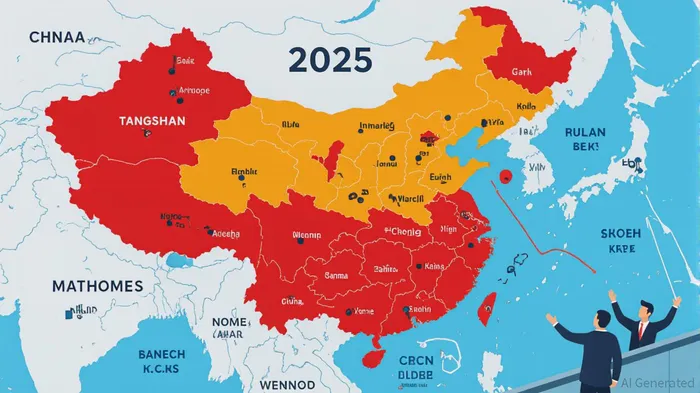
The iron ore market in 2025 is navigating a complex landscape shaped by China's fragmented steel output cuts, seasonal demand shifts, and the long-term push for decarbonization. While short-term volatility has been amplified by localized production halts—such as the August 2025 shutdowns in Tangshan—the broader implications for iron ore producers hinge on structural trends that extend beyond regulatory-driven price swings. For investors, the challenge lies in distinguishing between transient market noise and enduring shifts in China's steel industry, which remains the world's largest consumer of iron ore.
Short-Term Volatility: Regulatory Hiccups and Market Psychology
China's 2025 steel output cuts, announced as part of its “anti-involution” campaign to address overcapacity and environmental concerns, have created a patchwork of compliance. Provinces like Anhui and Jiangsu have received explicit 5% reduction targets, while key hubs like Hebei remain in limbo. This uneven implementation has led to a paradoxical market response: iron ore prices have risen despite reduced production in northern regions. For example, the Singapore Exchange's iron ore futures climbed to $103.60 per ton in August 2025, reflecting a 1.6% weekly gain.
The market's optimism stems from the perception that production cuts will tighten supply and boost steel prices, improving mill margins. This dynamic has allowed mills to absorb higher raw material costs, sustaining demand for iron ore even as output declines in restricted regions. However, this short-term resilience masks underlying risks. Elevated global iron ore stockpiles and the potential for delayed enforcement of output cuts in provinces like Hebei could lead to a price correction if demand fails to outpace supply.
Structural Shifts: Decarbonization and the Rise of High-Grade Ore
While regulatory-driven volatility dominates headlines, the long-term trajectory of the iron ore market is being reshaped by China's decarbonization agenda. The push for green steel technologies, which rely on high-grade iron ore (above 65% Fe) to reduce emissions, is creating a premium for quality over quantity. Premiums for high-grade ore have widened to $18–25 per ton over the 62% benchmark, signaling a structural shift in demand patterns.
This transition is particularly relevant for iron ore producers with access to high-grade reserves. Companies like ValeVALE-- (VALE) and BHP GroupBHP-- (BHP) are already pivoting toward higher-grade ore production, aligning with China's evolving needs. For investors, this represents a critical inflection point: producers that can adapt to quality-driven demand will outperform those reliant on low-grade, volume-based strategies.
Geopolitical and Economic Catalysts
The U.S. tariff rollback on Chinese goods—reducing duties from 145% to 30% for 90 days—has further complicated the outlook. The resulting surge in steel-intensive exports has temporarily bolstered demand, with daily crude steel output rising by 3% in April 2025. This export-driven demand has softened the urgency for mills to comply with output cuts, particularly in private sectors prioritizing profitability over regulatory compliance.
However, this short-term tailwind is unlikely to offset the long-term structural headwinds. China's property sector, which accounts for 25–30% of steel demand, remains fragile despite localized policy adjustments. A stabilization in this sector would be critical for sustaining iron ore demand beyond 2025.
Investment Implications: Balancing Risk and Resilience
For long-term investors, the key is to focus on iron ore producers with:
1. High-grade ore reserves to capitalize on decarbonization trends.
2. Operational flexibility to navigate regulatory shifts and seasonal demand swings.
3. Strong balance sheets to withstand periods of oversupply or price compression.
Companies like Rio TintoRIO-- (RIO.AX) and Fortescue Metals Group (FMG.AX) are well-positioned in this environment, given their strategic investments in high-grade ore and cost-efficient operations. Conversely, producers with significant exposure to low-grade ore or debt-heavy balance sheets may struggle to adapt to the evolving market.
Conclusion: A Market at the Crossroads
The iron ore market in 2025 is at a crossroads, caught between short-term regulatory-driven volatility and long-term structural shifts. While production cuts in northern China have created immediate price swings, the broader narrative is one of transformation. Investors who focus on the quality of ore, the adaptability of producers, and the trajectory of China's decarbonization agenda will be better equipped to navigate this dynamic landscape. For those with a long-term horizon, the current volatility may present an opportunity to position for a market that is evolving toward sustainability and efficiency.







Comentarios
Aún no hay comentarios