
Iridium's Strategic Position in the Evolving Satellite and Leverage Finance Markets
The satellite communications industry is undergoing a seismic shift, driven by technological innovation, intensifying competition, and evolving investor expectations. Iridium Communications Inc.IRDM-- (IRDM), a stalwart in the sector, has navigated these dynamics with a blend of operational discipline and strategic foresight. Following its Q3 2025 earnings report, the company's performance and capital structure warrant a closer examination of its growth catalysts and credit resilience in a market increasingly dominated by low Earth orbit (LEO) disruptors like Starlink and Amazon Kuiper.
Financial Performance: A Foundation for Growth
Iridium's Q3 2025 results underscored its ability to balance revenue growth with profitability. Total revenue rose 7% year-over-year to $226.9 million, with service revenue accounting for 73% of the total at $165.2 million. Commercial IoT data services, a key growth driver, surged 7% to $46.7 million, reflecting the company's expanding footprint in mission-critical applications such as aviation and maritime safety. Meanwhile, the U.S. government segment delivered a 10% year-over-year increase in operational EBITDA to $136.6 million, bolstered by rate hikes under its Enhanced Mobile Satellite Services contract with the U.S. Space Force.
The company's subscriber base also grew modestly, with 2.54 million billable subscribers as of Q3 2025, driven by IoT adoption. This performance has enabled IridiumIRDM-- to maintain a 25.2% operational margin, a critical metric for sustaining its capital-intensive business model. Looking ahead, the firm anticipates engineering and support revenue to outpace 2024 levels, further diversifying its income streams.
Credit Resilience: Balancing Leverage and Flexibility
Despite its robust cash flow generation, Iridium's net leverage ratio of 3.5x trailing twelve months (TTM) OEBITDA remains elevated compared to the satellite sector average of 1.41x. The company's debt structure includes a $1.8 billion term loan maturing in 2030 and a $50 million revolving facility maturing in 2028, with interest rates tied to SOFR plus 2.25% (and a 0.75% SOFR floor for the term loan). While these terms provide flexibility, credit agencies have assigned Iridium a "BB-" rating from S&P and a "B" from Moody's, both with stable outlooks.
Iridium's deleveraging strategy hinges on disciplined capital allocation. In Q3 2025, the company repurchased 1.9 million shares for $50 million and raised its dividend by 5%, signaling confidence in its free cash flow yield of 11.3%. These actions align with its goal to reduce leverage to below 3.5x by year-end 2025. However, the path to deleveraging is complicated by upcoming satellite investments, including the 2026 launch of chipsets for its NTN Direct solution and forays into quantum-safe cybersecurity.
Competitive Landscape: Niche Strengths in a Crowded Market
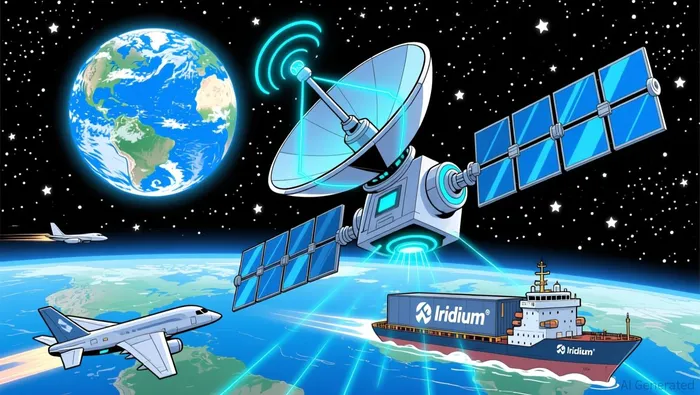 Iridium's market position is defined by its specialization in high-value, mission-critical applications-a niche where it retains a competitive edge despite the rise of LEO-based rivals. While Starlink dominates the residential broadband segment with a 72% U.S. market share, Iridium's focus on satellite phones, aviation safety, and IoT services for critical infrastructure has insulated it from direct competition in these areas.
However, the satellite IoT market is becoming increasingly fragmented, with over 100 vendors vying for market share. By 2024, the top seven satellite network operators, including Iridium, collectively held over 80% of the market. Projections suggest this dominance will erode by 2030 as Starlink and Amazon Kuiper scale their offerings. Iridium's response includes hybrid strategies, such as its partnership with Deutsche Telekom to integrate satellite connectivity into terrestrial networks, and R&D investments in quantum-safe cybersecurity to future-proof its infrastructure.
Analyst sentiment reflects this duality. While some remain bullish on Iridium's "unique network capabilities and strong execution in key markets," others have downgraded the stock, citing risks from LEO entrants and IoT margin pressures. The consensus price target was recently lowered to $31.00 from $33.38, reflecting cautious optimism.
Strategic Outlook: Innovation as a Growth Catalyst
Iridium's long-term strategy hinges on innovation to offset competitive pressures. The company's 2026 chipset launch for NTN Direct aims to expand its reach in the direct-to-device (D2D) market, a segment currently dominated by Starlink. Additionally, its foray into quantum-safe cybersecurity-a response to the looming threat of quantum computing-positions it to capture premium contracts in defense and critical infrastructure.
From a leverage finance perspective, Iridium's stable credit ratings and absence of financial maintenance covenants on its term loan provide breathing room for strategic investments. However, the company's ability to maintain its credit profile will depend on its success in monetizing these innovations while managing debt servicing costs in a rising interest rate environment.
Conclusion: A Calculated Bet on Resilience
Iridium's Q3 2025 results highlight a company navigating a complex landscape with a mix of caution and ambition. Its financial performance and credit resilience, while not without risks, demonstrate a commitment to balancing growth with prudence. For investors, the key question is whether Iridium's niche focus and innovation pipeline can sustain its market position as LEO competitors gain traction. The answer lies in its ability to execute on its 2026 roadmap and leverage its established infrastructure in high-margin, mission-critical applications. In a sector defined by rapid disruption, Iridium's strategic agility may yet prove its most valuable asset.





Comentarios
Aún no hay comentarios